
Exactitud de las fórmulas de cálculo de la lente intraocular en pacientes con catarata y curvatura corneal elevada
Título original: Accuracy of intraocular lens calculation formulas in cataract patients with steep corneal curvature
Chenguang Zhang, Guangzheng Dai, Emmanuel Eric Pazo, Ling Xu, Xianwei Wu, Hongda Zhang, Tiezhu Lin, Wei He
 PLoS ONE, 2020 · artículo · doi:10.1371/journal.pone.0241630 · citado 33 veces · Acceso abierto (CC BY)
Cataratas y cirugía del segmento anterior
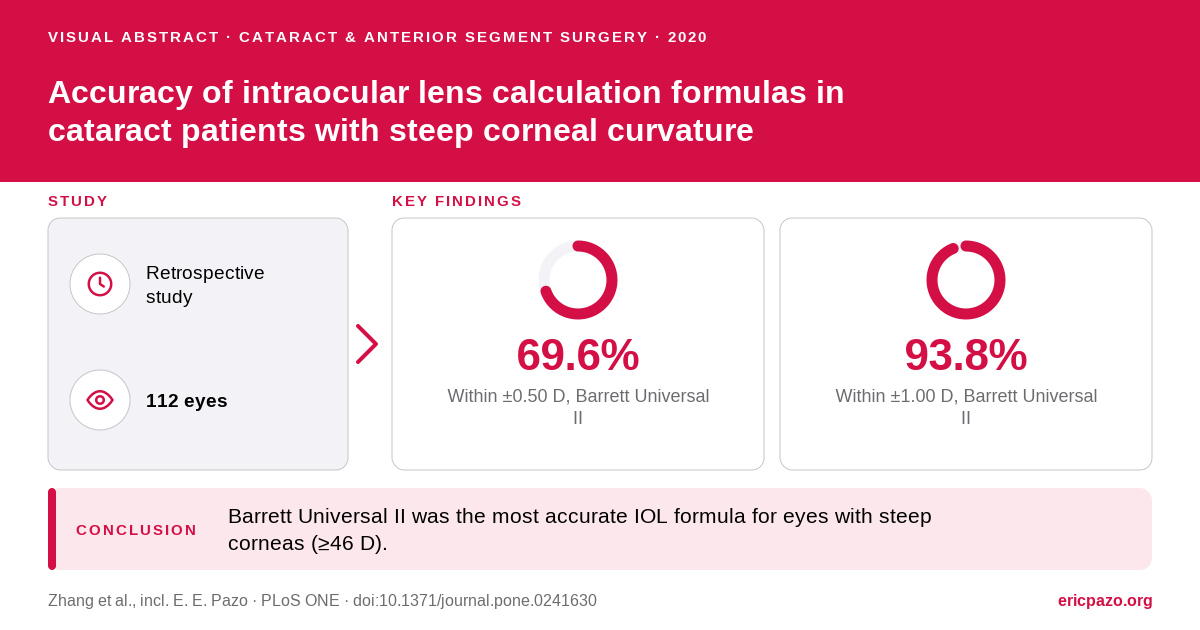
De un vistazo
Barrett Universal II fue la fórmula de LIO más exacta en ojos con córneas muy curvas (≥46 D).
- Diseño
- Estudio retrospectivo
- Muestra
- 112 ojos
- Dentro de ±0.50 D, Barrett Universal II
- 69.6%
- Dentro de ±1.00 D, Barrett Universal II
- 93.8%
Resumen
OBJETIVO: Comparar la exactitud de cinco fórmulas de cálculo de la lente intraocular (SRK/T, Haigis, Hoffer Q, Holladay y Barrett Universal Ⅱ) en pacientes con catarata y córnea de curvatura elevada ≥ 46.0 dioptrías. MÉTODOS: Estudio retrospectivo de facoemulsificación de catarata combinada con implante de lente intraocular en pacientes con córnea de curvatura elevada (curvatura corneal ≥ 46D). Se evaluaron y compararon los errores de predicción refractiva de las fórmulas de cálculo de la potencia de la LIO (SRK/T, Haigis, Holladay, Hoffer Q y Barrett Universal II) con las constantes del User Group for Laser Interference Biometry (ULIB). Los resultados de la refracción objetiva se evaluaron al mes de la cirugía. Según la longitud axial (LA), todos los pacientes se dividieron en tres grupos: LA corta (<22mm), LA normal (>22 a ≤24.5mm) y LA larga (>24.5mm). Se calcularon el error refractivo y el error refractivo absoluto (AE) entre la potencia refractiva posoperatoria real y la prevista. Se utilizó el análisis de covarianza para comparar las cinco fórmulas en cada grupo, y la correlación entre el error refractivo absoluto y la LA de cada fórmula se analizó mediante la prueba de correlación de Pearson. RESULTADO: Se recogieron en total 112 ojos de 83 pacientes con catarata y córnea de curvatura elevada. En el análisis de covarianza del error refractivo absoluto, la profundidad de la cámara anterior (ACD) fue una covariable en el grupo de LA corta (P<0.001). Las fórmulas SRK/T y Holladay tuvieron el menor error absoluto medio (MAE) (0.47D), y hubo diferencias estadísticamente significativas del MAE entre las cinco fórmulas en el grupo de LA corta (P = 0.024). La profundidad de la cámara anterior no mostró una correlación significativa en las cinco fórmulas en los grupos de LA normal y larga (P = 0.521 y P = 0.609, respectivamente). En el grupo de LA normal no hubo diferencias significativas del MAE entre las cinco fórmulas (P = 0.609). En el grupo de LA larga, la fórmula Barrett Universal II tuvo el menor MAE (0.35), y hubo diferencias estadísticamente significativas del MAE entre las cinco fórmulas (P = 0.012). En todo el rango de LA, la fórmula Barrett Universal II tuvo el menor MAE y el mayor porcentaje de ojos dentro de ± 0.50 D, ± 1.00 D y ± 1.50 D (69.6%, 93.8% y 98.2%, respectivamente). CONCLUSIÓN: En comparación con SRK/T, Haigis, Hoffer Q y Holladay, la fórmula Barrett Universal Ⅱ es más exacta para predecir la potencia de la LIO en pacientes con catarata y córnea de curvatura elevada ≥ 46.0 dioptrías.
Traducido del resumen original en inglés (licencia: CC BY).
Mostrar el resumen original
OBJECTIVE: To compare the accuracy of five kinds of intraocular lens calculation formulas (SRK/T, Haigis, Hoffer Q, Holladay and Barrett Universal Ⅱ) in cataract patients with steep curvature cornea ≥ 46.0 diopters. METHODS: This is a retrospective study of cataract phacoemulsification combined with intraocular lens implantation in patients with steep curvature cornea (corneal curvature ≥ 46D). The refractive prediction errors of IOL power calculation formulas (SRK/T, Haigis, Holladay, Hoffer Q, and Barrett Universal II) using User Group for Laser Interference Biometry (ULIB) constants were evaluated and compared. Objective refraction results were assessed at one month postoperatively. According to axial length (AL), all patients were divided into three groups: short AL group (<22mm), normal AL group (>22 to ≤24.5mm) and long AL group (>24.5mm). Calculate the refractive error and absolute refractive error (AE) between the actual postoperative refractive power and the predicted postoperative refractive power. The covariance analysis was used for the comparison of five formulas in each group. The correlation between the absolute refractive error and AL from every formula were analyzed by Pearson correlation test, respectively. RESULT: Total 112 eyes of 83 cataract patients with steep curvature cornea were collected. The anterior chamber depth (ACD) was a covariate in the short AL group in the covariance analysis of absolute refractive error (P<0.001). The SRK/T and Holladay formula had the lowest mean absolute error (MAE) (0.47D), there were statistically significant differences in MAE between the five formulas for short AL group (P = 0.024). The anterior chamber depth had no significant correlation in the five calculation formulas in the normal AL group and long AL group (P = 0.521, P = 0.609 respectively). In the normal AL group, there was no significant difference in MAE between the five calculation formulas (P = 0.609). In the long AL group, Barrett Universal II formula had the lowest MAE (0.35), and there were statistically significant differences in MAE between the five formulas (P = 0.012). Over the entire AL range, the Barrett Universal II formula had the lowest MAE and the highest percentage of eyes within ± 0.50 D, ± 1.00 D, and ± 1.50 D (69.6%, 93.8%, and 98.2% respectively). CONCLUSION: Compared to SRK/T, Haigis, Hoffer Q, and Holladay, Barrett Universal Ⅱ formula is more accurate in predicting the IOL power in the cataract patients with steep curvature cornea ≥ 46.0 diopters.
Palabras clave: intraocular lens power calculation; cataract surgery; refractive prediction error; axial length; Barrett Universal II formula; SRK/T formula; Haigis formula; Hoffer Q formula
Acceso
Cómo citar
Mostrar BibTeX
@article{zhang2020accuracy,
  title = {{Accuracy of intraocular lens calculation formulas in cataract patients with steep corneal curvature}},
  author = {Zhang, Chenguang and Dai, Guangzheng and Pazo, Emmanuel Eric and Xu, Ling and Wu, Xianwei and Zhang, Hongda and Lin, Tiezhu and He, Wei},
  journal = {PLoS ONE},
  year = {2020},
  doi = {10.1371/journal.pone.0241630},
  url = {https://doi.org/10.1371/journal.pone.0241630},
}
Trabajos relacionados
- Adherencia al seguimiento a largo plazo tras el implante de lente de colámero implantable en pacientes con miopía alta: un estudio unicéntrico de cohorte retrospectiva y encuesta CAP (2026)
- Predicción de la refracción ciclopléjica basada en aprendizaje automático con el Eyerobo Vision Screener: diseño, un estudio transversal comparativo de dispositivos (2026)
- Evaluación del impacto de las lámparas de hendidura portátiles asistidas por IA en la atención oftalmológica primaria rural (2025)
- Características de los parámetros biológicos y selección del tamaño de la lente de colámero implantable (ICL) en ojos con miopía moderada, alta y muy alta (2025)
- Exploración de modelos de aprendizaje automático para la seguridad del vault en el implante de ICL: un análisis comparativo de modelos de regresión y de clasificación (2025)