
陡峭角膜曲率白内障患者人工晶状体计算公式的准确性
原文标题: Accuracy of intraocular lens calculation formulas in cataract patients with steep corneal curvature
Chenguang Zhang, Guangzheng Dai, Emmanuel Eric Pazo, Ling Xu, Xianwei Wu, Hongda Zhang, Tiezhu Lin, Wei He
 PLoS ONE, 2020 · 期刊论文 · doi:10.1371/journal.pone.0241630 · 被引 33 次 · 开放获取(CC BY)
要点速览
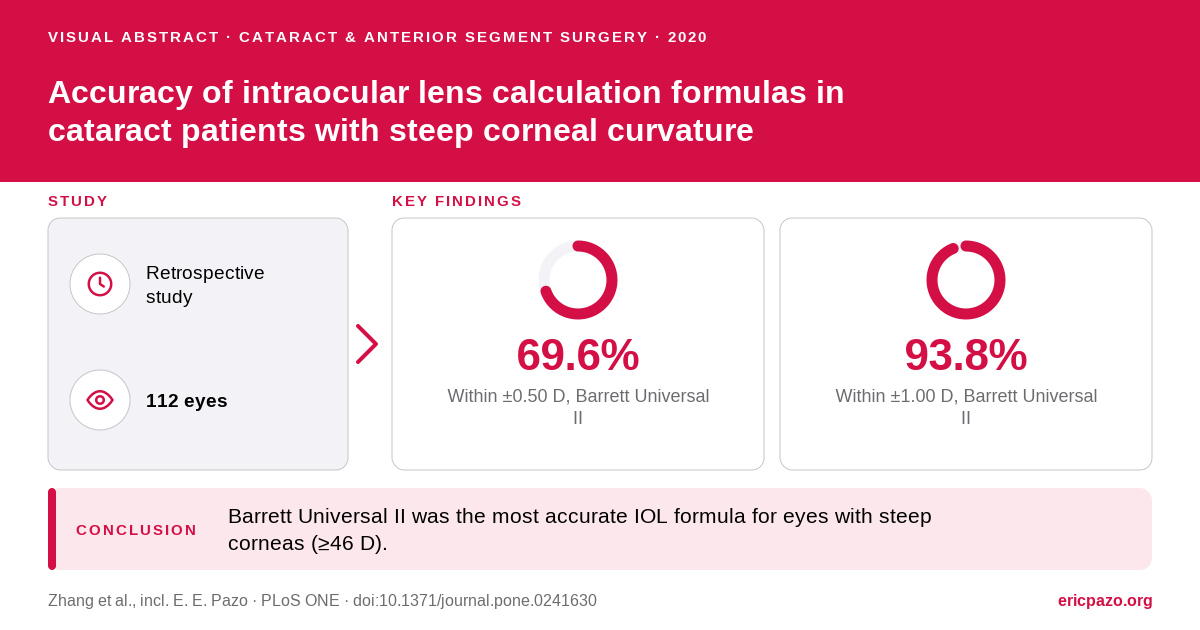
对于角膜陡峭(≥46 D)的眼,Barrett Universal II 是最准确的人工晶状体计算公式。
- 研究设计
- 回顾性研究
- 样本
- 112 只眼
- ±0.50 D 以内(Barrett Universal II)
- 69.6%
- ±1.00 D 以内(Barrett Universal II)
- 93.8%
摘要
目的:比较五种人工晶状体计算公式(SRK/T、Haigis、Hoffer Q、Holladay 和 Barrett Universal Ⅱ)在角膜曲率陡峭(≥ 46.0 屈光度)白内障患者中的准确性。方法:本研究为回顾性研究,对象为角膜曲率陡峭(角膜曲率 ≥ 46D)且接受白内障超声乳化联合人工晶状体植入术的患者。评估并比较采用激光干涉生物测量用户组(ULIB)常数的人工晶状体度数计算公式(SRK/T、Haigis、Holladay、Hoffer Q 和 Barrett Universal II)的屈光预测误差。术后一个月评估客观验光结果。根据眼轴长度(AL)将所有患者分为三组:短眼轴组(<22mm)、正常眼轴组(>22 至 ≤24.5mm)和长眼轴组(>24.5mm)。计算术后实际屈光度与预测术后屈光度之间的屈光误差和绝对屈光误差(AE)。采用协方差分析比较各组中的五种公式,并分别采用 Pearson 相关检验分析各公式绝对屈光误差与 AL 的相关性。结果:共收集 83 例角膜曲率陡峭白内障患者的 112 只眼。在绝对屈光误差的协方差分析中,前房深度(ACD)是短眼轴组的协变量(P<0.001)。SRK/T 和 Holladay 公式的平均绝对误差(MAE)最低(0.47D),短眼轴组五种公式之间的 MAE 存在统计学显著差异(P = 0.024)。在正常眼轴组和长眼轴组中,前房深度与五种计算公式均无显著相关(分别为 P = 0.521、P = 0.609)。在正常眼轴组中,五种计算公式之间的 MAE 无显著差异(P = 0.609)。在长眼轴组中,Barrett Universal II 公式的 MAE 最低(0.35),五种公式之间的 MAE 存在统计学显著差异(P = 0.012)。在整个 AL 范围内,Barrett Universal II 公式的 MAE 最低,且误差在 ± 0.50 D、± 1.00 D 和 ± 1.50 D 以内的眼比例最高(分别为 69.6%、93.8% 和 98.2%)。结论:与 SRK/T、Haigis、Hoffer Q 和 Holladay 相比,Barrett Universal Ⅱ 公式在预测角膜曲率陡峭(≥ 46.0 屈光度)白内障患者的人工晶状体度数时更为准确。
译自英文原文摘要(许可协议:CC BY)。
显示英文原文摘要
OBJECTIVE: To compare the accuracy of five kinds of intraocular lens calculation formulas (SRK/T, Haigis, Hoffer Q, Holladay and Barrett Universal Ⅱ) in cataract patients with steep curvature cornea ≥ 46.0 diopters. METHODS: This is a retrospective study of cataract phacoemulsification combined with intraocular lens implantation in patients with steep curvature cornea (corneal curvature ≥ 46D). The refractive prediction errors of IOL power calculation formulas (SRK/T, Haigis, Holladay, Hoffer Q, and Barrett Universal II) using User Group for Laser Interference Biometry (ULIB) constants were evaluated and compared. Objective refraction results were assessed at one month postoperatively. According to axial length (AL), all patients were divided into three groups: short AL group (<22mm), normal AL group (>22 to ≤24.5mm) and long AL group (>24.5mm). Calculate the refractive error and absolute refractive error (AE) between the actual postoperative refractive power and the predicted postoperative refractive power. The covariance analysis was used for the comparison of five formulas in each group. The correlation between the absolute refractive error and AL from every formula were analyzed by Pearson correlation test, respectively. RESULT: Total 112 eyes of 83 cataract patients with steep curvature cornea were collected. The anterior chamber depth (ACD) was a covariate in the short AL group in the covariance analysis of absolute refractive error (P<0.001). The SRK/T and Holladay formula had the lowest mean absolute error (MAE) (0.47D), there were statistically significant differences in MAE between the five formulas for short AL group (P = 0.024). The anterior chamber depth had no significant correlation in the five calculation formulas in the normal AL group and long AL group (P = 0.521, P = 0.609 respectively). In the normal AL group, there was no significant difference in MAE between the five calculation formulas (P = 0.609). In the long AL group, Barrett Universal II formula had the lowest MAE (0.35), and there were statistically significant differences in MAE between the five formulas (P = 0.012). Over the entire AL range, the Barrett Universal II formula had the lowest MAE and the highest percentage of eyes within ± 0.50 D, ± 1.00 D, and ± 1.50 D (69.6%, 93.8%, and 98.2% respectively). CONCLUSION: Compared to SRK/T, Haigis, Hoffer Q, and Holladay, Barrett Universal Ⅱ formula is more accurate in predicting the IOL power in the cataract patients with steep curvature cornea ≥ 46.0 diopters.
关键词: intraocular lens power calculation; cataract surgery; refractive prediction error; axial length; Barrett Universal II formula; SRK/T formula; Haigis formula; Hoffer Q formula
获取全文
引用格式
显示 BibTeX
@article{zhang2020accuracy,
  title = {{Accuracy of intraocular lens calculation formulas in cataract patients with steep corneal curvature}},
  author = {Zhang, Chenguang and Dai, Guangzheng and Pazo, Emmanuel Eric and Xu, Ling and Wu, Xianwei and Zhang, Hongda and Lin, Tiezhu and He, Wei},
  journal = {PLoS ONE},
  year = {2020},
  doi = {10.1371/journal.pone.0241630},
  url = {https://doi.org/10.1371/journal.pone.0241630},
}