
角膜曲率の大きい白内障患者における眼内レンズ計算式の精度
原題: Accuracy of intraocular lens calculation formulas in cataract patients with steep corneal curvature
Chenguang Zhang, Guangzheng Dai, Emmanuel Eric Pazo, Ling Xu, Xianwei Wu, Hongda Zhang, Tiezhu Lin, Wei He
 PLoS ONE, 2020 · 原著論文 · doi:10.1371/journal.pone.0241630 · 被引用 33 回 · オープンアクセス(CC BY)
要点
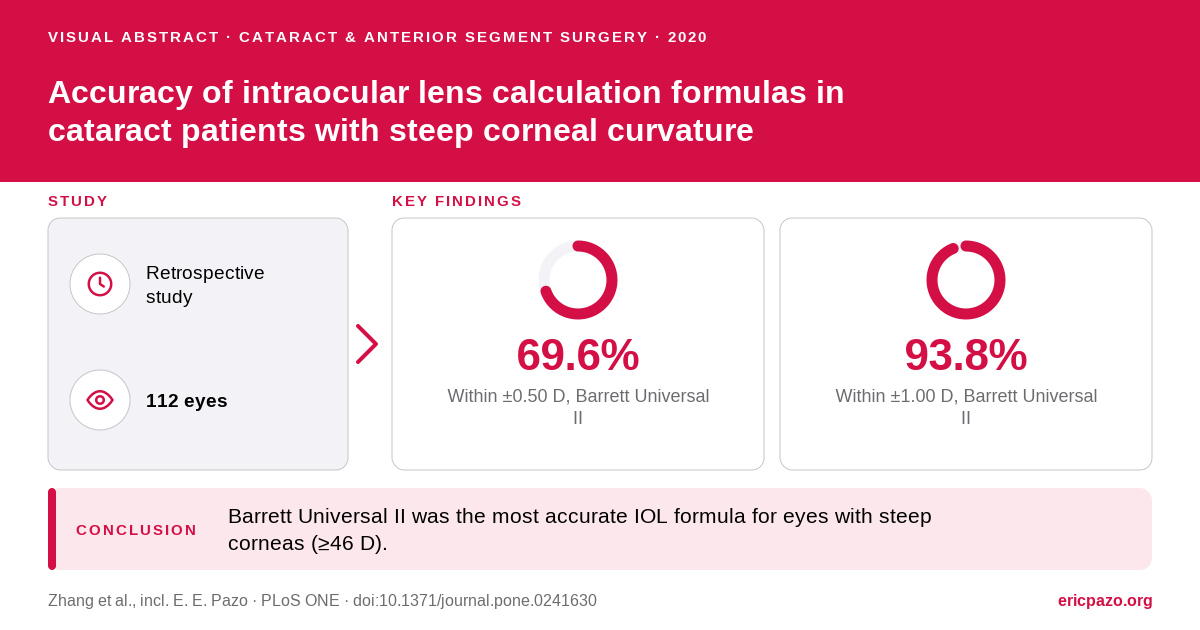
角膜曲率の大きい眼(≥46 D)では、Barrett Universal II が最も正確な IOL 計算式であった。
- 研究デザイン
- 後ろ向き研究
- 対象
- 112 眼
- ±0.50 D 以内(Barrett Universal II)
- 69.6%
- ±1.00 D 以内(Barrett Universal II)
- 93.8%
抄録
目的:角膜曲率が ≥ 46.0 ディオプターと大きい白内障患者において、5 種類の眼内レンズ計算式(SRK/T、Haigis、Hoffer Q、Holladay、Barrett Universal Ⅱ)の精度を比較する。方法:角膜曲率の大きい(角膜曲率 ≥ 46D)患者における白内障超音波乳化吸引術と眼内レンズ挿入術の後ろ向き研究である。User Group for Laser Interference Biometry(ULIB)定数を用いた IOL 度数計算式(SRK/T、Haigis、Holladay、Hoffer Q、Barrett Universal II)の屈折予測誤差を評価・比較した。客観的屈折結果は術後 1 か月に評価した。眼軸長(AL)に従い、全患者を短眼軸群(<22mm)、正常眼軸群(>22 ~ ≤24.5mm)、長眼軸群(>24.5mm)の 3 群に分けた。術後の実際の屈折値と予測屈折値との屈折誤差と絶対屈折誤差(AE)を算出した。各群の 5 つの計算式の比較には共分散分析を用い、各計算式の絶対屈折誤差と AL との相関は Pearson 相関検定で解析した。結果:角膜曲率の大きい白内障患者 83 人の計 112 眼を集めた。絶対屈折誤差の共分散分析では、短眼軸群で前房深度(ACD)が共変量であった(P<0.001)。SRK/T 式と Holladay 式の平均絶対誤差(MAE)が最も小さく(0.47D)、短眼軸群では 5 つの計算式の MAE に統計学的有意差があった(P = 0.024)。正常眼軸群と長眼軸群では、前房深度は 5 つの計算式のいずれとも有意な相関がなかった(それぞれ P = 0.521、P = 0.609)。正常眼軸群では、5 つの計算式の MAE に有意差はなかった(P = 0.609)。長眼軸群では Barrett Universal II 式の MAE が最も小さく(0.35)、5 つの計算式の MAE に統計学的有意差があった(P = 0.012)。AL の全範囲で、Barrett Universal II 式の MAE が最も小さく、± 0.50 D、± 1.00 D、± 1.50 D 以内の眼の割合が最も高かった(それぞれ 69.6%、93.8%、98.2%)。結論:SRK/T、Haigis、Hoffer Q、Holladay と比べ、Barrett Universal Ⅱ 式は角膜曲率 ≥ 46.0 ディオプターの白内障患者の IOL 度数をより正確に予測する。
英語の原文抄録からの翻訳です(ライセンス:CC BY)。
原文の抄録を表示
OBJECTIVE: To compare the accuracy of five kinds of intraocular lens calculation formulas (SRK/T, Haigis, Hoffer Q, Holladay and Barrett Universal Ⅱ) in cataract patients with steep curvature cornea ≥ 46.0 diopters. METHODS: This is a retrospective study of cataract phacoemulsification combined with intraocular lens implantation in patients with steep curvature cornea (corneal curvature ≥ 46D). The refractive prediction errors of IOL power calculation formulas (SRK/T, Haigis, Holladay, Hoffer Q, and Barrett Universal II) using User Group for Laser Interference Biometry (ULIB) constants were evaluated and compared. Objective refraction results were assessed at one month postoperatively. According to axial length (AL), all patients were divided into three groups: short AL group (<22mm), normal AL group (>22 to ≤24.5mm) and long AL group (>24.5mm). Calculate the refractive error and absolute refractive error (AE) between the actual postoperative refractive power and the predicted postoperative refractive power. The covariance analysis was used for the comparison of five formulas in each group. The correlation between the absolute refractive error and AL from every formula were analyzed by Pearson correlation test, respectively. RESULT: Total 112 eyes of 83 cataract patients with steep curvature cornea were collected. The anterior chamber depth (ACD) was a covariate in the short AL group in the covariance analysis of absolute refractive error (P<0.001). The SRK/T and Holladay formula had the lowest mean absolute error (MAE) (0.47D), there were statistically significant differences in MAE between the five formulas for short AL group (P = 0.024). The anterior chamber depth had no significant correlation in the five calculation formulas in the normal AL group and long AL group (P = 0.521, P = 0.609 respectively). In the normal AL group, there was no significant difference in MAE between the five calculation formulas (P = 0.609). In the long AL group, Barrett Universal II formula had the lowest MAE (0.35), and there were statistically significant differences in MAE between the five formulas (P = 0.012). Over the entire AL range, the Barrett Universal II formula had the lowest MAE and the highest percentage of eyes within ± 0.50 D, ± 1.00 D, and ± 1.50 D (69.6%, 93.8%, and 98.2% respectively). CONCLUSION: Compared to SRK/T, Haigis, Hoffer Q, and Holladay, Barrett Universal Ⅱ formula is more accurate in predicting the IOL power in the cataract patients with steep curvature cornea ≥ 46.0 diopters.
キーワード: intraocular lens power calculation; cataract surgery; refractive prediction error; axial length; Barrett Universal II formula; SRK/T formula; Haigis formula; Hoffer Q formula
アクセス
引用方法
BibTeX を表示
@article{zhang2020accuracy,
  title = {{Accuracy of intraocular lens calculation formulas in cataract patients with steep corneal curvature}},
  author = {Zhang, Chenguang and Dai, Guangzheng and Pazo, Emmanuel Eric and Xu, Ling and Wu, Xianwei and Zhang, Hongda and Lin, Tiezhu and He, Wei},
  journal = {PLoS ONE},
  year = {2020},
  doi = {10.1371/journal.pone.0241630},
  url = {https://doi.org/10.1371/journal.pone.0241630},
}