
Características de los parámetros biológicos y selección del tamaño de la lente de colámero implantable (ICL) en ojos con miopía moderada, alta y muy alta
Título original: Characteristics of biological parameters and implantable collamer lens (ICL) size selection in moderate, high, and super-high myopia eyes
Fei Ran Li, Yueni Ma, Wenjie Qi, Emmanuel Eric Pazo, Ruibo Yang, Shaozhen Zhao
 BMC Ophthalmology, 2025 · artículo · doi:10.1186/s12886-025-03934-y · citado 6 veces · Acceso abierto (CC BY-NC-ND)
Miopía y errores refractivosCataratas y cirugía del segmento anterior
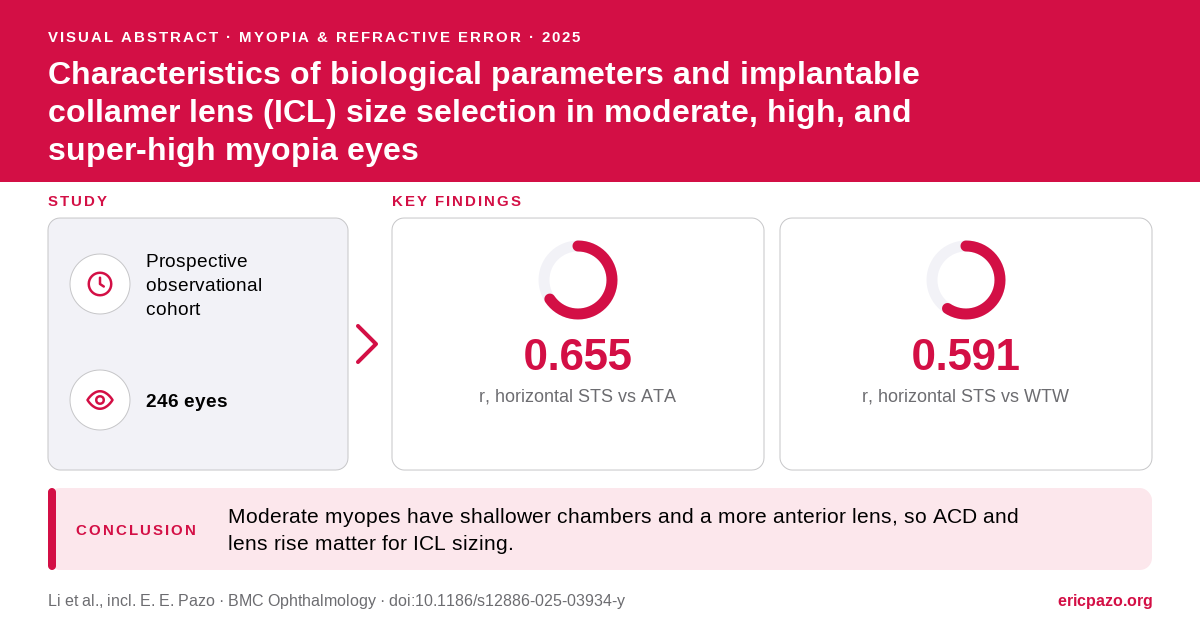
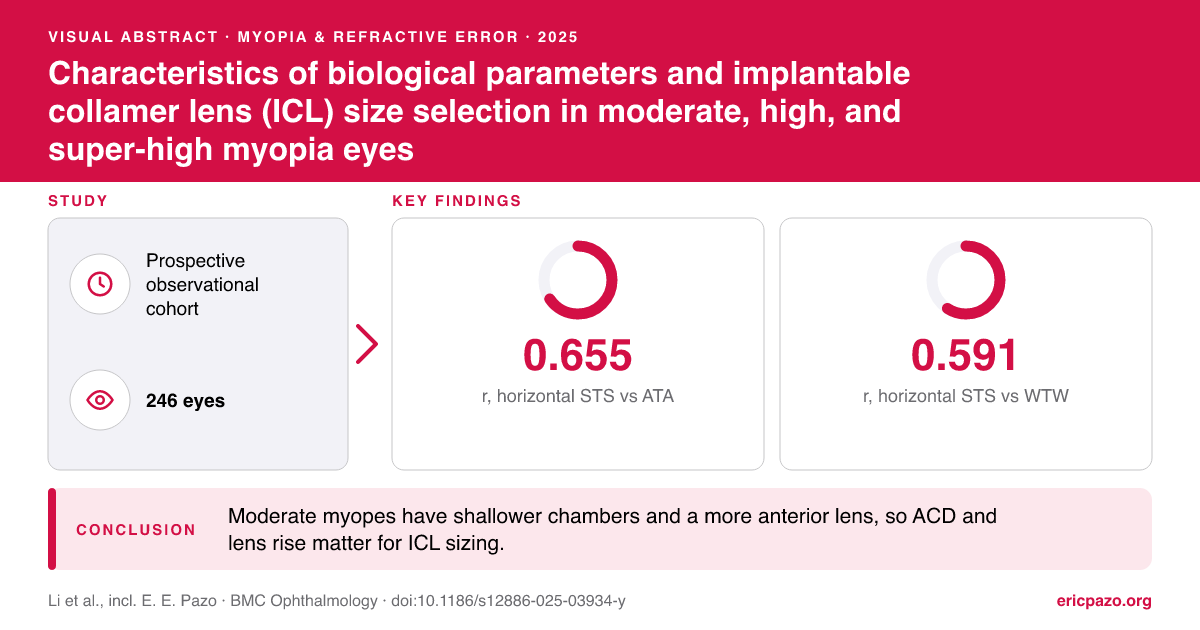
De un vistazo
Los miopes moderados tienen cámaras más estrechas y un cristalino más anterior, por lo que la ACD y la elevación del cristalino importan al dimensionar la ICL.
- Diseño
- Cohorte observacional prospectiva
- Muestra
- 246 ojos
- r, STS horizontal frente a ATA
- 0.655
- r, STS horizontal frente a WTW
- 0.591
Resumen
Este resumen se muestra en su idioma original, el inglés, porque la licencia del artículo (CC BY-NC-ND) no permite publicar traducciones.
OBJECTIVE: To analyze the characteristics of anterior segment biometric parameters in moderate, high, and super-high myopia eyes for ICL size selection. METHODS: A total of 246 eyes of 131 patients were included in this prospective observational cohort study. Preoperative axis length (AL), central keratometry (Kc), central corneal thickness (CCT), white-to-white (WTW), internal anterior chamber depth (ACD), trabecular iris angle (TIA), anterior chamber width (ACW), angle-to-angle distance (ATA), crystalline lens rise (CLR), lens thickness (LT), sulcus-to-sulcus (STS), ICL size, and postoperative vault at 1 month were recorded and compared among the different degrees of myopia groups. RESULTS: The moderate myopia showed smaller ACD and TIA than high and super-high myopia (P < 0.05). A higher proportion of CLR positive (+) was in the moderate myopia group (65%), while the super-high myopia group had a higher proportion of CLR negative (-) (55.3%). (P = 0.047). There were no statistical differences among the myopia groups in WTW, ATA, ACW, STS, LT, and postoperative vault (P>0.05). In different degrees of myopia groups, vertical ATA, ACW and STS were longer than horizontal ATA, ACW and STS (P < 0.001), and horizontal-STS showed a higher correlation with horizontal-ATA (r = 0.655) and horizontal-ACW (r = 0.660) than with WTW (r = 0.591). The 12.1 mm size ICL was slightly selected in moderate myopia (35.8%) more than high myopia (14.6%) and super-high myopia (26.3%) (P = 0.013). CONCLUSION: Compared to high and super-high myopia, moderate myopic eyes exhibited smaller ACD, TIA while similar WTW, ATA, ACW and STS, with the lens positioned more anteriorly. It should be concerned to the effect of sagittal axis parameters ACD and CLR on the ICL size in different degrees of myopia.
Palabras clave: implantable collamer lens; myopia severity; anterior segment biometry; anterior chamber depth; trabecular-iris angle; anterior chamber width; keratometry; corneal thickness
Acceso
Cómo citar
Mostrar BibTeX
@article{li2025characteristics,
  title = {{Characteristics of biological parameters and implantable collamer lens (ICL) size selection in moderate, high, and super-high myopia eyes}},
  author = {Li, Fei Ran and Ma, Yueni and Qi, Wenjie and Pazo, Emmanuel Eric and Yang, Ruibo and Zhao, Shaozhen},
  journal = {BMC Ophthalmology},
  year = {2025},
  doi = {10.1186/s12886-025-03934-y},
  url = {https://doi.org/10.1186/s12886-025-03934-y},
}
Trabajos relacionados
- Adherencia al seguimiento a largo plazo tras el implante de lente de colámero implantable en pacientes con miopía alta: un estudio unicéntrico de cohorte retrospectiva y encuesta CAP (2026)
- Predicción de la refracción ciclopléjica basada en aprendizaje automático con el Eyerobo Vision Screener: diseño, un estudio transversal comparativo de dispositivos (2026)
- Medición automatizada basada en aprendizaje profundo del volumen de retinosquisis y desprendimiento en la miopía patológica con contracción escleral posterior (2026)
- Desarrollo y validación interna de un modelo transformer sensible al tiempo para predecir la progresión de la miopía infantil a partir de datos longitudinales irregulares de cribado escolar (2026)
- Nuevo enfoque para la evaluación cuantitativa del estafiloma escleral: análisis de medidas de curvatura discreta de la esclera (2026)