
Exactitude des formules de calcul d'implant intraoculaire chez les patients atteints de cataracte à cornée cambrée
Titre original : Accuracy of intraocular lens calculation formulas in cataract patients with steep corneal curvature
Chenguang Zhang, Guangzheng Dai, Emmanuel Eric Pazo, Ling Xu, Xianwei Wu, Hongda Zhang, Tiezhu Lin, Wei He
 PLoS ONE, 2020 · article · doi:10.1371/journal.pone.0241630 · cité 33 fois · Accès libre (CC BY)
Cataracte et chirurgie du segment antérieur
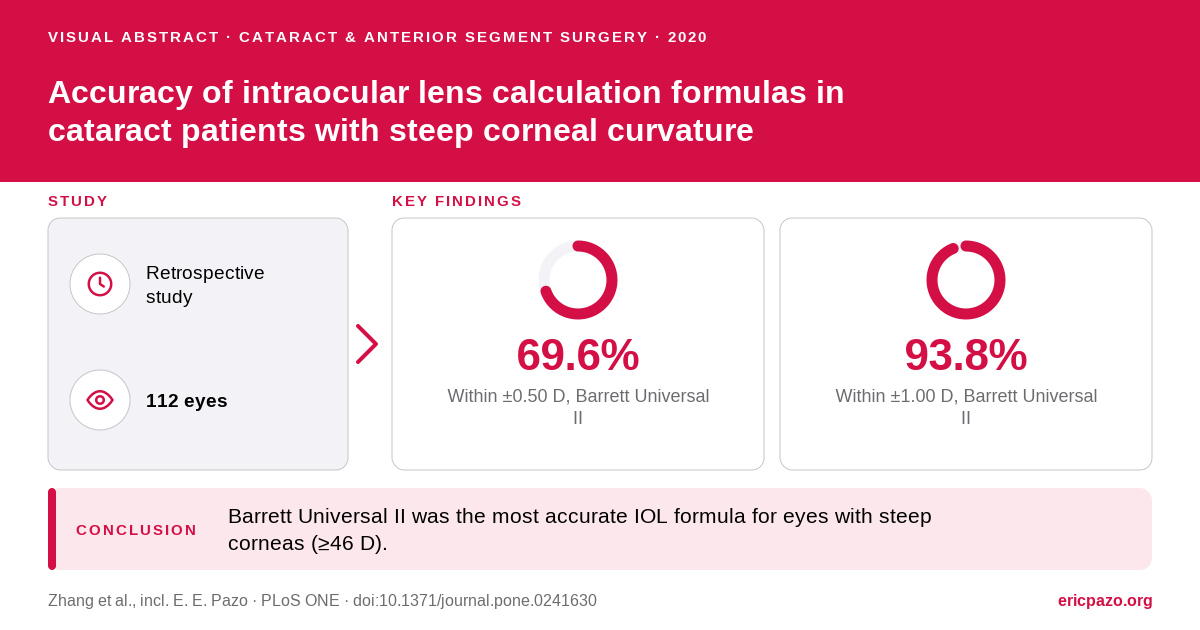
En bref
Barrett Universal II était la formule de calcul d'implant la plus exacte pour les yeux à cornée cambrée (≥46 D).
- Type d'étude
- Étude rétrospective
- Échantillon
- 112 yeux
- À ±0.50 D, Barrett Universal II
- 69.6%
- À ±1.00 D, Barrett Universal II
- 93.8%
Résumé
OBJECTIF : Comparer l'exactitude de cinq formules de calcul d'implant intraoculaire (SRK/T, Haigis, Hoffer Q, Holladay et Barrett Universal Ⅱ) chez des patients atteints de cataracte à cornée cambrée ≥ 46.0 dioptries. MÉTHODES : Étude rétrospective de phacoémulsification avec implantation d'une lentille intraoculaire chez des patients à cornée cambrée (courbure cornéenne ≥ 46D). Les erreurs de prédiction réfractive des formules de calcul de puissance d'implant (SRK/T, Haigis, Holladay, Hoffer Q et Barrett Universal II) avec les constantes de l'User Group for Laser Interference Biometry (ULIB) ont été évaluées et comparées. La réfraction objective a été évaluée un mois après l'intervention. Selon la longueur axiale (LA), les patients ont été répartis en trois groupes : LA courte (<22mm), LA normale (>22 à ≤24.5mm) et LA longue (>24.5mm). L'erreur réfractive et l'erreur réfractive absolue (AE) entre la réfraction postopératoire réelle et la réfraction postopératoire prédite ont été calculées. Une analyse de covariance a servi à comparer les cinq formules dans chaque groupe, et la corrélation entre l'erreur réfractive absolue et la LA pour chaque formule a été analysée par le test de corrélation de Pearson. RÉSULTAT : Au total, 112 yeux de 83 patients atteints de cataracte à cornée cambrée ont été inclus. Dans l'analyse de covariance de l'erreur réfractive absolue, la profondeur de chambre antérieure (ACD) était une covariable dans le groupe à LA courte (P<0.001). Les formules SRK/T et Holladay avaient l'erreur absolue moyenne (MAE) la plus faible (0.47D), et la MAE différait significativement entre les cinq formules dans le groupe à LA courte (P = 0.024). La profondeur de chambre antérieure n'était pas significativement corrélée dans les cinq formules dans les groupes à LA normale et longue (P = 0.521 et P = 0.609 respectivement). Dans le groupe à LA normale, la MAE ne différait pas significativement entre les cinq formules (P = 0.609). Dans le groupe à LA longue, la formule Barrett Universal II avait la MAE la plus faible (0.35), et la MAE différait significativement entre les cinq formules (P = 0.012). Sur l'ensemble des LA, la formule Barrett Universal II avait la MAE la plus faible et le plus fort pourcentage d'yeux à ± 0.50 D, ± 1.00 D et ± 1.50 D (69.6 %, 93.8 % et 98.2 % respectivement). CONCLUSION : Par rapport à SRK/T, Haigis, Hoffer Q et Holladay, la formule Barrett Universal Ⅱ prédit plus exactement la puissance de l'implant chez les patients atteints de cataracte à cornée cambrée ≥ 46.0 dioptries.
Traduit du résumé original en anglais (licence : CC BY).
Afficher le résumé original
OBJECTIVE: To compare the accuracy of five kinds of intraocular lens calculation formulas (SRK/T, Haigis, Hoffer Q, Holladay and Barrett Universal Ⅱ) in cataract patients with steep curvature cornea ≥ 46.0 diopters. METHODS: This is a retrospective study of cataract phacoemulsification combined with intraocular lens implantation in patients with steep curvature cornea (corneal curvature ≥ 46D). The refractive prediction errors of IOL power calculation formulas (SRK/T, Haigis, Holladay, Hoffer Q, and Barrett Universal II) using User Group for Laser Interference Biometry (ULIB) constants were evaluated and compared. Objective refraction results were assessed at one month postoperatively. According to axial length (AL), all patients were divided into three groups: short AL group (<22mm), normal AL group (>22 to ≤24.5mm) and long AL group (>24.5mm). Calculate the refractive error and absolute refractive error (AE) between the actual postoperative refractive power and the predicted postoperative refractive power. The covariance analysis was used for the comparison of five formulas in each group. The correlation between the absolute refractive error and AL from every formula were analyzed by Pearson correlation test, respectively. RESULT: Total 112 eyes of 83 cataract patients with steep curvature cornea were collected. The anterior chamber depth (ACD) was a covariate in the short AL group in the covariance analysis of absolute refractive error (P<0.001). The SRK/T and Holladay formula had the lowest mean absolute error (MAE) (0.47D), there were statistically significant differences in MAE between the five formulas for short AL group (P = 0.024). The anterior chamber depth had no significant correlation in the five calculation formulas in the normal AL group and long AL group (P = 0.521, P = 0.609 respectively). In the normal AL group, there was no significant difference in MAE between the five calculation formulas (P = 0.609). In the long AL group, Barrett Universal II formula had the lowest MAE (0.35), and there were statistically significant differences in MAE between the five formulas (P = 0.012). Over the entire AL range, the Barrett Universal II formula had the lowest MAE and the highest percentage of eyes within ± 0.50 D, ± 1.00 D, and ± 1.50 D (69.6%, 93.8%, and 98.2% respectively). CONCLUSION: Compared to SRK/T, Haigis, Hoffer Q, and Holladay, Barrett Universal Ⅱ formula is more accurate in predicting the IOL power in the cataract patients with steep curvature cornea ≥ 46.0 diopters.
Mots-clés : intraocular lens power calculation; cataract surgery; refractive prediction error; axial length; Barrett Universal II formula; SRK/T formula; Haigis formula; Hoffer Q formula
Accès
Comment citer
Afficher le BibTeX
@article{zhang2020accuracy,
  title = {{Accuracy of intraocular lens calculation formulas in cataract patients with steep corneal curvature}},
  author = {Zhang, Chenguang and Dai, Guangzheng and Pazo, Emmanuel Eric and Xu, Ling and Wu, Xianwei and Zhang, Hongda and Lin, Tiezhu and He, Wei},
  journal = {PLoS ONE},
  year = {2020},
  doi = {10.1371/journal.pone.0241630},
  url = {https://doi.org/10.1371/journal.pone.0241630},
}
Travaux liés
- Observance du suivi à long terme après implantation d'une lentille en collamer implantable chez des patients fortement myopes : une étude monocentrique de cohorte rétrospective et d'enquête CAP (2026)
- Prédiction de la réfraction sous cycloplégie par apprentissage automatique avec l'Eyerobo Vision Screener : plan, une étude transversale comparative d'appareils (2026)
- Évaluer l'impact des lampes à fente portables assistées par IA sur les soins ophtalmologiques primaires en milieu rural (2025)
- Caractéristiques des paramètres biologiques et choix de la taille de la lentille en collamer implantable (ICL) dans les yeux myopes modérés, forts et très forts (2025)
- Exploration de modèles d'apprentissage automatique pour la sécurité du vault dans l'implantation d'ICL : une analyse comparative de modèles de régression et de classification (2025)