
Evaluación del impacto de las lámparas de hendidura portátiles asistidas por IA en la atención oftalmológica primaria rural
Título original: Assessing the Impact of AI-Assisted Portable Slit Lamps on Rural Primary Ophthalmic Medical Service
Sile Yu, Chunhong Yan, Guanghao Qin, Emmanuel Eric Pazo, Xiangdong He, Peng Qi, Mingze Li, Dongming Han, Wei He, Xingru He
 Current Eye Research, 2025 · artículo · doi:10.1080/02713683.2025.2458131 · citado 6 veces
Cataratas y cirugía del segmento anterior
De un vistazo
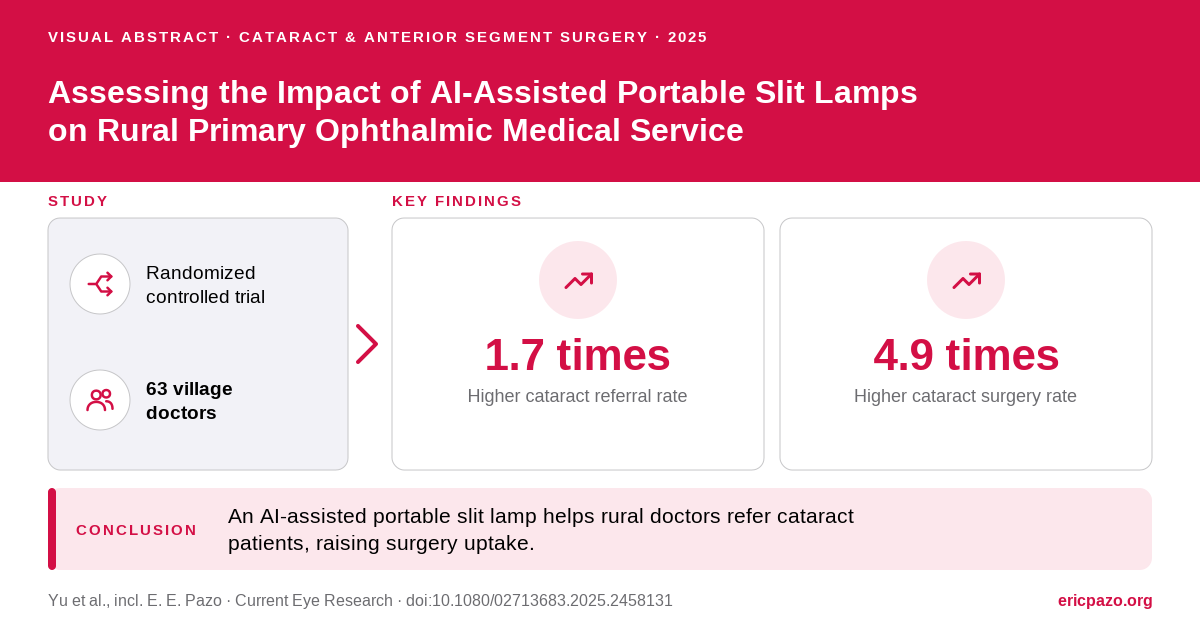
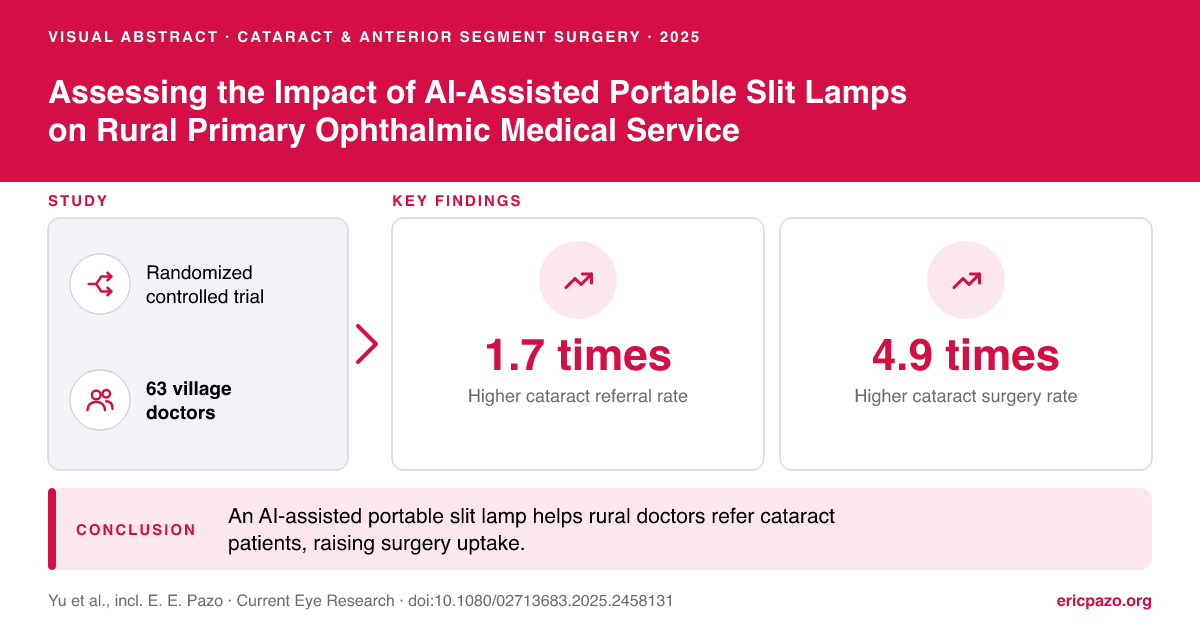
Una lámpara de hendidura portátil asistida por IA ayuda a los médicos rurales a derivar a los pacientes con catarata, lo que aumenta las cirugías realizadas.
- Diseño
- Ensayo controlado aleatorizado
- Muestra
- 63 médicos rurales
- Mayor tasa de derivación por catarata
- 1.7 times
- Mayor tasa de cirugía de catarata
- 4.9 times
Resumen
Este resumen se muestra en su idioma original, el inglés, porque el artículo no tiene una licencia abierta que permita traducciones.
PURPOSE: To investigate the effect of an AI-assisted portable slit lamp (iSpector) and basic ophthalmology training on cataract detection, referral, and surgery rate in rural areas. METHODS: This randomized control trial randomly assigned 63 village doctors to either the AI-assisted group (providing iSpector and training) or the control group (providing training). Doctors were followed for 1 year before intervention as a baseline and 1 year after to make the comparison. Multivariable Poisson regression was applied to compare the difference in cataract detection, referral, and surgery rate between the two groups, adjusted for primary doctors' baseline characteristics. We further conducted subgroup analysis to estimate the change after the intervention. RESULTS: Compared to the control group, the detection, referral, and surgery rate of cataracts among the AI-assisted group was comparable, 1.7 times higher, and 4.9 times higher, respectively. Providing iSpector and training increased the detection, referral, and surgery rate of cataracts. However, only based on training to elevate the detection rate of cataracts did not change the referral and surgery rate. CONCLUSIONS: iSpector helps village doctors detect and refer cataract patients appropriately, thus increasing the probability that patients receive cataract surgery.
Palabras clave: cataract detection; cataract surgery; village doctors; ophthalmology education; resource-limited settings; telemedicine
Acceso
Cómo citar
Mostrar BibTeX
@article{yu2025assessing,
  title = {{Assessing the Impact of AI-Assisted Portable Slit Lamps on Rural Primary Ophthalmic Medical Service}},
  author = {Yu, Sile and Yan, Chunhong and Qin, Guanghao and Pazo, Emmanuel Eric and He, Xiangdong and Qi, Peng and Li, Mingze and Han, Dongming and He, Wei and He, Xingru},
  journal = {Current Eye Research},
  year = {2025},
  doi = {10.1080/02713683.2025.2458131},
  url = {https://doi.org/10.1080/02713683.2025.2458131},
}
Trabajos relacionados
- Adherencia al seguimiento a largo plazo tras el implante de lente de colámero implantable en pacientes con miopía alta: un estudio unicéntrico de cohorte retrospectiva y encuesta CAP (2026)
- Predicción de la refracción ciclopléjica basada en aprendizaje automático con el Eyerobo Vision Screener: diseño, un estudio transversal comparativo de dispositivos (2026)
- Características de los parámetros biológicos y selección del tamaño de la lente de colámero implantable (ICL) en ojos con miopía moderada, alta y muy alta (2025)
- Exploración de modelos de aprendizaje automático para la seguridad del vault en el implante de ICL: un análisis comparativo de modelos de regresión y de clasificación (2025)
- Comparación múltiple de 8 fórmulas biométricas de lente intraocular, incluida una fórmula de lente delgada basada en aprendizaje automático (MM) y una fórmula de trazado de rayos integrada en la tomografía de coherencia óptica del segmento anterior (2024)