
Comparación de la calidad y el rendimiento visual entre 2 lentes intraoculares multifocales refractivas rotacionalmente asimétricas
Título original: Visual quality and performance comparison between 2 refractive rotationally asymmetric multifocal intraocular lenses
Richard N. McNeely, Emmanuel Eric Pazo, Andrew Spence, Olivier Richoz, Andrew M. Nesbit, Tara Moore, Jonathan Edward Moore
 Journal of Cataract & Refractive Surgery, 2017 · artículo · doi:10.1016/j.jcrs.2017.05.039 · citado 46 veces
Cataratas y cirugía del segmento anterior
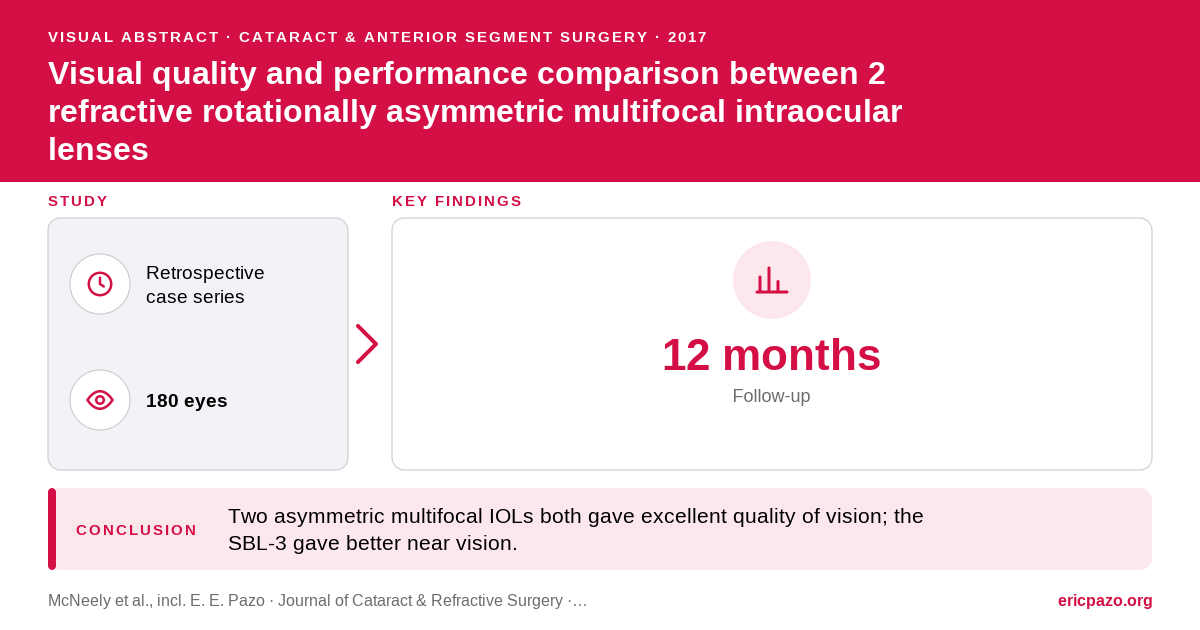
De un vistazo
Ambas LIO multifocales asimétricas proporcionaron una calidad visual excelente; la SBL-3 ofreció mejor visión de cerca.
- Diseño
- Serie de casos retrospectiva
- Muestra
- 180 ojos
- Seguimiento
- 12 months
Resumen
Este resumen se muestra en su idioma original, el inglés, porque el artículo no tiene una licencia abierta que permita traducciones.
PURPOSE: To compare the 12-month postoperative quality of vision and visual performance of 2 different refractive rotationally asymmetric multifocal intraocular lenses (IOLs). SETTING: Cathedral Eye Clinic, Belfast, Northern Ireland, United Kingdom. DESIGN: Retrospective case series. METHODS: Refractive lens exchange (RLE) patients were divided into 2 groups. Group A comprised eyes receiving a Lentis Mplus LS-312 MF30 IOL and Group B, eyes receiving a Lenstec SBL-3 IOL. Refraction, uncorrected (UDVA) and corrected distance visual acuities, uncorrected intermediate (UIVA) and near (UNVA) visual acuities, distance-corrected intermediate and near (DCNVA) visual acuities, and quality of vision were evaluated preoperatively and up to 12 months postoperatively. RESULTS: Each group comprised 90 eyes. Both groups had a high level of quality of vision 12 months postoperatively with no significant difference between the 2 groups (P = .919). There was no significant between-group difference in mean monocular and binocular UDVA, monocular UIVA, or monocular UNVA. Group B had statistically significantly better mean monocular DCNVA (P = .049), binocular UNVA (P = .011), and binocular DCNVA (P = .035). Group B had a higher percentage of complete spectacle independence. CONCLUSIONS: Both refractive rotationally asymmetric multifocal IOLs provided an excellent level of quality of vision 12 months postoperatively. Both IOL models restored distance, intermediate, and near visual function; however the IOLs in Group B provided better near visual performance.
Palabras clave: refractive lens exchange; visual quality; visual acuity; intermediate visual acuity; spectacle independence; intraocular lens comparison
Acceso
Cómo citar
Mostrar BibTeX
@article{mcneely2017visual,
  title = {{Visual quality and performance comparison between 2 refractive rotationally asymmetric multifocal intraocular lenses}},
  author = {McNeely, Richard N. and Pazo, Emmanuel Eric and Spence, Andrew and Richoz, Olivier and Nesbit, Andrew M. and Moore, Tara and Moore, Jonathan Edward},
  journal = {Journal of Cataract & Refractive Surgery},
  year = {2017},
  doi = {10.1016/j.jcrs.2017.05.039},
  url = {https://doi.org/10.1016/j.jcrs.2017.05.039},
}
Trabajos relacionados
- Adherencia al seguimiento a largo plazo tras el implante de lente de colámero implantable en pacientes con miopía alta: un estudio unicéntrico de cohorte retrospectiva y encuesta CAP (2026)
- Predicción de la refracción ciclopléjica basada en aprendizaje automático con el Eyerobo Vision Screener: diseño, un estudio transversal comparativo de dispositivos (2026)
- Evaluación del impacto de las lámparas de hendidura portátiles asistidas por IA en la atención oftalmológica primaria rural (2025)
- Características de los parámetros biológicos y selección del tamaño de la lente de colámero implantable (ICL) en ojos con miopía moderada, alta y muy alta (2025)
- Exploración de modelos de aprendizaje automático para la seguridad del vault en el implante de ICL: un análisis comparativo de modelos de regresión y de clasificación (2025)