
Comparaison de la qualité et des performances visuelles entre 2 lentilles intraoculaires multifocales réfractives à asymétrie rotationnelle
Titre original : Visual quality and performance comparison between 2 refractive rotationally asymmetric multifocal intraocular lenses
Richard N. McNeely, Emmanuel Eric Pazo, Andrew Spence, Olivier Richoz, Andrew M. Nesbit, Tara Moore, Jonathan Edward Moore
 Journal of Cataract & Refractive Surgery, 2017 · article · doi:10.1016/j.jcrs.2017.05.039 · cité 46 fois
Cataracte et chirurgie du segment antérieur
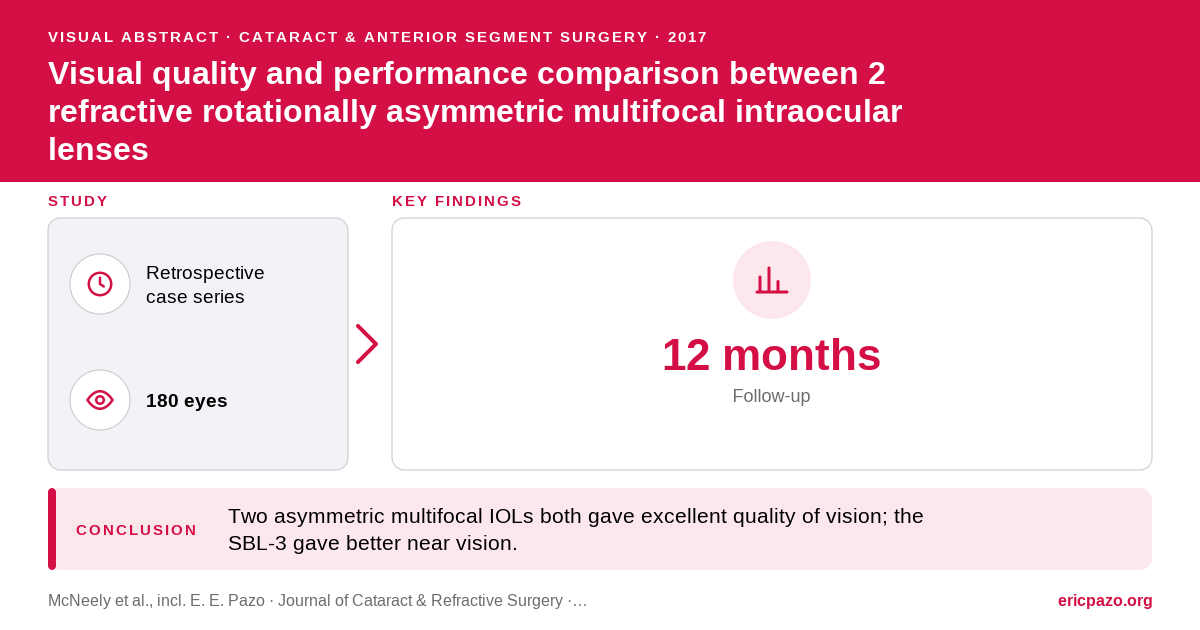
En bref
Les deux implants multifocaux asymétriques ont offert une excellente qualité de vision ; le SBL-3 a donné une meilleure vision de près.
- Type d'étude
- Série de cas rétrospective
- Échantillon
- 180 yeux
- Suivi
- 12 months
Résumé
Ce résumé est affiché dans sa langue d'origine, l'anglais, car l'article n'est pas publié sous une licence ouverte autorisant les traductions.
PURPOSE: To compare the 12-month postoperative quality of vision and visual performance of 2 different refractive rotationally asymmetric multifocal intraocular lenses (IOLs). SETTING: Cathedral Eye Clinic, Belfast, Northern Ireland, United Kingdom. DESIGN: Retrospective case series. METHODS: Refractive lens exchange (RLE) patients were divided into 2 groups. Group A comprised eyes receiving a Lentis Mplus LS-312 MF30 IOL and Group B, eyes receiving a Lenstec SBL-3 IOL. Refraction, uncorrected (UDVA) and corrected distance visual acuities, uncorrected intermediate (UIVA) and near (UNVA) visual acuities, distance-corrected intermediate and near (DCNVA) visual acuities, and quality of vision were evaluated preoperatively and up to 12 months postoperatively. RESULTS: Each group comprised 90 eyes. Both groups had a high level of quality of vision 12 months postoperatively with no significant difference between the 2 groups (P = .919). There was no significant between-group difference in mean monocular and binocular UDVA, monocular UIVA, or monocular UNVA. Group B had statistically significantly better mean monocular DCNVA (P = .049), binocular UNVA (P = .011), and binocular DCNVA (P = .035). Group B had a higher percentage of complete spectacle independence. CONCLUSIONS: Both refractive rotationally asymmetric multifocal IOLs provided an excellent level of quality of vision 12 months postoperatively. Both IOL models restored distance, intermediate, and near visual function; however the IOLs in Group B provided better near visual performance.
Mots-clés : refractive lens exchange; visual quality; visual acuity; intermediate visual acuity; spectacle independence; intraocular lens comparison
Accès
Comment citer
Afficher le BibTeX
@article{mcneely2017visual,
  title = {{Visual quality and performance comparison between 2 refractive rotationally asymmetric multifocal intraocular lenses}},
  author = {McNeely, Richard N. and Pazo, Emmanuel Eric and Spence, Andrew and Richoz, Olivier and Nesbit, Andrew M. and Moore, Tara and Moore, Jonathan Edward},
  journal = {Journal of Cataract & Refractive Surgery},
  year = {2017},
  doi = {10.1016/j.jcrs.2017.05.039},
  url = {https://doi.org/10.1016/j.jcrs.2017.05.039},
}
Travaux liés
- Observance du suivi à long terme après implantation d'une lentille en collamer implantable chez des patients fortement myopes : une étude monocentrique de cohorte rétrospective et d'enquête CAP (2026)
- Prédiction de la réfraction sous cycloplégie par apprentissage automatique avec l'Eyerobo Vision Screener : plan, une étude transversale comparative d'appareils (2026)
- Évaluer l'impact des lampes à fente portables assistées par IA sur les soins ophtalmologiques primaires en milieu rural (2025)
- Caractéristiques des paramètres biologiques et choix de la taille de la lentille en collamer implantable (ICL) dans les yeux myopes modérés, forts et très forts (2025)
- Exploration de modèles d'apprentissage automatique pour la sécurité du vault dans l'implantation d'ICL : une analyse comparative de modèles de régression et de classification (2025)