
ICL 挿入におけるボールトの安全性に関する機械学習モデルの検討:回帰モデルと分類モデルの比較解析
原題: Exploring Machine Learning Models for Vault Safety in ICL Implantation: A Comparative Analysis of Regression and Classification Models
Qing Zhang, Qi Li, Zhilong Yu, Ruibo Yang, Emmanuel Eric Pazo, Yue Huang, Hui Liu, Chen Zhang, Salissou Moutari, Shaozhen Zhao
 Ophthalmology and Therapy, 2025 · 原著論文 · doi:10.1007/s40123-025-01173-4 · 被引用 5 回 · オープンアクセス(CC BY-NC)
要点
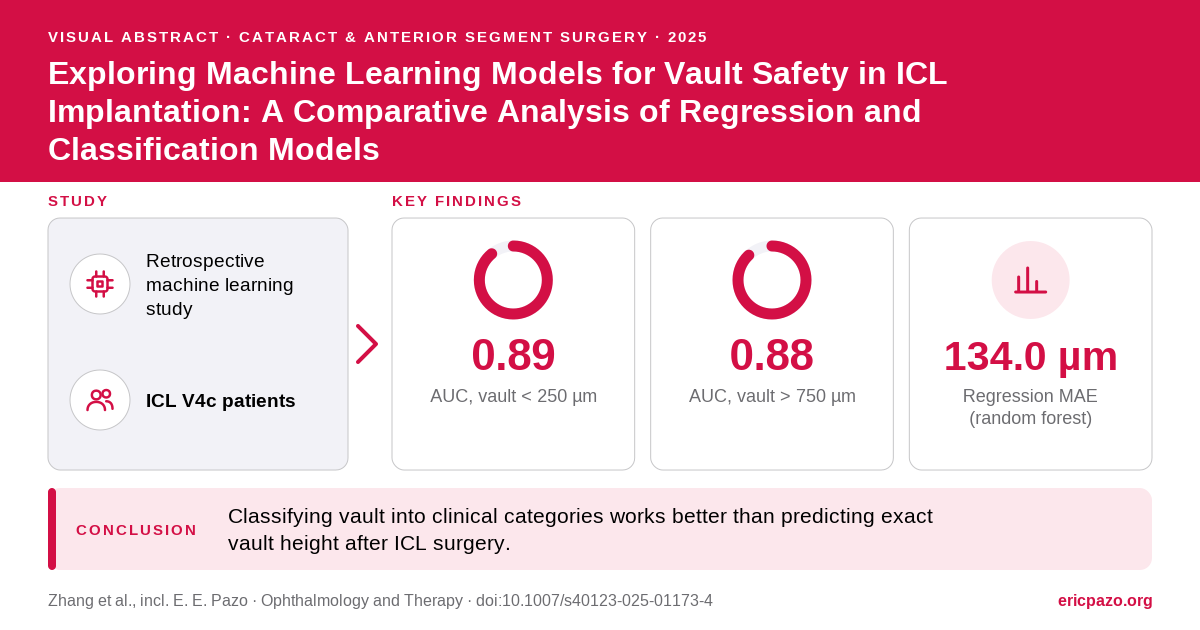
ICL 手術後のボールトは、正確な高さを予測するより臨床カテゴリーに分類するほうが有効である。
- 研究デザイン
- 後ろ向き機械学習研究
- 対象
- ICL V4c 患者
- AUC(ボールト < 250 µm)
- 0.89
- AUC(ボールト > 750 µm)
- 0.88
- 回帰の MAE(ランダムフォレスト)
- 134.0 µm
抄録
はじめに:有水晶体眼内コラマーレンズ(ICL)V4c 挿入後の術後ボールト高の正確な予測は、合併症を最小限に抑え最適な手術成績を得るために重要である。本研究は、回帰と分類の両アプローチに着目し、術後ボールト高を予測する機械学習モデルの性能を評価することを目的とする。方法:本後ろ向き研究では、前房深度、角膜横径(white-to-white)、ICL サイズなどを含む生体計測データと人口統計学的データを解析した。勾配ブースティング、ランダムフォレスト、CatBoost の各アルゴリズムを用いて回帰モデルと分類モデルを構築した。回帰モデルはボールト高を連続変数として予測し、分類モデルはボールト高を 2 値および多クラスの課題に分類した。モデル性能は、回帰モデルでは平均絶対誤差(MAE)と二乗平均平方根誤差(RMSE)、分類モデルでは正解率、F1 スコア、曲線下面積(AUC)で評価した。結果:回帰モデルの予測性能は中等度であり、ランダムフォレストが最良であった(MAE:134.0 µm、RMSE:171.3 µm、Pearson 相関係数:0.45)。一方、分類モデルは回帰アプローチより高い臨床的有用性を示した。2 値分類課題(ボールト < 250 µm 対 ≥ 250 µm)では勾配ブースティングが最も高い総合性能を示し、正解率は 89 ± 12%、AUC は 0.89 であった。ボールト > 750 µm 対 ≤ 750 µm の予測課題では、ランダムフォレストが最も有効な分類器であり、正解率 86 ± 9%、AUC 0.88 を達成した。多クラス分類では、中間的なボールト高(250 µm ≤ ボールト ≤ 750 µm)の予測で優れた性能を示し、このカテゴリーではランダムフォレストが最高の正解率 94.6% を達成した。しかし、すべてのモデルで極端なボールトのカテゴリーを正確に分類することは困難であった。結論:分類モデル、特に勾配ブースティングとランダムフォレストは、臨床的に重要なボールトのカテゴリーを予測する高い可能性を示し、個別化された手術計画とリスク管理の向上を可能にする。回帰モデルは中等度の知見をもたらしたものの、その限界から、臨床応用には分類アプローチのほうが適していることが示唆される。今後の研究では、極端なボールトの予測精度を高め、アンサンブル深層学習などの高度な手法を取り入れて結果をさらに改善すべきである。
英語の原文抄録からの翻訳です(ライセンス:CC BY-NC)。
原文の抄録を表示
INTRODUCTION: Accurate prediction of postoperative vault height following implantable collamer lens (ICL) V4c implantation is critical for minimizing complications and achieving optimal surgical outcomes. This study aims to evaluate the performance of machine learning models in predicting postoperative vault height, focusing on both regression and classification approaches. METHODS: This retrospective study analyzed biometric and demographic data, including anterior chamber depth, white-to-white distance, and ICL size, among other variables. Regression and classification models were developed using gradient boosting, random forest, and CatBoost algorithms. Regression models predicted vault height as a continuous variable, while classification models categorized vault heights into binary and multi-class tasks. Model performance was evaluated using metrics including the mean absolute error (MAE) and root mean squared error (RMSE) for regression models, while accuracy, F1-score, and area under the curve (AUC) were used for classification models. RESULTS: Regression models demonstrated moderate predictive performance, with random forest delivering the best performance (MAE: 134.0 µm, RMSE: 171.3 µm, Pearson's correlation coefficient: 0.45). On the other hand, classification models exhibited greater clinical applicability than regression approaches. For the binary classification task (vault < 250 µm vs. ≥ 250 µm), gradient boosting achieved the highest overall performance, with accuracy of 89 ± 12% and an AUC of 0.89. In the task of predicting vault > 750 µm vs. ≤ 750 µm, random forest emerged as the most effective classifier, achieving accuracy of 86 ± 9% and an AUC of 0.88. In multi-class classification, models demonstrated superior performance in predicting intermediate vault heights (250 µm ≤ vault ≤ 750 µm). Random forest achieved the highest accuracy of 94.6% in this category. However, all models faced challenges in accurately classifying extreme vault categories. CONCLUSIONS: Classification models, particularly gradient boosting and random forest, demonstrated strong potential for predicting clinically significant vault categories, enabling personalized surgical planning and improved risk management. While regression models offered moderate insights, their limitations suggest that classification approaches are better suited for clinical applications. Future research should focus on enhancing model accuracy for extreme vault prediction and integrating advanced techniques, such as ensemble deep learning, to further refine outcomes.
キーワード: implantable collamer lens; ICL V4c; classification models; regression models; gradient boosting; random forest; CatBoost; anterior chamber depth
アクセス
引用方法
BibTeX を表示
@article{zhang2025exploring,
  title = {{Exploring Machine Learning Models for Vault Safety in ICL Implantation: A Comparative Analysis of Regression and Classification Models}},
  author = {Zhang, Qing and Li, Qi and Yu, Zhilong and Yang, Ruibo and Pazo, Emmanuel Eric and Huang, Yue and Liu, Hui and Zhang, Chen and Moutari, Salissou and Zhao, Shaozhen},
  journal = {Ophthalmology and Therapy},
  year = {2025},
  doi = {10.1007/s40123-025-01173-4},
  url = {https://doi.org/10.1007/s40123-025-01173-4},
}