
Eyerobo Vision Screener を用いた機械学習による調節麻痺下屈折値の予測:デザイン—横断的機器比較研究
原題: Machine Learning-Based Prediction of Cycloplegic Refraction Using the Eyerobo Vision Screener: Design—A Cross-Sectional Comparative Device Study
Mengmeng Xia, Boxue Yao, Yumei Wang, Fengwei Liang, Wuxia Zhao, Li Qin, Shoukuan Liu, Muhammad Usama, Zhihui Zhang, Wu Guo, Emmanuel Eric Pazo, Xinjun Ren
 Ophthalmology and Therapy, 2026 · 原著論文 · doi:10.1007/s40123-026-01482-2 · オープンアクセス(CC BY-NC)
要点
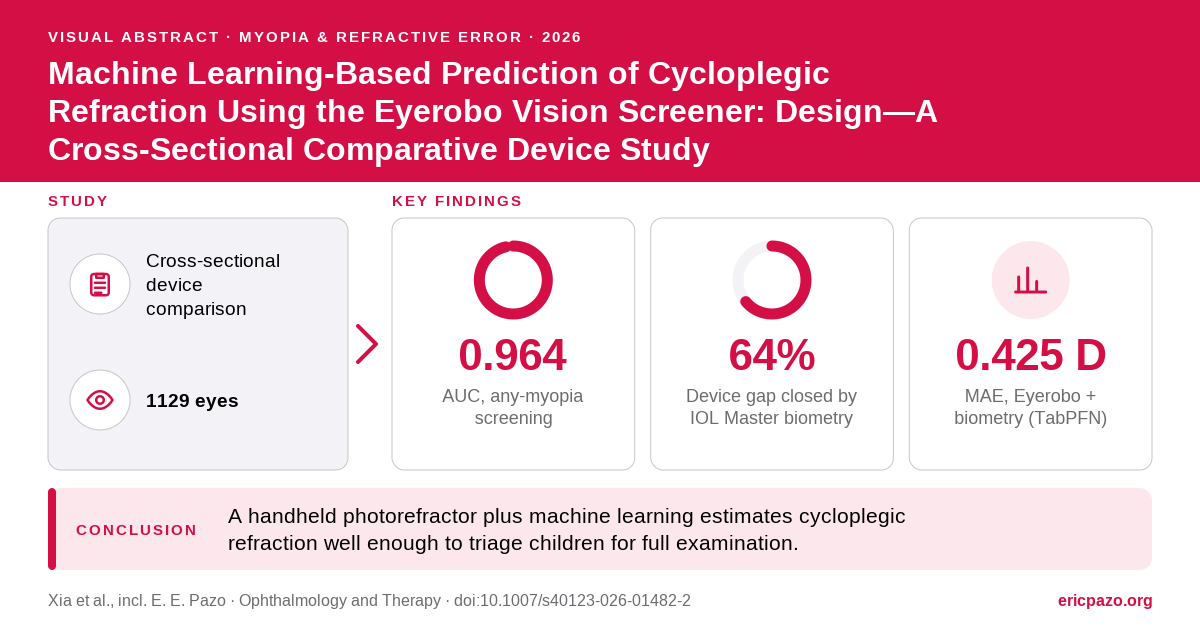
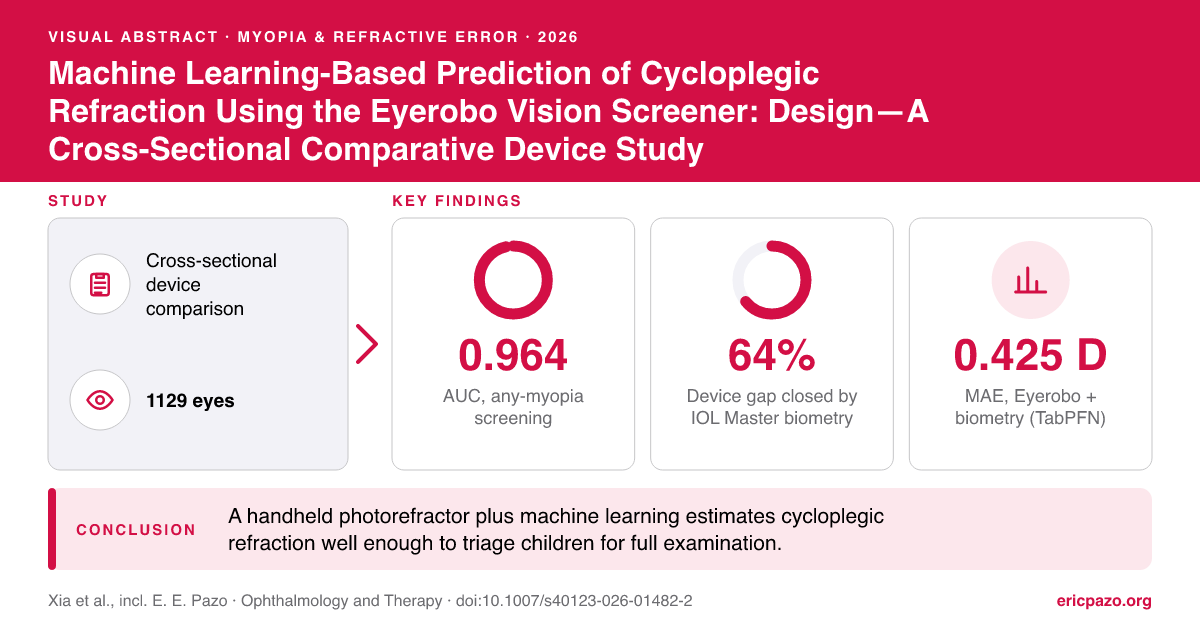
携帯型フォトレフラクターと機械学習の組み合わせにより、精密検査が必要な小児を選別できる程度に調節麻痺下屈折値を推定できる。
- 研究デザイン
- 横断的機器比較
- 対象
- 1129 眼
- AUC(あらゆる近視のスクリーニング)
- 0.964
- IOL Master 生体計測で縮まった機器間の差
- 64%
- MAE(Eyerobo + 生体計測、TabPFN)
- 0.425 D
抄録
本横断的機器比較研究の目的は、小児近視コホートにおいて、携帯型ハンドヘルドフォトレフラクターである Eyerobo Vision Screener(VS)と従来のオートレフラクトメーターを、調節麻痺下等価球面度数(SE)およびパワーベクトル成分(J0、J45)の機械学習による予測について比較すること、IOL Master による生体計測の追加が機器間の性能差を縮めるかを評価すること、そして臨床的に意味のある紹介閾値におけるスクリーニング向けの分類指標(感度、特異度、陽性・陰性的中率、受信者動作特性曲線下面積[AUC])を報告し、機器とモデルの組み合わせのトリアージ性能を定量化することである。6–18 歳の患者 574 人の 1129 眼について、薬剤による散瞳の前後に 3 種類の眼科機器でデータを収集した。すべての屈折測定値は Thibos らに従いパワーベクトル(SE、J0、J45)に分解した。Eyerobo VS とオートレフラクトメーターを(それぞれ散瞳前、散瞳後、両者の組み合わせの条件で)IOL Master 生体計測の有無とともに比較する対称的な枠組みから、臨床的根拠に基づく 12 の特徴量シナリオを構築した。ハイパーパラメータ調整を必要としない表形式基盤モデル TabPFN を、7 つの従来型機械学習アルゴリズムとともに、患者単位の 5 分割グループ交差検証を 3 つの乱数シードで繰り返して評価した。一致度は Bland–Altman 解析、Pearson 相関、臨床閾値解析で評価した。回帰指標に加えて、事前に規定した 3 つの臨床閾値(調節麻痺下 SE $$\le -0.50$$ D、$$\le -3.00$$ D、$$\le -6.00$$ D)でスクリーニング分類解析を行い、感度、特異度、陽性的中率(PPV)、陰性的中率(NPV)、AUC を 95% 対応ブートストラップ信頼区間とともに報告した。TabPFN と次点のアルゴリズムとの正式な対応のある統計的比較、および 1 患者 1 眼での感度分析も報告する。TabPFN はすべての Eyerobo シナリオで平均絶対誤差(MAE)が最小となり、オートレフラクトメーターのシナリオでは Ridge と同等であった。主要な Eyerobo Pre + IOL シナリオでは、TabPFN(0.425 D)と次点の勾配ブースティング学習器(XGBoost、0.542 D)との眼ごとの対応のある MAE の差は 0.117 D で TabPFN が優れており、対応のある Wilcoxon 符号付順位検定で $$p<0.001$$ であった。散瞳前の SE 予測では、オートレフラクトメーターの MAE は 0.295 D(± 0.50 D 以内 87.4%)であったのに対し、Eyerobo VS は 0.657 D(61.6%)であった。Eyerobo に IOL Master 生体計測を加えるとこの差は 64% 縮まり、MAE は 0.425 D(72.0%)となった。乱視のパワーベクトル成分では差はさらに縮まり、J0 の MAE はオートレフラクトメーター 0.106 D に対し Eyerobo + IOL 0.143 D、J45 の MAE は 0.060 D に対し 0.088 D であった。散瞳後のオートレフラクトメーターの予測は調節麻痺下の精度に近づいた(MAE = 0.203 D、± 0.50 D 以内 96.0%)。サブグループ解析では、Eyerobo は軽度近視で最も良好であり(MAE = 0.398 D、± 0.50 D 以内 75.6%)、強度近視と少数の非近視層では性能が低下した。スクリーニング分類解析では、あらゆる近視の閾値において Eyerobo とオートレフラクトメーターは運用上同等であった(Eyerobo AUC 0.964[95% CI 0.939–0.982]、感度 0.946、特異度 0.894;オートレフラクトメーター AUC 0.969[0.948–0.986]、感度 0.960、特異度 0.886;対応のある AUC の差 0.005[95% CI $$-0.022$$ ~ $$+0.034$$ ]、事前規定の $$\delta =0.05$$ マージンで形式上非劣性)。この単施設の小児紹介コホートにおいて、Eyerobo VS と機械学習の組み合わせは、完全な調節麻痺下検査に進むべき小児を識別するトリアージ補助として使用できる精度の調節麻痺下 SE 推定値を示し、乱視成分ではオートレフラクトメーターとほぼ同等の性能であった。IOL Master 生体計測の追加により機器間の差は 64% 縮まった。TabPFN は本コホートで評価したアルゴリズムの中で最良の性能を示し、ハイパーパラメータ調整も不要であるが、線形モデルや勾配ブースティングのベースラインとの差がわずかであることと外部検証がないことから、決定的な第一選択アルゴリズムとして推奨することはできない。提案手法は調節麻痺下屈折検査の代替ではなく、臨床導入の前に一般的な小児スクリーニングコホートでの前向き外部検証が必要である。
英語の原文抄録からの翻訳です(ライセンス:CC BY-NC)。
原文の抄録を表示
A cross-sectional comparative device study to compare the Eyerobo Vision Screener (VS), a portable handheld photorefractor, against a conventional auto-refractor for machine-learning-based prediction of cycloplegic spherical equivalent (SE) and power vector components (J0, J45) in a pediatric myopia cohort, to evaluate whether supplementary IOL Master biometry narrows the performance gap between devices, and to report screening-oriented classification metrics (sensitivity, specificity, positive and negative predictive values, area under the receiver operating characteristic curve [AUC]) at clinically meaningful referral thresholds that quantify the device–model combination’s triage performance. Data from 1129 eyes of 574 patients aged 6–18 years were collected using three ophthalmic devices before and after pharmacological dilation. All refractive measurements were decomposed into power vectors (SE, J0, J45) following Thibos et al. Twelve clinically motivated feature scenarios were constructed from a symmetric framework comparing the Eyerobo VS and auto-refractor (each under predilation, post-dilation, and combined conditions), with and without IOL Master biometry. TabPFN, a tabular foundation model requiring no hyperparameter tuning, was evaluated alongside seven conventional machine-learning algorithms using patient-level five-fold grouped cross-validation repeated over three random seeds. Agreement was assessed using Bland–Altman analysis, Pearson correlation, and clinical threshold analysis. In addition to regression metrics, a screening-classification analysis was performed at three prespecified clinical thresholds (cycloplegic SE $$\le -0.50$$ D, $$\le -3.00$$ D, and $$\le -6.00$$ D), reporting sensitivity, specificity, positive predictive value (PPV), negative predictive value (NPV), and AUC with 95% paired bootstrap confidence intervals. Formal paired statistical comparison between TabPFN and the next-best algorithm and a one-eye-per-patient sensitivity analysis are also reported. TabPFN achieved the lowest mean absolute error (MAE) on all Eyerobo scenarios and was competitive with Ridge on auto-refractor scenarios; on the headline Eyerobo Pre + IOL scenario, the per-eye paired difference in MAE between TabPFN (0.425 D) and the next-best gradient-boosting learner (XGBoost, 0.542 D) was 0.117 D in favour of TabPFN, with paired Wilcoxon signed-rank $$p<0.001$$ . For predilation SE prediction, the auto-refractor achieved an MAE of 0.295 D (87.4% within ± 0.50 D), compared with 0.657 D (61.6%) for the Eyerobo VS. Adding IOL Master biometry to the Eyerobo reduced this gap by 64%, yielding an MAE of 0.425 D (72.0%). For astigmatic power vector components, the gap narrowed further: J0 MAE was 0.106 D (auto-refractor) versus 0.143 D (Eyerobo + IOL), and J45 MAE was 0.060 D versus 0.088 D. Auto-refractor post-dilation predictions approached cycloplegic accuracy (MAE = 0.203 D, 96.0% within ± 0.50 D). Subgroup analysis showed the Eyerobo performed best for mild myopia (MAE = 0.398 D, 75.6% within ± 0.50 D) and degraded for high myopia and the small nonmyopic stratum. In the screening-classification analysis, the Eyerobo and the auto-refractor were operationally equivalent at the any-myopia threshold (Eyerobo AUC 0.964 [95% CI 0.939–0.982], sensitivity 0.946, specificity 0.894; auto-refractor AUC 0.969 [0.948–0.986], sensitivity 0.960, specificity 0.886; paired AUC difference 0.005 [95% CI $$-0.022$$ to $$+0.034$$ ], formally noninferior under a prespecified $$\delta =0.05$$ margin). Within this single-center pediatric referral cohort, the Eyerobo VS combined with machine learning produced cycloplegic SE estimates of a precision consistent with use as a triage adjunct to identify children who should proceed to a full cycloplegic examination, with near-equivalent performance to the auto-refractor for astigmatic components. The addition of IOL Master biometry narrowed the device gap by 64%. TabPFN achieved the best performance among the evaluated algorithms within this cohort and requires no hyperparameter tuning, but the modest margin over linear and gradient-boosting baselines and the absence of external validation preclude any recommendation as the definitive algorithm of choice. The proposed approach is not a substitute for cycloplegic refraction; prospective external validation in a general pediatric screening cohort is required before clinical deployment.
キーワード: cycloplegic refraction; childhood myopia; spherical equivalent; power vectors; TabPFN; machine learning prediction; refractive error screening; device comparison
アクセス
引用方法
BibTeX を表示
@article{xia2026machine,
  title = {{Machine Learning-Based Prediction of Cycloplegic Refraction Using the Eyerobo Vision Screener: Design—A Cross-Sectional Comparative Device Study}},
  author = {Xia, Mengmeng and Yao, Boxue and Wang, Yumei and Liang, Fengwei and Zhao, Wuxia and Qin, Li and Liu, Shoukuan and Usama, Muhammad and Zhang, Zhihui and Guo, Wu and Pazo, Emmanuel Eric and Ren, Xinjun},
  journal = {Ophthalmology and Therapy},
  year = {2026},
  doi = {10.1007/s40123-026-01482-2},
  url = {https://doi.org/10.1007/s40123-026-01482-2},
}