
強度近視患者における有水晶体眼内コラマーレンズ挿入術後の長期経過観察の遵守状況:単施設後ろ向きコホートおよび KAP 調査研究
原題: Long-term follow-up adherence after implantable collamer lens implantation in high-myopia patients: a single-center retrospective cohort and KAP survey study
Tongxin Niu, Xin Li, Ying Liu, Xin Li, Jingran Cao, Emmanuel Eric Pazo, S Z Zhao, Zhe Jia, Ruibo Yang
要点
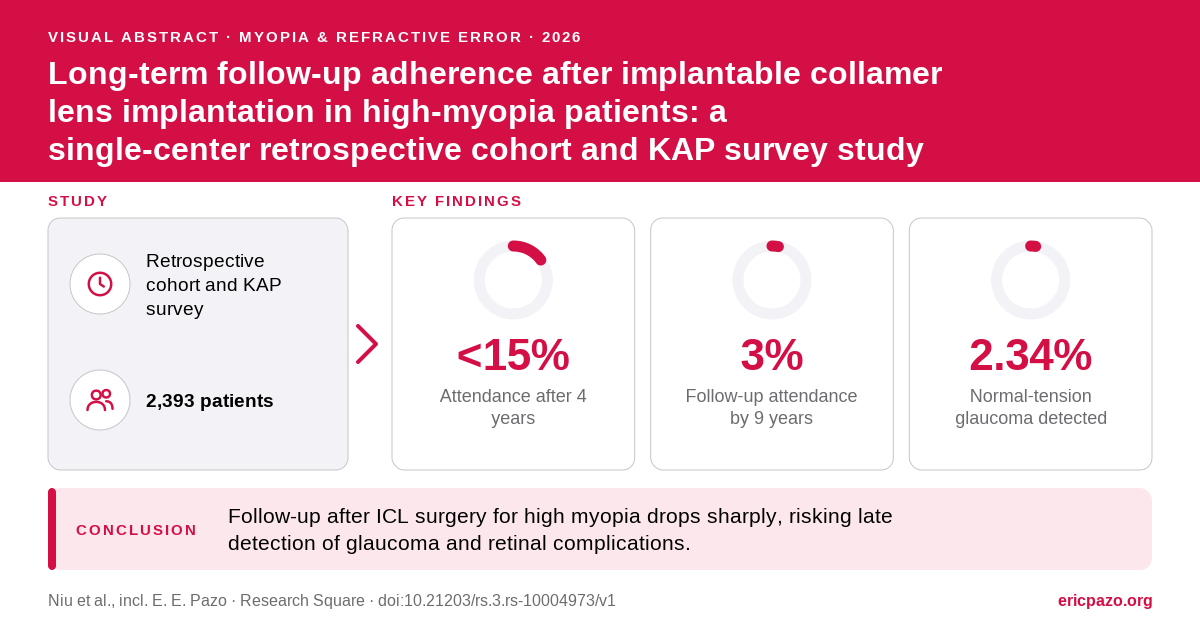
強度近視に対する ICL 手術後の経過観察は大きく減少し、緑内障や網膜合併症の発見が遅れるおそれがある。
- 研究デザイン
- 後ろ向きコホートと KAP 調査
- 対象
- 患者 2,393 人
- 4 年後の受診率
- <15%
- 9 年時点の経過観察受診率
- 3%
- 検出された正常眼圧緑内障
- 2.34%
抄録
要旨 背景 強度近視には、緑内障、網膜変性、周辺部網膜裂孔など視力を脅かす合併症のリスクがある。有水晶体眼内レンズ(PIOL)挿入術は屈折異常を効果的に矯正し良好な視機能をもたらすが、強度近視に伴う眼のリスクを減らすものではない。したがって、これらの患者における強度近視関連合併症を適時に発見するためには、定期的な長期経過観察が引き続き重要である。方法 本混合研究法による研究では、2016 年から 2023 年に単一の三次医療施設で V4c 有水晶体眼内コラマーレンズ(ICL)挿入術を受けた強度近視患者 2,393 人を対象とした。縦断的な経過観察記録のある 133 人のサブグループで長期経過観察の受診傾向を解析した。1 年を超える経過観察を終えた 128 人の別のサブグループでは、検出された眼合併症を評価した。術後患者を対象に知識・態度・行動(KAP)に関する横断調査を実施した。配布した 1,064 部の質問票のうち、174 件の有効回答を解析に含めた。経過観察の遵守に関連する因子を特定するためにロジスティック回帰を行った。結果 長期経過観察の受診率は時間とともに徐々に低下し、4 年後には 15% 未満、9 年時点では 3% となった。有効な KAP 質問票は計 174 件回収・解析され、有効回答率は 16.35%(配布 1,064 部)であった。主な障壁は、眼の健康に対する意識の欠如、症状がないこと、経過観察医療へのアクセスの制限であった。術後の経過観察検査では、正常眼圧緑内障(2.34%)や強度近視に伴う網膜病変(3.13%)などの眼合併症が検出された。注目すべきことに、確定した緑内障症例はすべて 40 歳以上の患者であった。強度近視患者では、正常な眼圧、正常な中心視力、非典型的な視神経乳頭形態、近視性乳頭周囲萎縮、薄い網膜が発見の遅れにつながる可能性がある。ロジスティック回帰では、知識が豊富であることと経過観察に前向きな態度が遵守の独立した保護因子であった。結論 ICL 挿入後の長期経過観察が不十分であると、強度近視関連の眼合併症の発見が遅れる可能性がある。これらの患者の早期発見を高め不可逆的な視力喪失を防ぐために、的を絞った健康教育、中年層および強度近視サブグループに対するリスク層別化した経過観察、医療アクセスの改善が急務である。
英語の原文抄録からの翻訳です(ライセンス:CC BY)。
原文の抄録を表示
Abstract Background High myopia carries the risk of sight-threatening complications, including glaucoma, retinal degeneration, and peripheral retinal breaks. Although phakic intraocular lens (PIOL) implantation surgery effectively corrects refractive error and provides good visual outcomes, it does not reduce the ocular risks associated with high myopia. Therefore, regular long-term follow-up remains important for the timely detection of high myopia–related complications in these patients. Methods This mixed-methods study included 2,393 patients with high myopia who underwent V4c implantable collamer lens (ICL) implantation between 2016 and 2023 at a single tertiary center. Long-term follow-up attendance trends were analyzed in a subgroup of 133 patients with available longitudinal follow-up records. A separate subgroup of 128 patients with more than 1 year of completed follow-up was assessed for detected ocular complications. A cross-sectional Knowledge–Attitude–Practice (KAP) survey was conducted among postoperative patients. Of 1,064 distributed questionnaires, 174 valid responses were included in the analysis. Logistic regression was performed to identify factors associated with follow-up adherence. Results Long-term follow-up attendance declined progressively over time, with rates falling below 15% after four years and to 3% by nine years. A total of 174 valid KAP questionnaires were collected and analyzed, with a valid response rate of 16.35% (1,064 questionnaires were distributed). Major barriers included a lack of eye healthcare awareness, absence of symptoms, and limited access to follow-up care. Ocular complications, including normal-tension glaucoma (2.34%) and retinal lesions associated with high myopia (3.13%), were detected during postoperative follow-up examinations. Notably, all confirmed glaucoma cases occurred in patients aged ≥ 40 years. In patients with high myopia, normal intraocular pressure, normal central visual acuity, atypical optic disc morphology, myopic peripapillary atrophy, and a thinner retina may contribute to delayed detection. Logistic regression showed that better knowledge and a positive attitude toward monitoring were independent protective factors for adherence. Conclusions Poor long-term follow-up after ICL implantation may lead to delayed detection of high myopia–related ocular complications. Targeted health education, risk-stratified monitoring for middle-aged and high myopia subgroups, and improved access to care are urgently needed to enhance early detection and prevent irreversible vision loss in these patients.
キーワード: implantable collamer lens; high myopia; phakic intraocular lens; normal-tension glaucoma; myopic retinal degeneration; patient education; middle-aged patients; retinal thickness
アクセス
引用方法
BibTeX を表示
@article{niu2026long,
  title = {{Long-term follow-up adherence after implantable collamer lens implantation in high-myopia patients: a single-center retrospective cohort and KAP survey study}},
  author = {Niu, Tongxin and Li, Xin and Liu, Ying and Li, Xin and Cao, Jingran and Pazo, Emmanuel Eric and Zhao, S Z and Jia, Zhe and Yang, Ruibo},
  journal = {Research Square},
  year = {2026},
  doi = {10.21203/rs.3.rs-10004973/v1},
  url = {https://doi.org/10.21203/rs.3.rs-10004973/v1},
}