
Prise en charge de la sécheresse oculaire post-LASIK par lumière pulsée intense associée au hyaluronate de sodium à 0.1 % et à un masque oculaire chauffant
Titre original : Management of Post-LASIK Dry Eye with Intense Pulsed Light in Combination with 0.1% Sodium Hyaluronate and Heated Eye Mask
Yi Wu, Ling Xu, Yilin Song, Qing Zhang, Guanghao Qin, Lanting Yang, Jinfei Ma, Christoph Palme, Jonathan Edward Moore, Emmanuel Eric Pazo, Wei He
 Ophthalmology and Therapy, 2021 · article · doi:10.1007/s40123-021-00418-2 · cité 35 fois · Accès libre (CC BY-NC)
Surface oculaire et sécheresse oculaireCataracte et chirurgie du segment antérieur
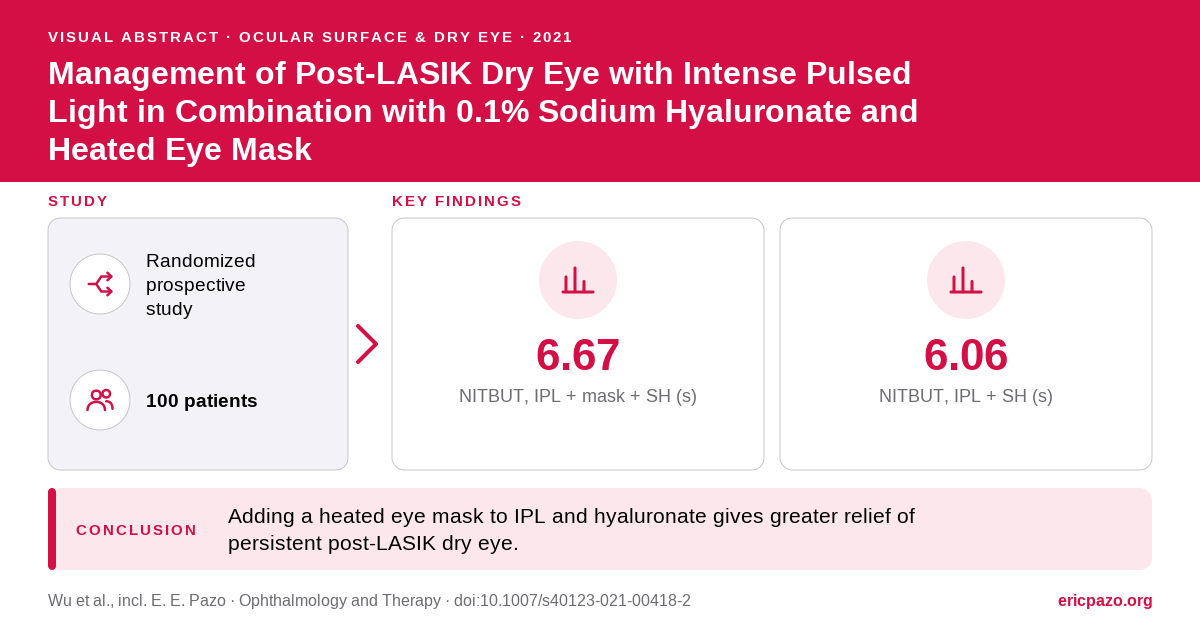
En bref
L'ajout d'un masque oculaire chauffant à la LPI et au hyaluronate soulage davantage la sécheresse oculaire persistante après LASIK.
- Type d'étude
- Étude prospective randomisée
- Échantillon
- 100 patients
- NITBUT, LPI + masque + SH (s)
- 6.67
- NITBUT, LPI + SH (s)
- 6.06
Résumé
INTRODUCTION : La kératomileusis in situ assistée par laser (LASIK) est l'un des traitements réfractifs les plus pratiqués. La sécheresse oculaire (SO) est fréquente après LASIK et peut être gênante en postopératoire. Des traitements comme la lumière pulsée intense (LPI), le hyaluronate de sodium (SH) et le masque oculaire chauffant (HEM) amélioreraient les signes et symptômes de la SO. OBJECTIF : Cette étude prospective visait à évaluer et comparer les effets de la LPI associée au SH à 0.1 % (groupe LPI, 50 yeux) et de la LPI associée au SH à 0.1 % et au HEM (groupe LPI +, 50 yeux) chez des participants atteints de SO persistante après LASIK. MÉTHODES : L'analyse finale a inclus 100 patients (100 yeux) opérés par LASIK pour myopie et souffrant depuis plus d'un an d'une SO modérée à sévère après LASIK. Les participants ont été répartis au hasard entre le groupe LPI (2 séances de LPI) et le groupe LPI + (2 séances de LPI et HEM quotidien pendant 4 semaines), les deux groupes poursuivant l'instillation quotidienne d'un collyre sans conservateur de SH à 0.1 % (HYLO-COMOD®). Le temps de rupture lacrymale non invasif (NITBUT), la couche lipidique du film lacrymal (TFLL), la hauteur du ménisque lacrymal inférieur (LTMH), la qualité des glandes de Meibomius (MGQ), l'expressibilité des glandes de Meibomius (MGEx), la coloration cornéenne à la fluorescéine (CFS), l'indice de la maladie de la surface oculaire (OSDI) et une enquête sur l'usage de larmes artificielles (ATU) ont été évalués à l'inclusion (BL) et aux suivis à 2 (F1) et 4 semaines (F2). RÉSULTATS : Après le protocole de traitement, tous les paramètres de sécheresse oculaire (SO) évalués dans cette étude se sont significativement améliorés (P < 0.05) dans les deux groupes à F2 par rapport à leurs mesures respectives à BL. La comparaison entre groupes à F2 a montré des différences significatives du NITBUT (LPI : 6.06 ± 0.59 contre LPI + : 6.67 ± 0.86, P < 0.001), de la TFLL (LPI : 1.90 ± 0.65 contre LPI + : 1.60 ± 0.64, P = 0.021), de la LTMH (LPI : 0.186 ± 0.053 contre 0.204 ± 0.034, P = 0.003), de la MGQ (LPI : 1.48 ± 0.54 contre LPI + : 1.26 ± 0.56, P = 0.026), de la MGEx (LPI : 1.62 ± 0.53 contre LPI + : 1.44 ± 0.50, P = 0.038) et de l'OSDI (LPI : 32.54 ± 6.85 contre LPI + : 29.76 ± 4.74, P = 0.001), tandis que le score CFS (LPI : 4.02 ± 0.65 contre LPI + : 3.96 ± 0.73, P = 0.652) et l'ATU (LPI : 1.88 ± 0.63 contre LPI + : 1.72 ± 0.50, P = 0.159) ne différaient pas significativement. CONCLUSION : Les signes et symptômes de la SO post-LASIK peuvent être améliorés en associant des traitements comme la LPI, le HEM et le SH à 0.1 %. L'augmentation de la TFLL obtenue par l'association LPI, SH à 0.1 % et HEM a eu un effet positif plus important sur les mesures subjectives et objectives de SO chez les participants atteints de SO persistante après LASIK.
Traduit du résumé original en anglais (licence : CC BY-NC).
Afficher le résumé original
INTRODUCTION: Laser in situ keratomelieusis (LASIK) is one of the most frequently performed refractive treatments. Dry eye (DE) is common in patients after LASIK and can be bothersome postoperatively. Therapies such as intense pulsed light (IPL), sodium hyaluronate (SH) and heated eye mask (HEM) have been reported to improve signs and symptoms of DE . AIM: The purpose of this prospective study was to evaluate and compare the effects of IPL and 0.1% SH (IPL group, 50 eyes) and IPL in combination with 0.1% SH and HEM (IPL + group, 50 eyes) in participants with persistent post-LASIK DE. METHODS: The final analysis included 100 patients (100 eyes) who had LASIK for myopic correction and had been experiencing moderate to severe DE following LASIK for over a year. Participants were randomly assigned to either the IPL group (2 IPL sessions) or IPL + group (2 IPL sessions and daily HEM for 4 weeks), and both groups continued the use of daily 0.1% SH (HYLO-COMOD®) preservative-free eye drops. Non-invasive tear break-up time (NITBUT), tear film lipid layer (TFLL), lower tear meniscus height (LTMH), meibomian gland quality (MGQ), meibomian gland expressibility (MGEx), corneal fluorescein staining (CFS), ocular surface disease index (OSDI) and artificial tear usage (ATU) survey were assessed at baseline (BL) and follow-up at 2 (F1) and 4 weeks (F2). RESULTS: Following the treatment protocol, all dry eye (DE) parameters assessed in this study improved significantly (P < 0.05) in both groups at F2 compared with their respective BL measurements. Inter-group comparison at F2 found significant differences in their NITBUT (IPL: 6.06 ± 0.59 vs. IPL +: 6.67 ± 0.86, P < 0.001), TFLL (IPL: 1.90 ± 0.65 vs. IPL +: 1.60 ± 0.64, P = 0.021), LTMH (IPL: 0.186 ± 0.053 vs. 0.204 ± 0.034, P = 0.003), MGQ (IPL: 1.48 ± 0.54 vs. IPL +: 1.26 ± 0.56, P = 0.026), MGEx (IPL: 1.62 ± 0.53 vs. IPL +: 1.44 ± 0.50, P = 0.038) and OSDI (IPL: 32.54 ± 6.85 vs. IPL +: 29.76 ± 4.74, P = 0.001), while CFS score (IPL: 4.02 ± 0.65 vs. IPL +: 3.96 ± 0.73, P = 0.652) and ATU (IPL: 1.88 ± 0.63 vs. IPL +: 1.72 ± 0.50, P = 0.159) showed no significant difference. CONCLUSION: Post-LASIK DE signs and symptoms can be improved by combining therapies such as IPL, HEM and 0.1% SH. Increased TFLL due to a combination of IPL, 0.1% SH and HEM had a greater positive impact on the subjective and objective DE measurements in participants with persistent post-LASIK DE.
Mots-clés : intense pulsed light; sodium hyaluronate; meibography; meibomian gland dysfunction; tear film break-up time; tear film lipid layer; corneal fluorescein staining; Ocular Surface Disease Index
Accès
Comment citer
Afficher le BibTeX
@article{wu2021management,
  title = {{Management of Post-LASIK Dry Eye with Intense Pulsed Light in Combination with 0.1% Sodium Hyaluronate and Heated Eye Mask}},
  author = {Wu, Yi and Xu, Ling and Song, Yilin and Zhang, Qing and Qin, Guanghao and Yang, Lanting and Ma, Jinfei and Palme, Christoph and Moore, Jonathan Edward and Pazo, Emmanuel Eric and He, Wei},
  journal = {Ophthalmology and Therapy},
  year = {2021},
  doi = {10.1007/s40123-021-00418-2},
  url = {https://doi.org/10.1007/s40123-021-00418-2},
}
Travaux liés
- Effets du remodelage épithélial cornéen sur l'asphéricité cornéenne après FS-LASIK et Trans-PRK : une étude prospective (2024)
- Lumière pulsée intense dans le traitement de la sécheresse oculaire réfractaire après LASIK (2020)
- Impact de l'orientation de l'astigmatisme cornéen préopératoire sur la réfraction postopératoire en équivalent sphérique après implantation d'une lentille intraoculaire (2018)
- Seuil d'astigmatisme postopératoire compatible avec la satisfaction des patients après échange du cristallin à visée réfractive et implantation d'une lentille intraoculaire multifocale (2016)
- Analyse de l'influence de l'espace au bord du volet sur la régénération des nerfs cornéens après LASIK assisté par laser femtoseconde (2026)