
强脉冲光联合 0.1% 玻璃酸钠及热敷眼罩治疗 LASIK 术后干眼
原文标题: Management of Post-LASIK Dry Eye with Intense Pulsed Light in Combination with 0.1% Sodium Hyaluronate and Heated Eye Mask
Yi Wu, Ling Xu, Yilin Song, Qing Zhang, Guanghao Qin, Lanting Yang, Jinfei Ma, Christoph Palme, Jonathan Edward Moore, Emmanuel Eric Pazo, Wei He
 Ophthalmology and Therapy, 2021 · 期刊论文 · doi:10.1007/s40123-021-00418-2 · 被引 35 次 · 开放获取(CC BY-NC)
要点速览
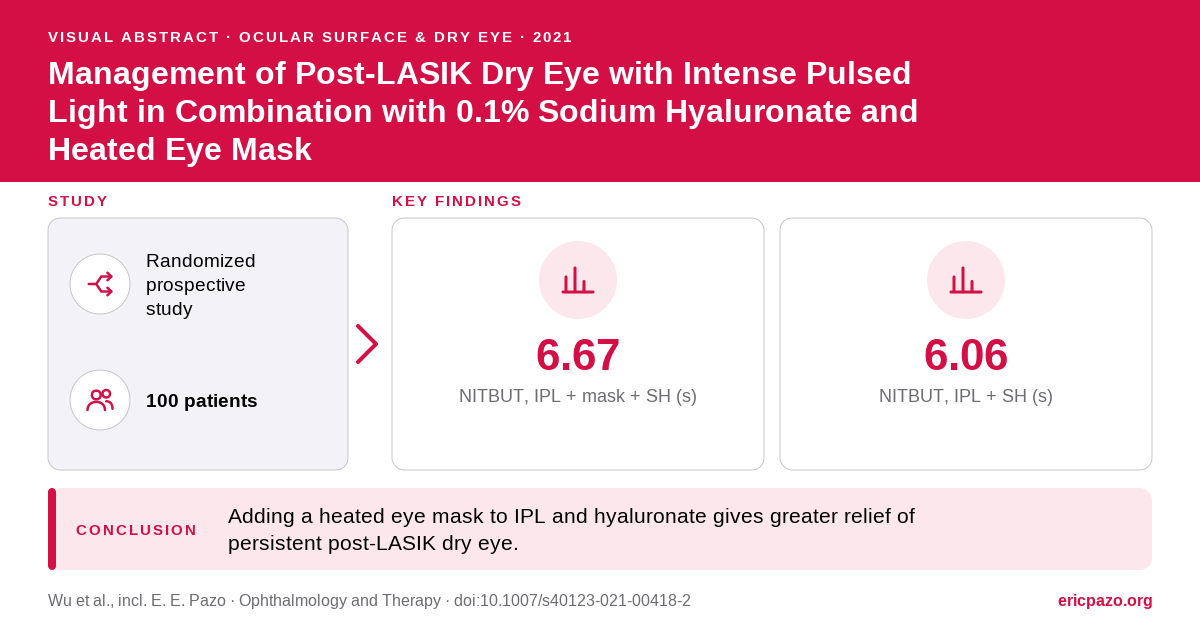
在强脉冲光和玻璃酸钠基础上加用热敷眼罩,可更好地缓解持续性 LASIK 术后干眼。
- 研究设计
- 随机前瞻性研究
- 样本
- 100 例患者
- NITBUT(IPL + 眼罩 + SH,秒)
- 6.67
- NITBUT(IPL + SH,秒)
- 6.06
摘要
引言:准分子激光原位角膜磨镶术(LASIK)是最常开展的屈光手术之一。干眼(DE)在 LASIK 术后患者中很常见,可能给术后带来困扰。已有报道称,强脉冲光(IPL)、玻璃酸钠(SH)和热敷眼罩(HEM)等疗法可改善 DE 的体征和症状。目的:这项前瞻性研究旨在评估并比较 IPL 联合 0.1% SH(IPL 组,50 只眼)与 IPL 联合 0.1% SH 及 HEM(IPL + 组,50 只眼)对持续性 LASIK 术后 DE 参与者的效果。方法:最终分析纳入 100 例患者(100 只眼),均因近视矫正接受 LASIK,且术后中重度 DE 已持续一年以上。参与者被随机分配至 IPL 组(2 次 IPL 治疗)或 IPL + 组(2 次 IPL 治疗并每日使用 HEM,持续 4 周),两组均继续每日使用 0.1% SH(HYLO-COMOD®)无防腐剂滴眼液。在基线(BL)及第 2 周(F1)和第 4 周(F2)随访时评估非侵入性泪膜破裂时间(NITBUT)、泪膜脂质层(TFLL)、下泪河高度(LTMH)、睑板腺质量(MGQ)、睑板腺可挤压性(MGEx)、角膜荧光素染色(CFS)、眼表疾病指数(OSDI)以及人工泪液使用(ATU)调查。结果:按治疗方案治疗后,两组在 F2 时本研究评估的所有干眼(DE)参数均较各自 BL 测量值显著改善(P < 0.05)。F2 时组间比较发现,NITBUT(IPL:6.06 ± 0.59 vs. IPL +:6.67 ± 0.86,P < 0.001)、TFLL(IPL:1.90 ± 0.65 vs. IPL +:1.60 ± 0.64,P = 0.021)、LTMH(IPL:0.186 ± 0.053 vs. 0.204 ± 0.034,P = 0.003)、MGQ(IPL:1.48 ± 0.54 vs. IPL +:1.26 ± 0.56,P = 0.026)、MGEx(IPL:1.62 ± 0.53 vs. IPL +:1.44 ± 0.50,P = 0.038)和 OSDI(IPL:32.54 ± 6.85 vs. IPL +:29.76 ± 4.74,P = 0.001)存在显著差异,而 CFS 评分(IPL:4.02 ± 0.65 vs. IPL +:3.96 ± 0.73,P = 0.652)和 ATU(IPL:1.88 ± 0.63 vs. IPL +:1.72 ± 0.50,P = 0.159)无显著差异。结论:联合应用 IPL、HEM 和 0.1% SH 等疗法可改善 LASIK 术后 DE 的体征和症状。IPL、0.1% SH 与 HEM 联合使用使 TFLL 增加,对持续性 LASIK 术后 DE 参与者的主观和客观 DE 指标产生了更大的积极影响。
译自英文原文摘要(许可协议:CC BY-NC)。
显示英文原文摘要
INTRODUCTION: Laser in situ keratomelieusis (LASIK) is one of the most frequently performed refractive treatments. Dry eye (DE) is common in patients after LASIK and can be bothersome postoperatively. Therapies such as intense pulsed light (IPL), sodium hyaluronate (SH) and heated eye mask (HEM) have been reported to improve signs and symptoms of DE . AIM: The purpose of this prospective study was to evaluate and compare the effects of IPL and 0.1% SH (IPL group, 50 eyes) and IPL in combination with 0.1% SH and HEM (IPL + group, 50 eyes) in participants with persistent post-LASIK DE. METHODS: The final analysis included 100 patients (100 eyes) who had LASIK for myopic correction and had been experiencing moderate to severe DE following LASIK for over a year. Participants were randomly assigned to either the IPL group (2 IPL sessions) or IPL + group (2 IPL sessions and daily HEM for 4 weeks), and both groups continued the use of daily 0.1% SH (HYLO-COMOD®) preservative-free eye drops. Non-invasive tear break-up time (NITBUT), tear film lipid layer (TFLL), lower tear meniscus height (LTMH), meibomian gland quality (MGQ), meibomian gland expressibility (MGEx), corneal fluorescein staining (CFS), ocular surface disease index (OSDI) and artificial tear usage (ATU) survey were assessed at baseline (BL) and follow-up at 2 (F1) and 4 weeks (F2). RESULTS: Following the treatment protocol, all dry eye (DE) parameters assessed in this study improved significantly (P < 0.05) in both groups at F2 compared with their respective BL measurements. Inter-group comparison at F2 found significant differences in their NITBUT (IPL: 6.06 ± 0.59 vs. IPL +: 6.67 ± 0.86, P < 0.001), TFLL (IPL: 1.90 ± 0.65 vs. IPL +: 1.60 ± 0.64, P = 0.021), LTMH (IPL: 0.186 ± 0.053 vs. 0.204 ± 0.034, P = 0.003), MGQ (IPL: 1.48 ± 0.54 vs. IPL +: 1.26 ± 0.56, P = 0.026), MGEx (IPL: 1.62 ± 0.53 vs. IPL +: 1.44 ± 0.50, P = 0.038) and OSDI (IPL: 32.54 ± 6.85 vs. IPL +: 29.76 ± 4.74, P = 0.001), while CFS score (IPL: 4.02 ± 0.65 vs. IPL +: 3.96 ± 0.73, P = 0.652) and ATU (IPL: 1.88 ± 0.63 vs. IPL +: 1.72 ± 0.50, P = 0.159) showed no significant difference. CONCLUSION: Post-LASIK DE signs and symptoms can be improved by combining therapies such as IPL, HEM and 0.1% SH. Increased TFLL due to a combination of IPL, 0.1% SH and HEM had a greater positive impact on the subjective and objective DE measurements in participants with persistent post-LASIK DE.
关键词: intense pulsed light; sodium hyaluronate; meibography; meibomian gland dysfunction; tear film break-up time; tear film lipid layer; corneal fluorescein staining; Ocular Surface Disease Index
获取全文
引用格式
显示 BibTeX
@article{wu2021management,
  title = {{Management of Post-LASIK Dry Eye with Intense Pulsed Light in Combination with 0.1% Sodium Hyaluronate and Heated Eye Mask}},
  author = {Wu, Yi and Xu, Ling and Song, Yilin and Zhang, Qing and Qin, Guanghao and Yang, Lanting and Ma, Jinfei and Palme, Christoph and Moore, Jonathan Edward and Pazo, Emmanuel Eric and He, Wei},
  journal = {Ophthalmology and Therapy},
  year = {2021},
  doi = {10.1007/s40123-021-00418-2},
  url = {https://doi.org/10.1007/s40123-021-00418-2},
}