
強パルス光と 0.1% ヒアルロン酸ナトリウムおよび温熱アイマスクの併用による LASIK 後ドライアイの管理
原題: Management of Post-LASIK Dry Eye with Intense Pulsed Light in Combination with 0.1% Sodium Hyaluronate and Heated Eye Mask
Yi Wu, Ling Xu, Yilin Song, Qing Zhang, Guanghao Qin, Lanting Yang, Jinfei Ma, Christoph Palme, Jonathan Edward Moore, Emmanuel Eric Pazo, Wei He
 Ophthalmology and Therapy, 2021 · 原著論文 · doi:10.1007/s40123-021-00418-2 · 被引用 35 回 · オープンアクセス(CC BY-NC)
要点
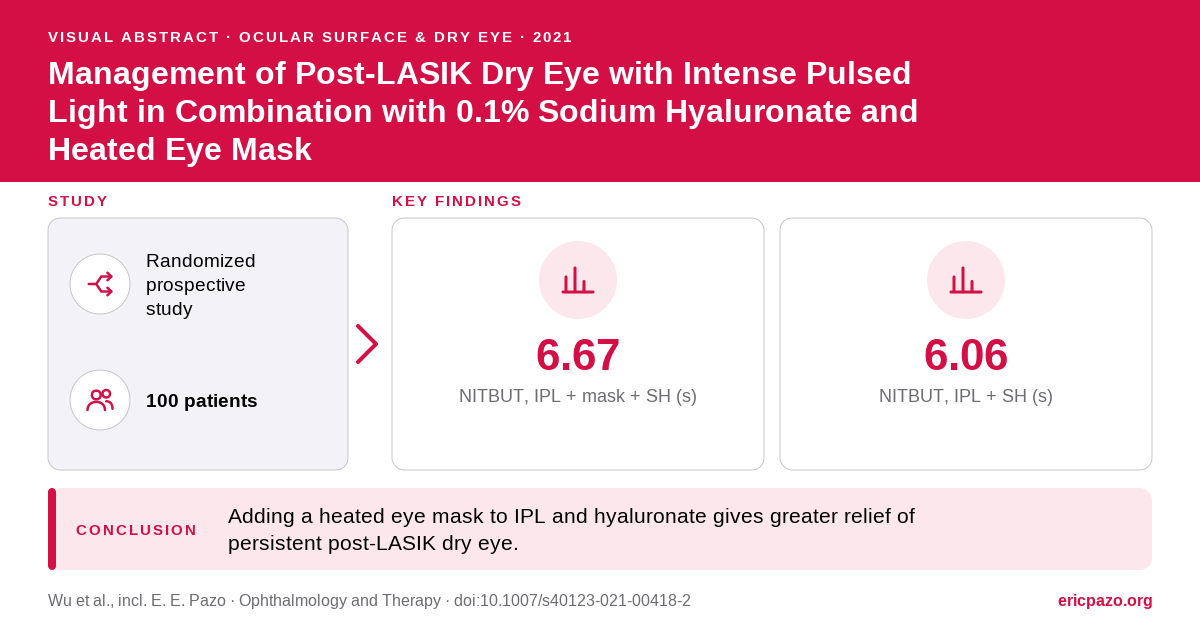
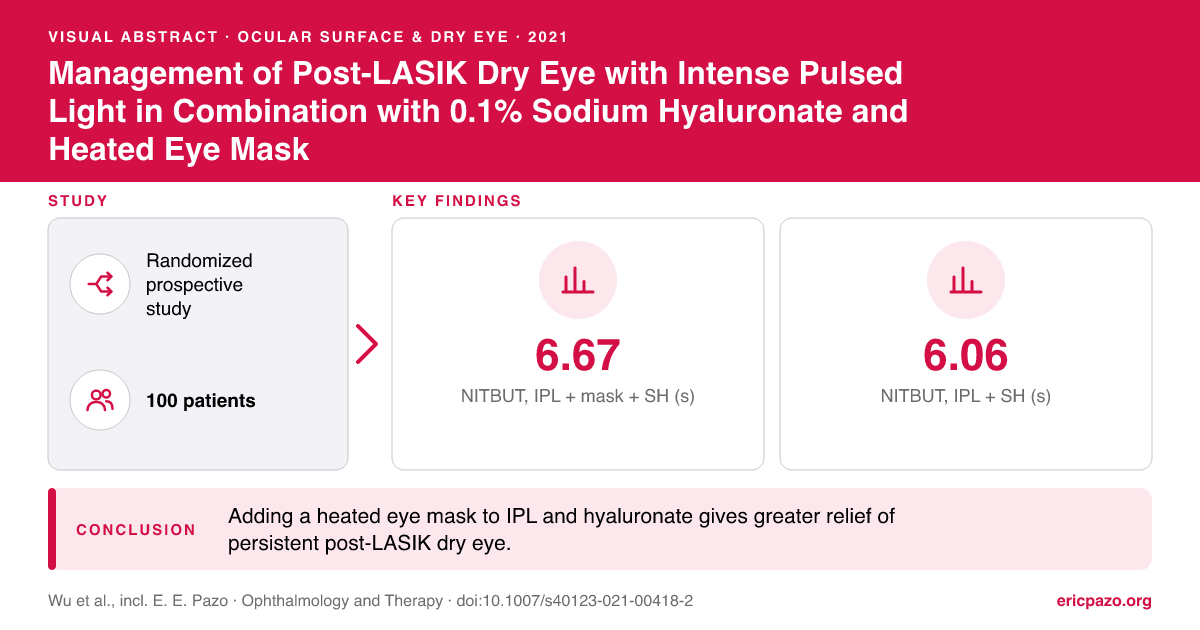
IPL とヒアルロン酸に温熱アイマスクを加えると、遷延する LASIK 後ドライアイがより軽減する。
- 研究デザイン
- ランダム化前向き研究
- 対象
- 患者 100 人
- NITBUT(IPL + マスク + SH、秒)
- 6.67
- NITBUT(IPL + SH、秒)
- 6.06
抄録
はじめに:レーザー角膜内切削形成術(LASIK)は最も多く行われている屈折矯正手術の一つである。LASIK 後の患者にはドライアイ(DE)がよくみられ、術後に煩わしいことがある。強パルス光(IPL)、ヒアルロン酸ナトリウム(SH)、温熱アイマスク(HEM)などの治療は、DE の徴候と症状を改善することが報告されている。目的:本前向き研究の目的は、遷延する LASIK 後 DE の参加者において、IPL と 0.1% SH の併用(IPL 群、50 眼)と、IPL と 0.1% SH および HEM の併用(IPL + 群、50 眼)の効果を評価・比較することであった。方法:最終解析には、近視矯正のために LASIK を受け、LASIK 後の中等度から重度の DE が 1 年以上続いている患者 100 人(100 眼)を含めた。参加者を IPL 群(IPL 2 回)または IPL + 群(IPL 2 回と 4 週間の毎日の HEM)に無作為に割り付け、両群とも防腐剤無添加の 0.1% SH(HYLO-COMOD®)点眼を毎日継続した。非侵襲的涙液層破壊時間(NITBUT)、涙液層脂質層(TFLL)、下方涙液メニスカス高(LTMH)、マイボーム腺の質(MGQ)、マイボーム腺圧出性(MGEx)、角膜フルオレセイン染色(CFS)、Ocular Surface Disease Index(OSDI)、人工涙液使用(ATU)調査を、ベースライン(BL)と 2 週(F1)・4 週(F2)の経過観察時に評価した。結果:治療プロトコル後、F2 では両群とも本研究で評価したすべてのドライアイ(DE)パラメータがそれぞれの BL 測定値より有意に改善した(P < 0.05)。F2 での群間比較では、NITBUT(IPL:6.06 ± 0.59 対 IPL +:6.67 ± 0.86、P < 0.001)、TFLL(IPL:1.90 ± 0.65 対 IPL +:1.60 ± 0.64、P = 0.021)、LTMH(IPL:0.186 ± 0.053 対 0.204 ± 0.034、P = 0.003)、MGQ(IPL:1.48 ± 0.54 対 IPL +:1.26 ± 0.56、P = 0.026)、MGEx(IPL:1.62 ± 0.53 対 IPL +:1.44 ± 0.50、P = 0.038)、OSDI(IPL:32.54 ± 6.85 対 IPL +:29.76 ± 4.74、P = 0.001)に有意差がみられたが、CFS スコア(IPL:4.02 ± 0.65 対 IPL +:3.96 ± 0.73、P = 0.652)と ATU(IPL:1.88 ± 0.63 対 IPL +:1.72 ± 0.50、P = 0.159)には有意差がなかった。結論:IPL、HEM、0.1% SH などの治療を組み合わせることで、LASIK 後 DE の徴候と症状を改善できる。IPL、0.1% SH、HEM の併用による TFLL の増加は、遷延する LASIK 後 DE の参加者の主観的・客観的 DE 指標により大きな好影響を及ぼした。
英語の原文抄録からの翻訳です(ライセンス:CC BY-NC)。
原文の抄録を表示
INTRODUCTION: Laser in situ keratomelieusis (LASIK) is one of the most frequently performed refractive treatments. Dry eye (DE) is common in patients after LASIK and can be bothersome postoperatively. Therapies such as intense pulsed light (IPL), sodium hyaluronate (SH) and heated eye mask (HEM) have been reported to improve signs and symptoms of DE . AIM: The purpose of this prospective study was to evaluate and compare the effects of IPL and 0.1% SH (IPL group, 50 eyes) and IPL in combination with 0.1% SH and HEM (IPL + group, 50 eyes) in participants with persistent post-LASIK DE. METHODS: The final analysis included 100 patients (100 eyes) who had LASIK for myopic correction and had been experiencing moderate to severe DE following LASIK for over a year. Participants were randomly assigned to either the IPL group (2 IPL sessions) or IPL + group (2 IPL sessions and daily HEM for 4 weeks), and both groups continued the use of daily 0.1% SH (HYLO-COMOD®) preservative-free eye drops. Non-invasive tear break-up time (NITBUT), tear film lipid layer (TFLL), lower tear meniscus height (LTMH), meibomian gland quality (MGQ), meibomian gland expressibility (MGEx), corneal fluorescein staining (CFS), ocular surface disease index (OSDI) and artificial tear usage (ATU) survey were assessed at baseline (BL) and follow-up at 2 (F1) and 4 weeks (F2). RESULTS: Following the treatment protocol, all dry eye (DE) parameters assessed in this study improved significantly (P < 0.05) in both groups at F2 compared with their respective BL measurements. Inter-group comparison at F2 found significant differences in their NITBUT (IPL: 6.06 ± 0.59 vs. IPL +: 6.67 ± 0.86, P < 0.001), TFLL (IPL: 1.90 ± 0.65 vs. IPL +: 1.60 ± 0.64, P = 0.021), LTMH (IPL: 0.186 ± 0.053 vs. 0.204 ± 0.034, P = 0.003), MGQ (IPL: 1.48 ± 0.54 vs. IPL +: 1.26 ± 0.56, P = 0.026), MGEx (IPL: 1.62 ± 0.53 vs. IPL +: 1.44 ± 0.50, P = 0.038) and OSDI (IPL: 32.54 ± 6.85 vs. IPL +: 29.76 ± 4.74, P = 0.001), while CFS score (IPL: 4.02 ± 0.65 vs. IPL +: 3.96 ± 0.73, P = 0.652) and ATU (IPL: 1.88 ± 0.63 vs. IPL +: 1.72 ± 0.50, P = 0.159) showed no significant difference. CONCLUSION: Post-LASIK DE signs and symptoms can be improved by combining therapies such as IPL, HEM and 0.1% SH. Increased TFLL due to a combination of IPL, 0.1% SH and HEM had a greater positive impact on the subjective and objective DE measurements in participants with persistent post-LASIK DE.
キーワード: intense pulsed light; sodium hyaluronate; meibography; meibomian gland dysfunction; tear film break-up time; tear film lipid layer; corneal fluorescein staining; Ocular Surface Disease Index
アクセス
引用方法
BibTeX を表示
@article{wu2021management,
  title = {{Management of Post-LASIK Dry Eye with Intense Pulsed Light in Combination with 0.1% Sodium Hyaluronate and Heated Eye Mask}},
  author = {Wu, Yi and Xu, Ling and Song, Yilin and Zhang, Qing and Qin, Guanghao and Yang, Lanting and Ma, Jinfei and Palme, Christoph and Moore, Jonathan Edward and Pazo, Emmanuel Eric and He, Wei},
  journal = {Ophthalmology and Therapy},
  year = {2021},
  doi = {10.1007/s40123-021-00418-2},
  url = {https://doi.org/10.1007/s40123-021-00418-2},
}