
Impact de l'orientation de l'astigmatisme cornéen préopératoire sur la réfraction postopératoire en équivalent sphérique après implantation d'une lentille intraoculaire
Titre original : Investigating the impact of preoperative corneal astigmatism orientation on the postoperative spherical equivalent refraction following intraocular lens implantation
Richard N. McNeely, Salissou Moutari, Emmanuel Eric Pazo, Jonathan Edward Moore
 Eye and Vision, 2018 · article · doi:10.1186/s40662-018-0103-4 · cité 3 fois · Accès libre (CC BY)
Surface oculaire et sécheresse oculaireCataracte et chirurgie du segment antérieur
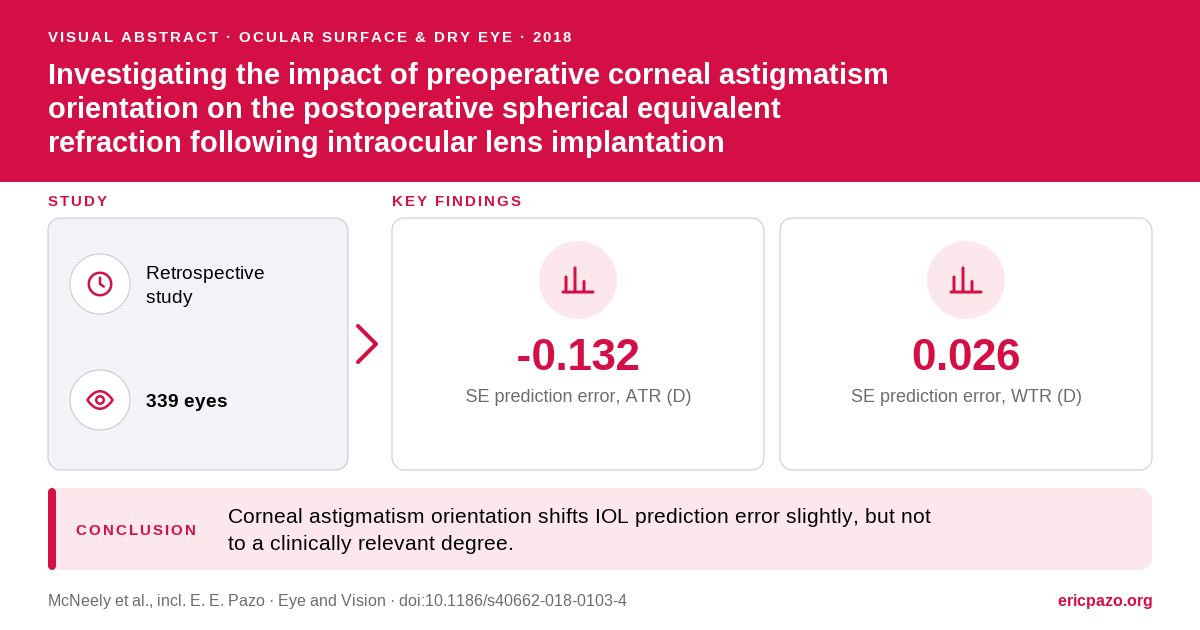
En bref
L'orientation de l'astigmatisme cornéen modifie légèrement l'erreur de prédiction de l'implant, mais pas de façon cliniquement pertinente.
- Type d'étude
- Étude rétrospective
- Échantillon
- 339 yeux
- Erreur de prédiction de l'ES, inverse (D)
- -0.132
- Erreur de prédiction de l'ES, direct (D)
- 0.026
Résumé
CONTEXTE : Étudier l'impact de l'orientation de l'astigmatisme cornéen préopératoire sur l'atteinte de la réfraction cible postopératoire après implantation d'une lentille intraoculaire (LIO) monofocale. MÉTHODES : Cette étude a inclus 339 yeux ayant subi sans complication une chirurgie de la cataracte ou un échange du cristallin à visée réfractive (RLE), suivi de l'implantation d'une LIO monofocale. Les yeux ont d'abord été classés selon la longueur axiale, puis selon l'orientation de l'astigmatisme cornéen antérieur préopératoire. Le groupe 1 présentait un astigmatisme cornéen antérieur inverse (ATR), le groupe 2 un astigmatisme direct (WTR) et le groupe 3 un astigmatisme oblique (OB). L'astigmatisme cornéen préopératoire a été déterminé avec l'IOLMaster (Carl Zeiss Meditec AG). Une réfraction postopératoire a été réalisée pour tous les yeux, et les résultats ont été calculés et comparés par groupe. RÉSULTATS : Dans les yeux de longueur axiale supérieure à 22.0 mm et inférieure à 25.0 mm, l'amplitude de l'astigmatisme cornéen préopératoire différait significativement entre les groupes 2 et 3, avec 0.827 ± 0.376 D dans le groupe 2 et 0.677 ± 0.387 D dans le groupe 3. L'erreur moyenne de prédiction de l'équivalent sphérique (ES) postopératoire était de - 0.132 ± 0.475 D dans le groupe 1, 0.026 ± 0.497 D dans le groupe 2 et - 0.130 ± 0.477 D dans le groupe 3. La différence entre les groupes 1 et 2 était significative. Dans les yeux de longueur axiale inférieure ou égale à 22.0 mm et supérieure ou égale à 25.0 mm, il n'y avait pas de différence significative d'amplitude de l'astigmatisme cornéen préopératoire ni d'erreur de prédiction de l'ES postopératoire entre les groupes d'orientation. CONCLUSIONS : L'orientation de l'astigmatisme cornéen antérieur préopératoire a significativement influencé l'erreur de prédiction biométrique postopératoire dans les yeux présentant un astigmatisme de 1.75 D ou moins et une longueur axiale comprise entre 22.0 mm et 25.0 mm. Ces résultats n'étaient toutefois pas cliniquement significatifs.
Traduit du résumé original en anglais (licence : CC BY).
Afficher le résumé original
BACKGROUND: To investigate the impact of the orientation of preoperative corneal astigmatism on achieving the postoperative target refraction following monofocal intraocular lens (IOL) implantation. METHODS: This study enrolled 339 eyes who had uneventful cataract surgery or refractive lens exchange (RLE) with subsequent monofocal IOL implantation. Eyes were initially categorized dependent upon axial length and then on the orientation of preoperative anterior corneal astigmatism. Group 1 had against-the-rule (ATR) anterior corneal astigmatism, group 2 had with-the-rule (WTR) anterior corneal astigmatism, and group 3 had oblique (OB) anterior corneal astigmatism. The preoperative corneal astigmatism was determined by the IOLMaster (Carl Zeiss Meditec AG). Postoperative refraction was completed for all eyes, and the results were calculated and compared for the separate groups. RESULTS: In eyes with axial lengths greater than 22.0 mm and less than 25.0 mm there was a significant difference between the magnitude of preoperative corneal astigmatism between groups 2 and 3 with 0.827 ± 0.376 D in group 2, and 0.677 ± 0.387 D in group 3. The mean postoperative spherical equivalent (SE) prediction error was - 0.132 ± 0.475 D in group 1, 0.026 ± 0.497 D in group 2, and - 0.130 ± 0.477 D in group 3. There was a significant difference between groups 1 and 2. There was no significant difference in the magnitude of preoperative corneal astigmatism and postoperative SE prediction error between the anterior corneal astigmatism orientation groups in eyes with axial lengths of less than or equal to 22.0 mm and greater than or equal to 25.0 mm. CONCLUSIONS: The orientation of preoperative anterior corneal astigmatism significantly affected the postoperative biometry prediction error in eyes with astigmatism of 1.75 D or less in eyes with the axial length between 22.0 mm and 25.0 mm. However, the results were not clinically significant.
Mots-clés : monofocal intraocular lens; refractive lens exchange; cataract surgery; spherical equivalent refraction; axial length; against-the-rule astigmatism; with-the-rule astigmatism; oblique astigmatism
Accès
Comment citer
Afficher le BibTeX
@article{mcneely2018investigating,
  title = {{Investigating the impact of preoperative corneal astigmatism orientation on the postoperative spherical equivalent refraction following intraocular lens implantation}},
  author = {McNeely, Richard N. and Moutari, Salissou and Pazo, Emmanuel Eric and Moore, Jonathan Edward},
  journal = {Eye and Vision},
  year = {2018},
  doi = {10.1186/s40662-018-0103-4},
  url = {https://doi.org/10.1186/s40662-018-0103-4},
}
Travaux liés
- Effets du remodelage épithélial cornéen sur l'asphéricité cornéenne après FS-LASIK et Trans-PRK : une étude prospective (2024)
- Prise en charge de la sécheresse oculaire post-LASIK par lumière pulsée intense associée au hyaluronate de sodium à 0.1 % et à un masque oculaire chauffant (2021)
- Lumière pulsée intense dans le traitement de la sécheresse oculaire réfractaire après LASIK (2020)
- Seuil d'astigmatisme postopératoire compatible avec la satisfaction des patients après échange du cristallin à visée réfractive et implantation d'une lentille intraoculaire multifocale (2016)
- Analyse de l'influence de l'espace au bord du volet sur la régénération des nerfs cornéens après LASIK assisté par laser femtoseconde (2026)