
Lumière pulsée intense dans le traitement de la sécheresse oculaire réfractaire après LASIK
Titre original : Intense Pulse Light for Treating Post-LASIK Refractory Dry Eye
Emmanuel Eric Pazo, He Huang, Qing-Xia Fan, Can Zhang, Yue You, Lanting Yang, Ling Xu, Jonathan Edward Moore, Wei He
 Photobiomodulation Photomedicine and Laser Surgery, 2020 · article · doi:10.1089/photob.2020.4931 · cité 42 fois
Surface oculaire et sécheresse oculaireCataracte et chirurgie du segment antérieur
En bref
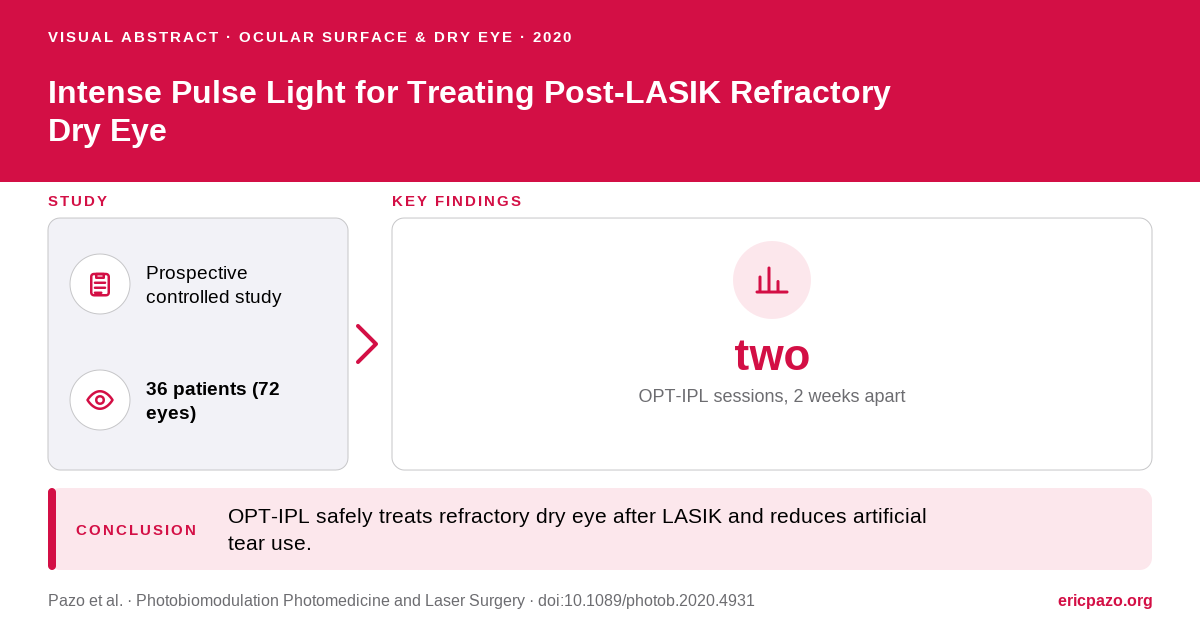
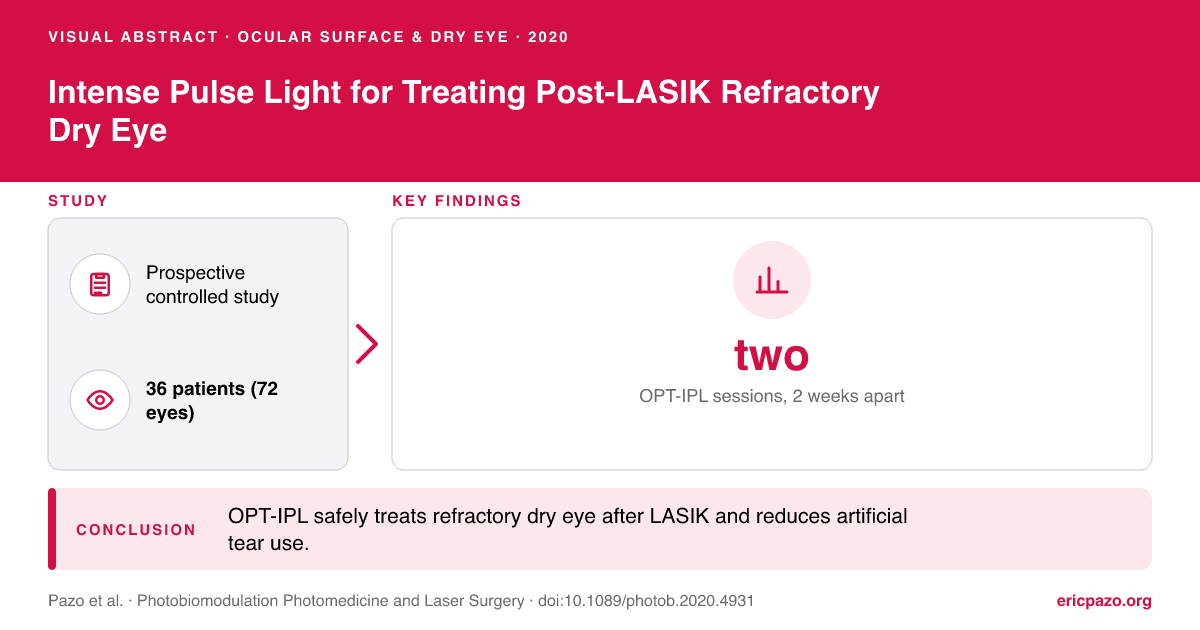
L'OPT-IPL traite sans danger la sécheresse oculaire réfractaire après LASIK et réduit l'usage de larmes artificielles.
- Type d'étude
- Étude prospective contrôlée
- Échantillon
- 36 patients (72 yeux)
- Séances d'OPT-IPL, à 2 semaines d'intervalle
- two
Résumé
Ce résumé est affiché dans sa langue d'origine, l'anglais, car l'article n'est pas publié sous une licence ouverte autorisant les traductions.
Objective: Optimal pulse technology-intense pulse light (OPT-IPL) treatment on patients with post-LASIK refractory dry eye (DE). Background: The prevalence of dry eye disease is common and can lead to ocular discomfort, reduced visual acuity, lowered quality of vision and life. Materials and methods: A prospective study was conducted on 72 eyes of 36 patients (treatment group, n = 42 eyes; control group, n = 30 eyes) who had previously undergone myopic LASIK correction with subsequent refractory DE. All eyes fulfilled the Japanese DE criteria and had not responded to conventional DE treatment. The treatment group underwent two OPT-IPL treatment sessions at 2-week intervals, while the control group received no treatment. Best-corrected visual acuity (BCVA), ocular surface disease index (OSDI), noninvasive breakup time (NITBUT), tear film lipid layer (TFLL) quality, corneal fluorescein staining, meibum gland (MG), endothelial cell count (ECC), and intraocular pressure (IOP) were assessed at baseline (D0), day-14 (D14) and day-28 (D28) after OPT-IPL treatment. Results: The mean age of treatment group and control group was 30.48 ± 5.16 years (12 females, 57%) and 31.00 ± 4.33 years (8 females, 53%), respectively. Treatment group had clinically and statistically significant improvement in NITBUT and was observed at D14 ( p < 0.001) and D28 ( p < 0.001). OSDI, TFLL score, and MG quality and expressibility improved significantly ( p < 0.05) at D28, whereas BCVA, ECC, and IOP showed no significant changes at D14 and D28 between the groups. Conclusions: Our results suggest that post-LASIK refractory DE is safely treated with OPT-IPL treatment. OPT-IPL treatment reduced the severity of symptoms and improved the overall tear film stability in patients with severe refractory DE post-LASIK surgery. In addition, the frequency of artificial tears usage was significantly less and can be attributed to the reduction in OSDI scores due to improved TFLL and tear film stability.
Mots-clés : refractory dry eye; myopic LASIK; tear film stability; tear film lipid layer; Ocular Surface Disease Index; corneal fluorescein staining; endothelial cell count; artificial tears
Accès
Comment citer
Afficher le BibTeX
@article{pazo2020intense,
  title = {{Intense Pulse Light for Treating Post-LASIK Refractory Dry Eye}},
  author = {Pazo, Emmanuel Eric and Huang, He and Fan, Qing-Xia and Zhang, Can and You, Yue and Yang, Lanting and Xu, Ling and Moore, Jonathan Edward and He, Wei},
  journal = {Photobiomodulation Photomedicine and Laser Surgery},
  year = {2020},
  doi = {10.1089/photob.2020.4931},
  url = {https://doi.org/10.1089/photob.2020.4931},
}
Travaux liés
- Effets du remodelage épithélial cornéen sur l'asphéricité cornéenne après FS-LASIK et Trans-PRK : une étude prospective (2024)
- Prise en charge de la sécheresse oculaire post-LASIK par lumière pulsée intense associée au hyaluronate de sodium à 0.1 % et à un masque oculaire chauffant (2021)
- Impact de l'orientation de l'astigmatisme cornéen préopératoire sur la réfraction postopératoire en équivalent sphérique après implantation d'une lentille intraoculaire (2018)
- Seuil d'astigmatisme postopératoire compatible avec la satisfaction des patients après échange du cristallin à visée réfractive et implantation d'une lentille intraoculaire multifocale (2016)
- Analyse de l'influence de l'espace au bord du volet sur la régénération des nerfs cornéens après LASIK assisté par laser femtoseconde (2026)