
Effets du remodelage épithélial cornéen sur l'asphéricité cornéenne après FS-LASIK et Trans-PRK : une étude prospective
Titre original : Effects of corneal epithelial remodeling on corneal asphericity after FS-LASIK and Trans-PRK: A prospective study
Mingyu Xu, Fan Yang, Emmanuel Eric Pazo, Qiwei Li, Zheng Kun Yang, Yue Huang, Shaozhen Zhao
 Indian Journal of Ophthalmology, 2024 · article · doi:10.4103/ijo.ijo_623_24 · cité 11 fois · Accès libre (CC BY-NC-SA)
Cataracte et chirurgie du segment antérieurSurface oculaire et sécheresse oculaire
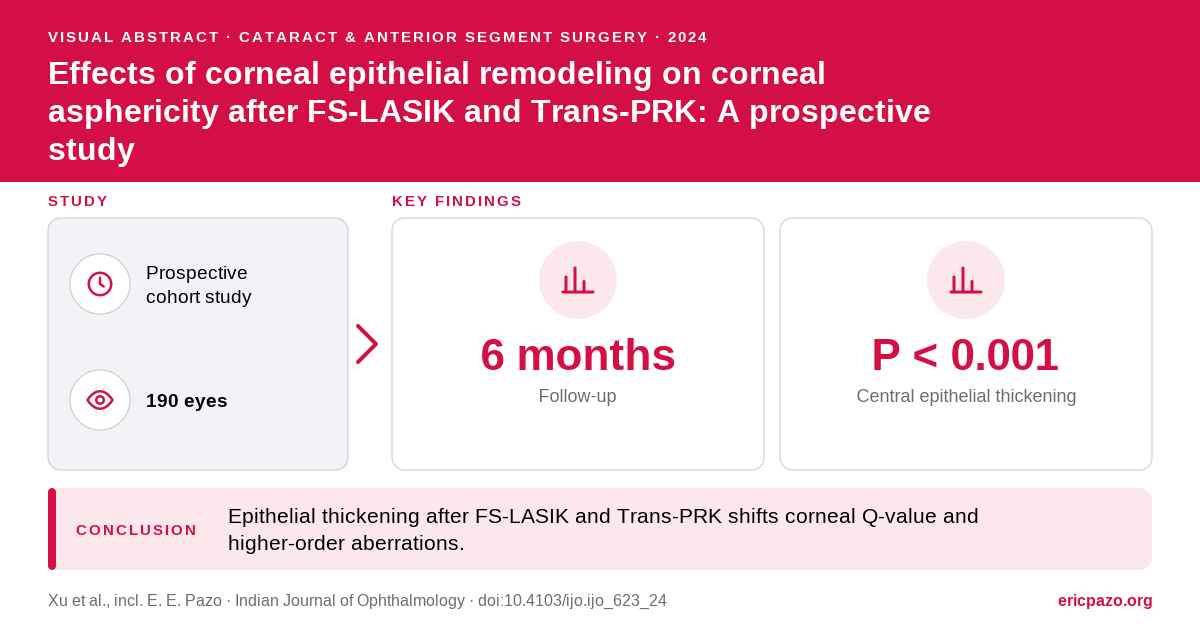
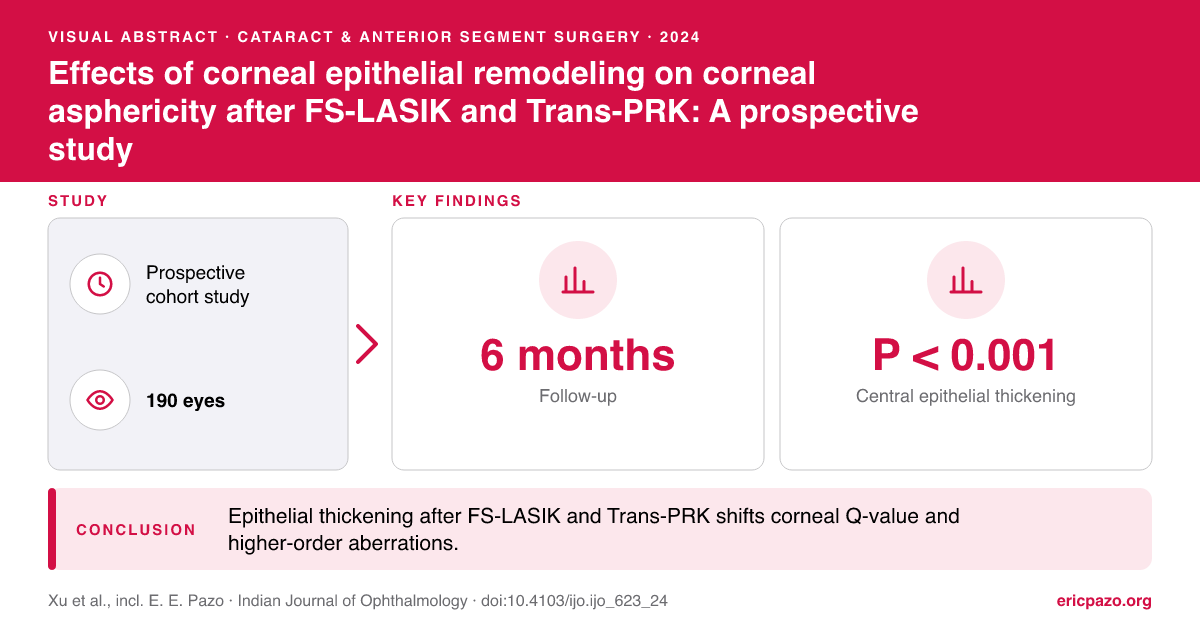
En bref
L'épaississement épithélial après FS-LASIK et Trans-PRK modifie la valeur Q cornéenne et les aberrations d'ordre élevé.
- Type d'étude
- Étude de cohorte prospective
- Échantillon
- 190 yeux
- Suivi
- 6 months
- Épaississement épithélial central
- P < 0.001
Résumé
OBJECTIF : Observer les variations de l'épaisseur épithéliale cornéenne après chirurgie FS-LASIK et Trans-PRK et étudier l'impact du remodelage épithélial cornéen sur la valeur Q et les HOA. MÉTHODES : Dans cette étude de cohorte prospective, 50 patients (100 yeux) ont été opérés par FS-LASIK et 45 patients (90 yeux) par Trans-PRK. L'OCT du segment antérieur a servi à mesurer l'épaisseur épithéliale cornéenne dans différentes zones (zone centrale : 0-2 mm ; zone paracentrale : 2-5 mm ; zone médio-périphérique : 5-6 mm) avant l'intervention et à 1 semaine, 1 mois, 3 mois et 6 mois après. La corrélation entre le △CET dans les régions supérieure, nasale, inférieure et temporale à 6 mois postopératoires et le △Q et le △HOA a été analysée. RÉSULTATS : À 6 mois postopératoires, l'épaisseur épithéliale avait augmenté dans les zones centrale, paracentrale et médio-périphérique après FS-LASIK et Trans-PRK. L'épaisseur épithéliale centrale et les différentes régions des zones paracentrale et médio-périphérique présentaient un épaississement significatif ( P < 0.001). Dans les zones paracentrale et médio-périphérique, le △CET des différentes régions après LASIK et Trans-PRK était positivement corrélé au △Q ( P < 0.05) et au △HOA ( P < 0.05). CONCLUSION : Un épaississement épithélial significatif a été observé après FS-LASIK et Trans-PRK. Les modifications épithéliales selon les régions entraînent des valeurs Q différentes selon les régions et ont des effets différents sur les HOA. Cela a une certaine valeur d'orientation pour la conception de la chirurgie réfractive, et limiter l'augmentation de la valeur Q pourrait améliorer la qualité visuelle postopératoire.
Traduit du résumé original en anglais (licence : CC BY-NC-SA).
Afficher le résumé original
PURPOSE: To observe the changes in corneal epithelial thickness after FS-LASIK and Trans-PRK surgery and to investigate the impact of corneal epithelial remodeling on Q-value and HOA. METHODS: In this prospective cohort study, 50 patients (100 eyes) underwent FS-LASIK and 45 patients (90 eyes) underwent Trans-PRK. Anterior segment OCT was used to measure the corneal epithelial thickness in different corneal zones (central zone: 0-2 mm; paracentral zone: 2-5 mm; and mid-peripheral zone: 5-6 mm) preoperatively and postoperatively at 1 week, 1 month, 3 months, and 6 months. The correlation between △CET in the superior, nasal, inferior, and temporal region at 6 months postoperatively and △Q and △HOA was analyzed. RESULTS: At 6 months postoperatively, the epithelial thickness increased in the central, paracentral, and mid-peripheral zones in FS-LASIK and Trans-PRK. Central epithelial thickness and different regions of the paracentral zone and mid-peripheral exhibited significant thickening ( P < 0.001). In the para-central zone and mid-peripheral zone, the △CET in different regions after LASIK and Trans-PRK was positively correlated with △Q ( P < 0.05) and △HOA ( P < 0.05). CONCLUSION: After FS-LASIK and Trans-PRK, significant epithelial thickening was observed. Epithelial changes in different regions lead to different Q-values in different regions and have different effects on HOA. This has a certain guiding significance for the design of refractive surgery, and minimizing the increase of Q-value may improve the postoperative visual quality.
Mots-clés : corneal epithelial thickness; FS-LASIK; corneal asphericity; Q-value; higher-order aberrations; refractive surgery; postoperative visual quality; anterior segment OCT
Accès
Comment citer
Afficher le BibTeX
@article{xu2024effects,
  title = {{Effects of corneal epithelial remodeling on corneal asphericity after FS-LASIK and Trans-PRK: A prospective study}},
  author = {Xu, Mingyu and Yang, Fan and Pazo, Emmanuel Eric and Li, Qiwei and Yang, Zheng Kun and Huang, Yue and Zhao, Shaozhen},
  journal = {Indian Journal of Ophthalmology},
  year = {2024},
  doi = {10.4103/ijo.ijo_623_24},
  url = {https://doi.org/10.4103/ijo.ijo_623_24},
}
Travaux liés
- Prise en charge de la sécheresse oculaire post-LASIK par lumière pulsée intense associée au hyaluronate de sodium à 0.1 % et à un masque oculaire chauffant (2021)
- Lumière pulsée intense dans le traitement de la sécheresse oculaire réfractaire après LASIK (2020)
- Impact de l'orientation de l'astigmatisme cornéen préopératoire sur la réfraction postopératoire en équivalent sphérique après implantation d'une lentille intraoculaire (2018)
- Seuil d'astigmatisme postopératoire compatible avec la satisfaction des patients après échange du cristallin à visée réfractive et implantation d'une lentille intraoculaire multifocale (2016)
- Analyse de l'influence de l'espace au bord du volet sur la régénération des nerfs cornéens après LASIK assisté par laser femtoseconde (2026)