
Tratamiento del ojo seco post-LASIK con luz pulsada intensa combinada con hialuronato sódico al 0.1% y mascarilla ocular térmica
Título original: Management of Post-LASIK Dry Eye with Intense Pulsed Light in Combination with 0.1% Sodium Hyaluronate and Heated Eye Mask
Yi Wu, Ling Xu, Yilin Song, Qing Zhang, Guanghao Qin, Lanting Yang, Jinfei Ma, Christoph Palme, Jonathan Edward Moore, Emmanuel Eric Pazo, Wei He
 Ophthalmology and Therapy, 2021 · artículo · doi:10.1007/s40123-021-00418-2 · citado 35 veces · Acceso abierto (CC BY-NC)
Superficie ocular y ojo secoCataratas y cirugía del segmento anterior
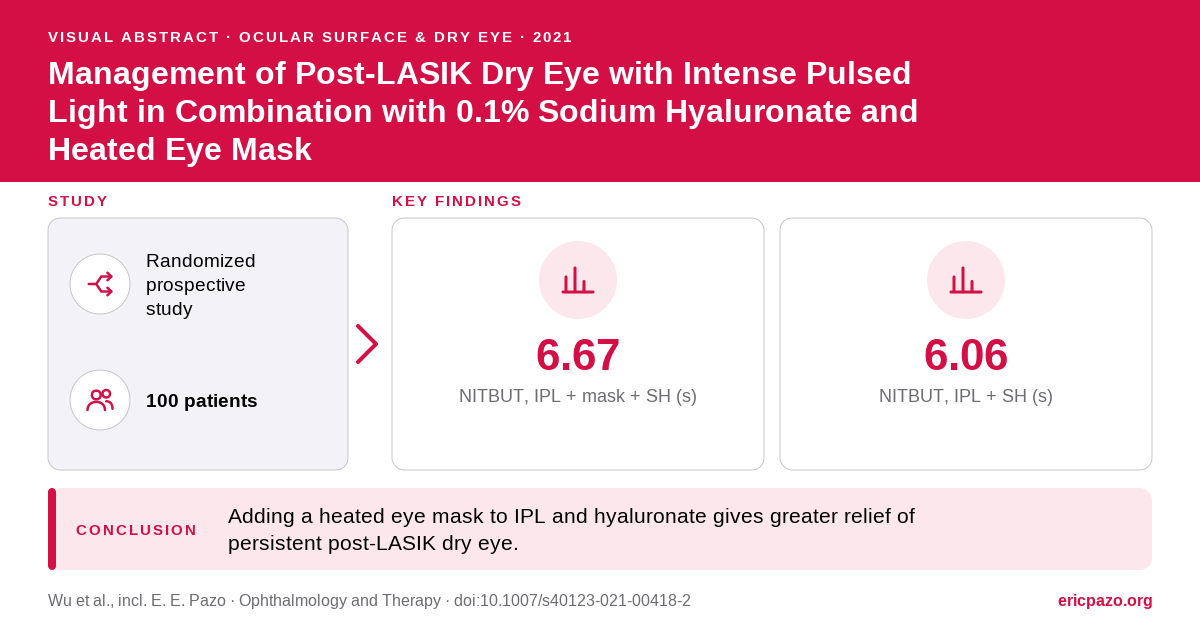
De un vistazo
Añadir una mascarilla ocular térmica a la IPL y al hialuronato alivia más el ojo seco persistente tras LASIK.
- Diseño
- Estudio prospectivo aleatorizado
- Muestra
- 100 pacientes
- NITBUT, IPL + mascarilla + SH (s)
- 6.67
- NITBUT, IPL + SH (s)
- 6.06
Resumen
INTRODUCCIÓN: La queratomileusis in situ asistida por láser (LASIK) es uno de los tratamientos refractivos más realizados. El ojo seco (OS) es frecuente en los pacientes tras LASIK y puede resultar molesto en el posoperatorio. Se ha descrito que terapias como la luz pulsada intensa (IPL), el hialuronato sódico (SH) y la mascarilla ocular térmica (HEM) mejoran los signos y síntomas del OS. OBJETIVO: El objetivo de este estudio prospectivo fue evaluar y comparar los efectos de la IPL con SH al 0.1% (grupo IPL, 50 ojos) y de la IPL combinada con SH al 0.1% y HEM (grupo IPL +, 50 ojos) en participantes con OS persistente tras LASIK. MÉTODOS: El análisis final incluyó a 100 pacientes (100 ojos) sometidos a LASIK para corregir la miopía que presentaban OS moderado a grave tras LASIK desde hacía más de un año. Los participantes se asignaron aleatoriamente al grupo IPL (2 sesiones de IPL) o al grupo IPL + (2 sesiones de IPL y HEM diaria durante 4 semanas), y ambos grupos siguieron usando a diario colirio sin conservantes de SH al 0.1% (HYLO-COMOD®). Se evaluaron el tiempo de ruptura lagrimal no invasivo (NITBUT), la capa lipídica de la película lagrimal (TFLL), la altura del menisco lagrimal inferior (LTMH), la calidad de las glándulas de Meibomio (MGQ), la expresibilidad de las glándulas de Meibomio (MGEx), la tinción corneal con fluoresceína (CFS), el índice de enfermedad de la superficie ocular (OSDI) y una encuesta sobre el uso de lágrimas artificiales (ATU) al inicio (BL) y en los seguimientos de las semanas 2 (F1) y 4 (F2). RESULTADOS: Tras el protocolo de tratamiento, todos los parámetros de ojo seco (OS) evaluados en este estudio mejoraron significativamente (P < 0.05) en ambos grupos en F2 en comparación con sus respectivas mediciones en BL. La comparación entre grupos en F2 mostró diferencias significativas en el NITBUT (IPL: 6.06 ± 0.59 frente a IPL +: 6.67 ± 0.86, P < 0.001), la TFLL (IPL: 1.90 ± 0.65 frente a IPL +: 1.60 ± 0.64, P = 0.021), la LTMH (IPL: 0.186 ± 0.053 frente a 0.204 ± 0.034, P = 0.003), la MGQ (IPL: 1.48 ± 0.54 frente a IPL +: 1.26 ± 0.56, P = 0.026), la MGEx (IPL: 1.62 ± 0.53 frente a IPL +: 1.44 ± 0.50, P = 0.038) y el OSDI (IPL: 32.54 ± 6.85 frente a IPL +: 29.76 ± 4.74, P = 0.001), mientras que la puntuación CFS (IPL: 4.02 ± 0.65 frente a IPL +: 3.96 ± 0.73, P = 0.652) y el ATU (IPL: 1.88 ± 0.63 frente a IPL +: 1.72 ± 0.50, P = 0.159) no mostraron diferencias significativas. CONCLUSIÓN: Los signos y síntomas del OS post-LASIK pueden mejorar combinando terapias como la IPL, la HEM y el SH al 0.1%. El aumento de la TFLL debido a la combinación de IPL, SH al 0.1% y HEM tuvo un mayor impacto positivo en las medidas subjetivas y objetivas de OS en los participantes con OS persistente tras LASIK.
Traducido del resumen original en inglés (licencia: CC BY-NC).
Mostrar el resumen original
INTRODUCTION: Laser in situ keratomelieusis (LASIK) is one of the most frequently performed refractive treatments. Dry eye (DE) is common in patients after LASIK and can be bothersome postoperatively. Therapies such as intense pulsed light (IPL), sodium hyaluronate (SH) and heated eye mask (HEM) have been reported to improve signs and symptoms of DE . AIM: The purpose of this prospective study was to evaluate and compare the effects of IPL and 0.1% SH (IPL group, 50 eyes) and IPL in combination with 0.1% SH and HEM (IPL + group, 50 eyes) in participants with persistent post-LASIK DE. METHODS: The final analysis included 100 patients (100 eyes) who had LASIK for myopic correction and had been experiencing moderate to severe DE following LASIK for over a year. Participants were randomly assigned to either the IPL group (2 IPL sessions) or IPL + group (2 IPL sessions and daily HEM for 4 weeks), and both groups continued the use of daily 0.1% SH (HYLO-COMOD®) preservative-free eye drops. Non-invasive tear break-up time (NITBUT), tear film lipid layer (TFLL), lower tear meniscus height (LTMH), meibomian gland quality (MGQ), meibomian gland expressibility (MGEx), corneal fluorescein staining (CFS), ocular surface disease index (OSDI) and artificial tear usage (ATU) survey were assessed at baseline (BL) and follow-up at 2 (F1) and 4 weeks (F2). RESULTS: Following the treatment protocol, all dry eye (DE) parameters assessed in this study improved significantly (P < 0.05) in both groups at F2 compared with their respective BL measurements. Inter-group comparison at F2 found significant differences in their NITBUT (IPL: 6.06 ± 0.59 vs. IPL +: 6.67 ± 0.86, P < 0.001), TFLL (IPL: 1.90 ± 0.65 vs. IPL +: 1.60 ± 0.64, P = 0.021), LTMH (IPL: 0.186 ± 0.053 vs. 0.204 ± 0.034, P = 0.003), MGQ (IPL: 1.48 ± 0.54 vs. IPL +: 1.26 ± 0.56, P = 0.026), MGEx (IPL: 1.62 ± 0.53 vs. IPL +: 1.44 ± 0.50, P = 0.038) and OSDI (IPL: 32.54 ± 6.85 vs. IPL +: 29.76 ± 4.74, P = 0.001), while CFS score (IPL: 4.02 ± 0.65 vs. IPL +: 3.96 ± 0.73, P = 0.652) and ATU (IPL: 1.88 ± 0.63 vs. IPL +: 1.72 ± 0.50, P = 0.159) showed no significant difference. CONCLUSION: Post-LASIK DE signs and symptoms can be improved by combining therapies such as IPL, HEM and 0.1% SH. Increased TFLL due to a combination of IPL, 0.1% SH and HEM had a greater positive impact on the subjective and objective DE measurements in participants with persistent post-LASIK DE.
Palabras clave: intense pulsed light; sodium hyaluronate; meibography; meibomian gland dysfunction; tear film break-up time; tear film lipid layer; corneal fluorescein staining; Ocular Surface Disease Index
Acceso
Cómo citar
Mostrar BibTeX
@article{wu2021management,
  title = {{Management of Post-LASIK Dry Eye with Intense Pulsed Light in Combination with 0.1% Sodium Hyaluronate and Heated Eye Mask}},
  author = {Wu, Yi and Xu, Ling and Song, Yilin and Zhang, Qing and Qin, Guanghao and Yang, Lanting and Ma, Jinfei and Palme, Christoph and Moore, Jonathan Edward and Pazo, Emmanuel Eric and He, Wei},
  journal = {Ophthalmology and Therapy},
  year = {2021},
  doi = {10.1007/s40123-021-00418-2},
  url = {https://doi.org/10.1007/s40123-021-00418-2},
}
Trabajos relacionados
- Efectos de la remodelación epitelial corneal sobre la asfericidad corneal tras FS-LASIK y Trans-PRK: un estudio prospectivo (2024)
- Luz pulsada intensa para el tratamiento del ojo seco refractario post-LASIK (2020)
- Investigación del impacto de la orientación del astigmatismo corneal preoperatorio sobre la refracción en equivalente esférico posoperatoria tras el implante de lente intraocular (2018)
- Límite umbral del astigmatismo posoperatorio para la satisfacción del paciente tras el cambio de cristalino con fines refractivos y el implante de lente intraocular multifocal (2016)
- Análisis de la influencia del espacio del margen del colgajo en la regeneración de los nervios corneales tras LASIK asistido por láser de femtosegundo (2026)