
Évaluer l'impact des lampes à fente portables assistées par IA sur les soins ophtalmologiques primaires en milieu rural
Titre original : Assessing the Impact of AI-Assisted Portable Slit Lamps on Rural Primary Ophthalmic Medical Service
Sile Yu, Chunhong Yan, Guanghao Qin, Emmanuel Eric Pazo, Xiangdong He, Peng Qi, Mingze Li, Dongming Han, Wei He, Xingru He
 Current Eye Research, 2025 · article · doi:10.1080/02713683.2025.2458131 · cité 6 fois
Cataracte et chirurgie du segment antérieur
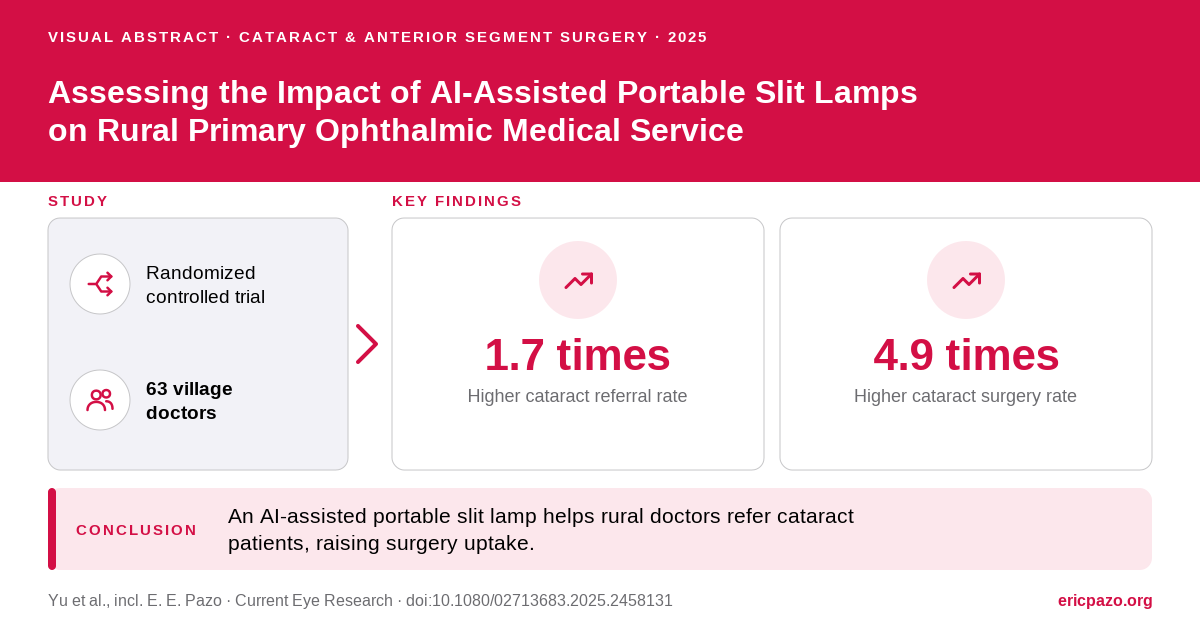
En bref
Une lampe à fente portable assistée par IA aide les médecins ruraux à adresser les patients atteints de cataracte, ce qui augmente le recours à la chirurgie.
- Type d'étude
- Essai contrôlé randomisé
- Échantillon
- 63 médecins de village
- Taux d'adressage pour cataracte plus élevé
- 1.7 times
- Taux de chirurgie de la cataracte plus élevé
- 4.9 times
Résumé
Ce résumé est affiché dans sa langue d'origine, l'anglais, car l'article n'est pas publié sous une licence ouverte autorisant les traductions.
PURPOSE: To investigate the effect of an AI-assisted portable slit lamp (iSpector) and basic ophthalmology training on cataract detection, referral, and surgery rate in rural areas. METHODS: This randomized control trial randomly assigned 63 village doctors to either the AI-assisted group (providing iSpector and training) or the control group (providing training). Doctors were followed for 1 year before intervention as a baseline and 1 year after to make the comparison. Multivariable Poisson regression was applied to compare the difference in cataract detection, referral, and surgery rate between the two groups, adjusted for primary doctors' baseline characteristics. We further conducted subgroup analysis to estimate the change after the intervention. RESULTS: Compared to the control group, the detection, referral, and surgery rate of cataracts among the AI-assisted group was comparable, 1.7 times higher, and 4.9 times higher, respectively. Providing iSpector and training increased the detection, referral, and surgery rate of cataracts. However, only based on training to elevate the detection rate of cataracts did not change the referral and surgery rate. CONCLUSIONS: iSpector helps village doctors detect and refer cataract patients appropriately, thus increasing the probability that patients receive cataract surgery.
Mots-clés : cataract detection; cataract surgery; village doctors; ophthalmology education; resource-limited settings; telemedicine
Accès
Comment citer
Afficher le BibTeX
@article{yu2025assessing,
  title = {{Assessing the Impact of AI-Assisted Portable Slit Lamps on Rural Primary Ophthalmic Medical Service}},
  author = {Yu, Sile and Yan, Chunhong and Qin, Guanghao and Pazo, Emmanuel Eric and He, Xiangdong and Qi, Peng and Li, Mingze and Han, Dongming and He, Wei and He, Xingru},
  journal = {Current Eye Research},
  year = {2025},
  doi = {10.1080/02713683.2025.2458131},
  url = {https://doi.org/10.1080/02713683.2025.2458131},
}
Travaux liés
- Observance du suivi à long terme après implantation d'une lentille en collamer implantable chez des patients fortement myopes : une étude monocentrique de cohorte rétrospective et d'enquête CAP (2026)
- Prédiction de la réfraction sous cycloplégie par apprentissage automatique avec l'Eyerobo Vision Screener : plan, une étude transversale comparative d'appareils (2026)
- Caractéristiques des paramètres biologiques et choix de la taille de la lentille en collamer implantable (ICL) dans les yeux myopes modérés, forts et très forts (2025)
- Exploration de modèles d'apprentissage automatique pour la sécurité du vault dans l'implantation d'ICL : une analyse comparative de modèles de régression et de classification (2025)
- Comparaison multiple de 8 formules biométriques de lentille intraoculaire, dont une formule de lentille mince par apprentissage automatique (MM) et une formule de tracé de rayons intégrée à une tomographie par cohérence optique du segment antérieur (2024)