
Caractéristiques des paramètres biologiques et choix de la taille de la lentille en collamer implantable (ICL) dans les yeux myopes modérés, forts et très forts
Titre original : Characteristics of biological parameters and implantable collamer lens (ICL) size selection in moderate, high, and super-high myopia eyes
Fei Ran Li, Yueni Ma, Wenjie Qi, Emmanuel Eric Pazo, Ruibo Yang, Shaozhen Zhao
 BMC Ophthalmology, 2025 · article · doi:10.1186/s12886-025-03934-y · cité 6 fois · Accès libre (CC BY-NC-ND)
Myopie et erreurs réfractivesCataracte et chirurgie du segment antérieur
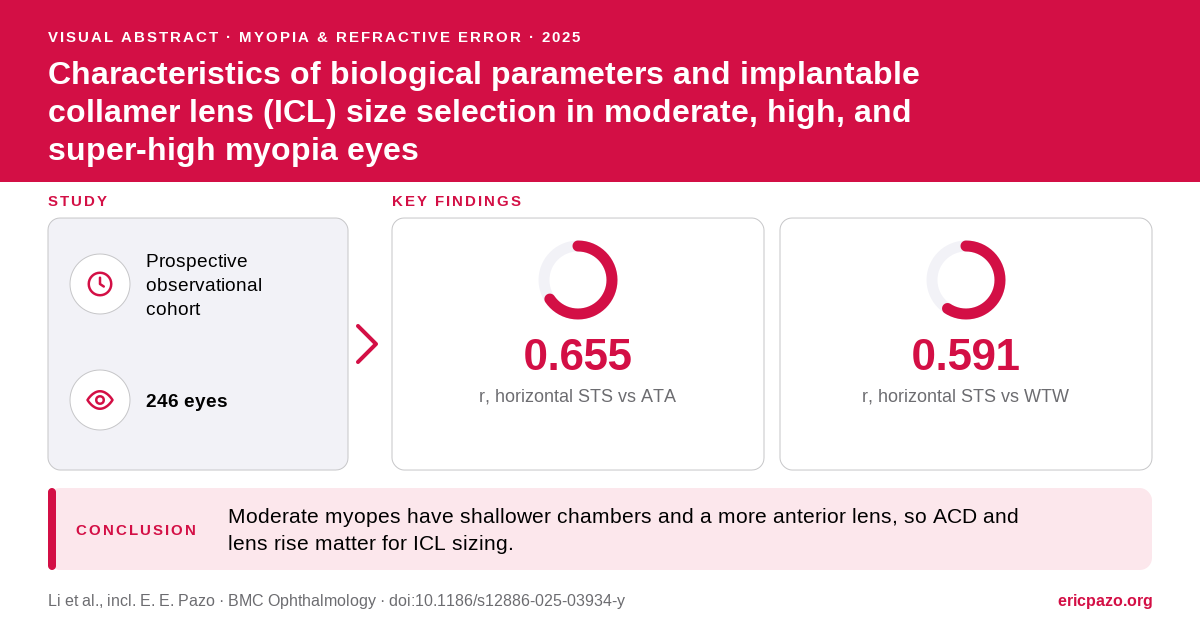
En bref
Les myopes modérés ont des chambres moins profondes et un cristallin plus antérieur ; l'ACD et la flèche cristallinienne comptent donc pour le choix de la taille de l'ICL.
- Type d'étude
- Cohorte observationnelle prospective
- Échantillon
- 246 yeux
- r, STS horizontal contre ATA
- 0.655
- r, STS horizontal contre WTW
- 0.591
Résumé
Ce résumé est affiché dans sa langue d'origine, l'anglais, car la licence de l'article (CC BY-NC-ND) ne permet pas de publier des traductions.
OBJECTIVE: To analyze the characteristics of anterior segment biometric parameters in moderate, high, and super-high myopia eyes for ICL size selection. METHODS: A total of 246 eyes of 131 patients were included in this prospective observational cohort study. Preoperative axis length (AL), central keratometry (Kc), central corneal thickness (CCT), white-to-white (WTW), internal anterior chamber depth (ACD), trabecular iris angle (TIA), anterior chamber width (ACW), angle-to-angle distance (ATA), crystalline lens rise (CLR), lens thickness (LT), sulcus-to-sulcus (STS), ICL size, and postoperative vault at 1 month were recorded and compared among the different degrees of myopia groups. RESULTS: The moderate myopia showed smaller ACD and TIA than high and super-high myopia (P < 0.05). A higher proportion of CLR positive (+) was in the moderate myopia group (65%), while the super-high myopia group had a higher proportion of CLR negative (-) (55.3%). (P = 0.047). There were no statistical differences among the myopia groups in WTW, ATA, ACW, STS, LT, and postoperative vault (P>0.05). In different degrees of myopia groups, vertical ATA, ACW and STS were longer than horizontal ATA, ACW and STS (P < 0.001), and horizontal-STS showed a higher correlation with horizontal-ATA (r = 0.655) and horizontal-ACW (r = 0.660) than with WTW (r = 0.591). The 12.1 mm size ICL was slightly selected in moderate myopia (35.8%) more than high myopia (14.6%) and super-high myopia (26.3%) (P = 0.013). CONCLUSION: Compared to high and super-high myopia, moderate myopic eyes exhibited smaller ACD, TIA while similar WTW, ATA, ACW and STS, with the lens positioned more anteriorly. It should be concerned to the effect of sagittal axis parameters ACD and CLR on the ICL size in different degrees of myopia.
Mots-clés : implantable collamer lens; myopia severity; anterior segment biometry; anterior chamber depth; trabecular-iris angle; anterior chamber width; keratometry; corneal thickness
Accès
Comment citer
Afficher le BibTeX
@article{li2025characteristics,
  title = {{Characteristics of biological parameters and implantable collamer lens (ICL) size selection in moderate, high, and super-high myopia eyes}},
  author = {Li, Fei Ran and Ma, Yueni and Qi, Wenjie and Pazo, Emmanuel Eric and Yang, Ruibo and Zhao, Shaozhen},
  journal = {BMC Ophthalmology},
  year = {2025},
  doi = {10.1186/s12886-025-03934-y},
  url = {https://doi.org/10.1186/s12886-025-03934-y},
}
Travaux liés
- Observance du suivi à long terme après implantation d'une lentille en collamer implantable chez des patients fortement myopes : une étude monocentrique de cohorte rétrospective et d'enquête CAP (2026)
- Prédiction de la réfraction sous cycloplégie par apprentissage automatique avec l'Eyerobo Vision Screener : plan, une étude transversale comparative d'appareils (2026)
- Mesure automatisée par apprentissage profond du volume de rétinoschisis et de décollement dans la myopie pathologique avec contraction sclérale postérieure (2026)
- Développement et validation interne d'un modèle transformer sensible au temps pour prédire la progression de la myopie de l'enfant à partir de données longitudinales irrégulières de dépistage scolaire (2026)
- Nouvelle approche pour l'évaluation quantitative du staphylome scléral : analyse de mesures de courbure discrète de la sclère (2026)