
Prédiction de la réfraction sous cycloplégie par apprentissage automatique avec l'Eyerobo Vision Screener : plan, une étude transversale comparative d'appareils
Titre original : Machine Learning-Based Prediction of Cycloplegic Refraction Using the Eyerobo Vision Screener: Design—A Cross-Sectional Comparative Device Study
Mengmeng Xia, Boxue Yao, Yumei Wang, Fengwei Liang, Wuxia Zhao, Li Qin, Shoukuan Liu, Muhammad Usama, Zhihui Zhang, Wu Guo, Emmanuel Eric Pazo, Xinjun Ren
 Ophthalmology and Therapy, 2026 · article · doi:10.1007/s40123-026-01482-2 · Accès libre (CC BY-NC)
Myopie et erreurs réfractivesCataracte et chirurgie du segment antérieurIA et apprentissage profond
En bref
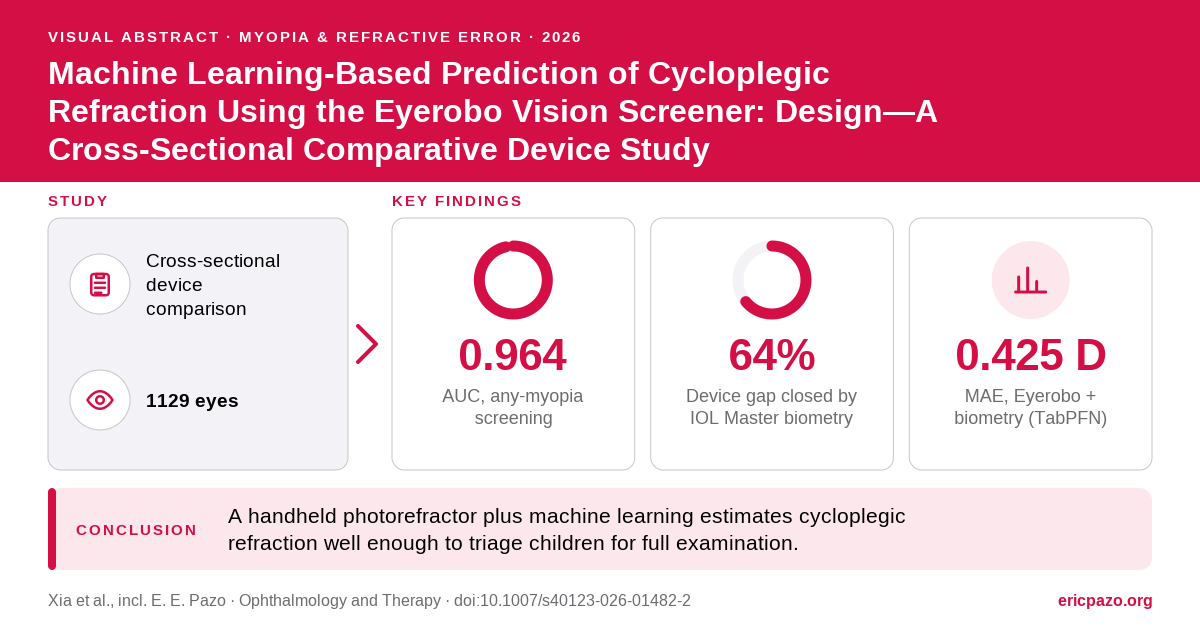
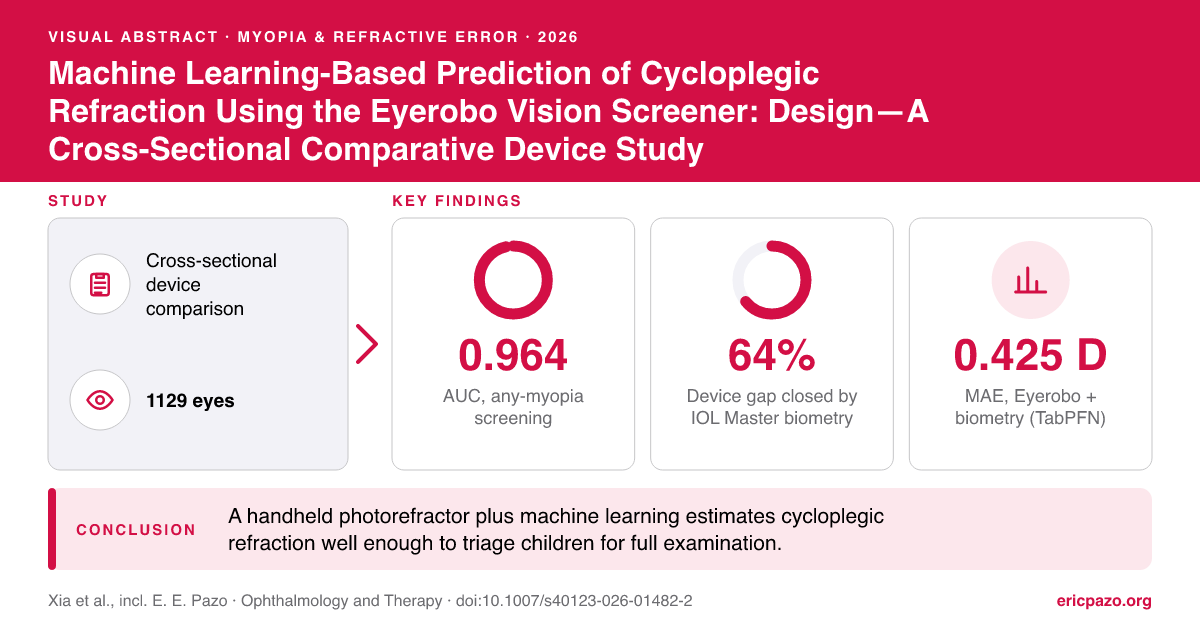
Un photoréfracteur portable associé à l'apprentissage automatique estime suffisamment bien la réfraction sous cycloplégie pour orienter les enfants vers un examen complet.
- Type d'étude
- Comparaison transversale d'appareils
- Échantillon
- 1129 yeux
- AUC, dépistage de toute myopie
- 0.964
- Écart entre appareils réduit par la biométrie IOL Master
- 64%
- MAE, Eyerobo + biométrie (TabPFN)
- 0.425 D
Résumé
Étude transversale comparative d'appareils visant à comparer l'Eyerobo Vision Screener (VS), un photoréfracteur portable tenu à la main, à un autoréfractomètre conventionnel pour la prédiction, par apprentissage automatique, de l'équivalent sphérique (ES) sous cycloplégie et des composantes des vecteurs de puissance (J0, J45) dans une cohorte pédiatrique de myopes ; à déterminer si une biométrie complémentaire par IOL Master réduit l'écart de performance entre appareils ; et à rapporter des indicateurs de classification orientés dépistage (sensibilité, spécificité, valeurs prédictives positive et négative, aire sous la courbe ROC [AUC]) à des seuils d'orientation cliniquement pertinents, afin de quantifier les performances de tri de la combinaison appareil–modèle. Les données de 1129 yeux de 574 patients âgés de 6–18 ans ont été recueillies avec trois appareils ophtalmiques avant et après dilatation pharmacologique. Toutes les mesures réfractives ont été décomposées en vecteurs de puissance (ES, J0, J45) selon Thibos et al. Douze scénarios de variables cliniquement motivés ont été construits à partir d'un cadre symétrique comparant l'Eyerobo VS et l'autoréfractomètre (chacun avant dilatation, après dilatation et en combinaison), avec et sans biométrie IOL Master. TabPFN, un modèle de fondation tabulaire ne nécessitant aucun réglage d'hyperparamètres, a été évalué avec sept algorithmes conventionnels d'apprentissage automatique par validation croisée groupée à cinq plis au niveau du patient, répétée avec trois graines aléatoires. La concordance a été évaluée par analyse de Bland–Altman, corrélation de Pearson et analyse de seuils cliniques. Outre les indicateurs de régression, une analyse de classification pour le dépistage a été réalisée à trois seuils cliniques prédéfinis (ES sous cycloplégie $$\le -0.50$$ D, $$\le -3.00$$ D et $$\le -6.00$$ D), avec sensibilité, spécificité, valeur prédictive positive (VPP), valeur prédictive négative (VPN) et AUC assortis d'intervalles de confiance bootstrap appariés à 95 %. Une comparaison statistique formelle appariée entre TabPFN et le meilleur algorithme suivant ainsi qu'une analyse de sensibilité à un œil par patient sont également rapportées. TabPFN a obtenu l'erreur absolue moyenne (MAE) la plus faible dans tous les scénarios Eyerobo et s'est montré compétitif avec Ridge dans les scénarios de l'autoréfractomètre ; dans le scénario principal Eyerobo Pré + IOL, la différence appariée par œil de MAE entre TabPFN (0.425 D) et le meilleur modèle de gradient boosting suivant (XGBoost, 0.542 D) était de 0.117 D en faveur de TabPFN, avec un test des rangs signés de Wilcoxon apparié $$p<0.001$$ . Pour la prédiction de l'ES avant dilatation, l'autoréfractomètre a obtenu une MAE de 0.295 D (87.4 % à ± 0.50 D), contre 0.657 D (61.6 %) pour l'Eyerobo VS. L'ajout de la biométrie IOL Master à l'Eyerobo a réduit cet écart de 64 %, pour une MAE de 0.425 D (72.0 %). Pour les composantes astigmates des vecteurs de puissance, l'écart s'est encore réduit : la MAE de J0 était de 0.106 D (autoréfractomètre) contre 0.143 D (Eyerobo + IOL), et celle de J45 de 0.060 D contre 0.088 D. Les prédictions de l'autoréfractomètre après dilatation approchaient la précision de la cycloplégie (MAE = 0.203 D, 96.0 % à ± 0.50 D). L'analyse en sous-groupes a montré que l'Eyerobo fonctionnait le mieux pour la myopie légère (MAE = 0.398 D, 75.6 % à ± 0.50 D) et se dégradait pour la forte myopie et pour la petite strate non myope. Dans l'analyse de classification pour le dépistage, l'Eyerobo et l'autoréfractomètre étaient opérationnellement équivalents au seuil de toute myopie (Eyerobo AUC 0.964 [IC à 95 % 0.939–0.982], sensibilité 0.946, spécificité 0.894 ; autoréfractomètre AUC 0.969 [0.948–0.986], sensibilité 0.960, spécificité 0.886 ; différence appariée d'AUC 0.005 [IC à 95 % $$-0.022$$ à $$+0.034$$ ], formellement non inférieure avec une marge prédéfinie $$\delta =0.05$$ ). Dans cette cohorte pédiatrique monocentrique d'enfants adressés, l'Eyerobo VS associé à l'apprentissage automatique a produit des estimations de l'ES sous cycloplégie d'une précision compatible avec un usage d'appoint au tri, pour repérer les enfants devant passer un examen complet sous cycloplégie, avec des performances quasi équivalentes à celles de l'autoréfractomètre pour les composantes astigmates. L'ajout de la biométrie IOL Master a réduit l'écart entre appareils de 64 %. TabPFN a obtenu les meilleures performances parmi les algorithmes évalués dans cette cohorte et ne nécessite aucun réglage d'hyperparamètres, mais la faible marge par rapport aux modèles linéaires et de gradient boosting et l'absence de validation externe ne permettent pas de le recommander comme algorithme de choix définitif. L'approche proposée ne remplace pas la réfraction sous cycloplégie ; une validation externe prospective dans une cohorte générale de dépistage pédiatrique est nécessaire avant tout déploiement clinique.
Traduit du résumé original en anglais (licence : CC BY-NC).
Afficher le résumé original
A cross-sectional comparative device study to compare the Eyerobo Vision Screener (VS), a portable handheld photorefractor, against a conventional auto-refractor for machine-learning-based prediction of cycloplegic spherical equivalent (SE) and power vector components (J0, J45) in a pediatric myopia cohort, to evaluate whether supplementary IOL Master biometry narrows the performance gap between devices, and to report screening-oriented classification metrics (sensitivity, specificity, positive and negative predictive values, area under the receiver operating characteristic curve [AUC]) at clinically meaningful referral thresholds that quantify the device–model combination’s triage performance. Data from 1129 eyes of 574 patients aged 6–18 years were collected using three ophthalmic devices before and after pharmacological dilation. All refractive measurements were decomposed into power vectors (SE, J0, J45) following Thibos et al. Twelve clinically motivated feature scenarios were constructed from a symmetric framework comparing the Eyerobo VS and auto-refractor (each under predilation, post-dilation, and combined conditions), with and without IOL Master biometry. TabPFN, a tabular foundation model requiring no hyperparameter tuning, was evaluated alongside seven conventional machine-learning algorithms using patient-level five-fold grouped cross-validation repeated over three random seeds. Agreement was assessed using Bland–Altman analysis, Pearson correlation, and clinical threshold analysis. In addition to regression metrics, a screening-classification analysis was performed at three prespecified clinical thresholds (cycloplegic SE $$\le -0.50$$ D, $$\le -3.00$$ D, and $$\le -6.00$$ D), reporting sensitivity, specificity, positive predictive value (PPV), negative predictive value (NPV), and AUC with 95% paired bootstrap confidence intervals. Formal paired statistical comparison between TabPFN and the next-best algorithm and a one-eye-per-patient sensitivity analysis are also reported. TabPFN achieved the lowest mean absolute error (MAE) on all Eyerobo scenarios and was competitive with Ridge on auto-refractor scenarios; on the headline Eyerobo Pre + IOL scenario, the per-eye paired difference in MAE between TabPFN (0.425 D) and the next-best gradient-boosting learner (XGBoost, 0.542 D) was 0.117 D in favour of TabPFN, with paired Wilcoxon signed-rank $$p<0.001$$ . For predilation SE prediction, the auto-refractor achieved an MAE of 0.295 D (87.4% within ± 0.50 D), compared with 0.657 D (61.6%) for the Eyerobo VS. Adding IOL Master biometry to the Eyerobo reduced this gap by 64%, yielding an MAE of 0.425 D (72.0%). For astigmatic power vector components, the gap narrowed further: J0 MAE was 0.106 D (auto-refractor) versus 0.143 D (Eyerobo + IOL), and J45 MAE was 0.060 D versus 0.088 D. Auto-refractor post-dilation predictions approached cycloplegic accuracy (MAE = 0.203 D, 96.0% within ± 0.50 D). Subgroup analysis showed the Eyerobo performed best for mild myopia (MAE = 0.398 D, 75.6% within ± 0.50 D) and degraded for high myopia and the small nonmyopic stratum. In the screening-classification analysis, the Eyerobo and the auto-refractor were operationally equivalent at the any-myopia threshold (Eyerobo AUC 0.964 [95% CI 0.939–0.982], sensitivity 0.946, specificity 0.894; auto-refractor AUC 0.969 [0.948–0.986], sensitivity 0.960, specificity 0.886; paired AUC difference 0.005 [95% CI $$-0.022$$ to $$+0.034$$ ], formally noninferior under a prespecified $$\delta =0.05$$ margin). Within this single-center pediatric referral cohort, the Eyerobo VS combined with machine learning produced cycloplegic SE estimates of a precision consistent with use as a triage adjunct to identify children who should proceed to a full cycloplegic examination, with near-equivalent performance to the auto-refractor for astigmatic components. The addition of IOL Master biometry narrowed the device gap by 64%. TabPFN achieved the best performance among the evaluated algorithms within this cohort and requires no hyperparameter tuning, but the modest margin over linear and gradient-boosting baselines and the absence of external validation preclude any recommendation as the definitive algorithm of choice. The proposed approach is not a substitute for cycloplegic refraction; prospective external validation in a general pediatric screening cohort is required before clinical deployment.
Mots-clés : cycloplegic refraction; childhood myopia; spherical equivalent; power vectors; TabPFN; machine learning prediction; refractive error screening; device comparison
Accès
Comment citer
Afficher le BibTeX
@article{xia2026machine,
  title = {{Machine Learning-Based Prediction of Cycloplegic Refraction Using the Eyerobo Vision Screener: Design—A Cross-Sectional Comparative Device Study}},
  author = {Xia, Mengmeng and Yao, Boxue and Wang, Yumei and Liang, Fengwei and Zhao, Wuxia and Qin, Li and Liu, Shoukuan and Usama, Muhammad and Zhang, Zhihui and Guo, Wu and Pazo, Emmanuel Eric and Ren, Xinjun},
  journal = {Ophthalmology and Therapy},
  year = {2026},
  doi = {10.1007/s40123-026-01482-2},
  url = {https://doi.org/10.1007/s40123-026-01482-2},
}
Travaux liés
- Mesure automatisée par apprentissage profond du volume de rétinoschisis et de décollement dans la myopie pathologique avec contraction sclérale postérieure (2026)
- Développement et validation interne d'un modèle transformer sensible au temps pour prédire la progression de la myopie de l'enfant à partir de données longitudinales irrégulières de dépistage scolaire (2026)
- Observance du suivi à long terme après implantation d'une lentille en collamer implantable chez des patients fortement myopes : une étude monocentrique de cohorte rétrospective et d'enquête CAP (2026)
- Prédire la progression de la myopie pédiatrique à partir d'une seule visite de dépistage : une étude de développement et de validation multi-critères (2026)
- Caractéristiques des paramètres biologiques et choix de la taille de la lentille en collamer implantable (ICL) dans les yeux myopes modérés, forts et très forts (2025)