
Influence de la pupille sur la qualité de vision avec les implants multifocaux à asymétrie rotationnelle à segment de près intégré en surface
Titre original : Pupil influence on the quality of vision in rotationally asymmetric multifocal IOLs with surface-embedded near segment
Emmanuel Eric Pazo, Richard N. McNeely, Olivier Richoz, Andrew M. Nesbit, Tara Moore, Jonathan Edward Moore
 Journal of Cataract & Refractive Surgery, 2017 · article · doi:10.1016/j.jcrs.2017.08.013 · cité 20 fois
Cataracte et chirurgie du segment antérieur
En bref
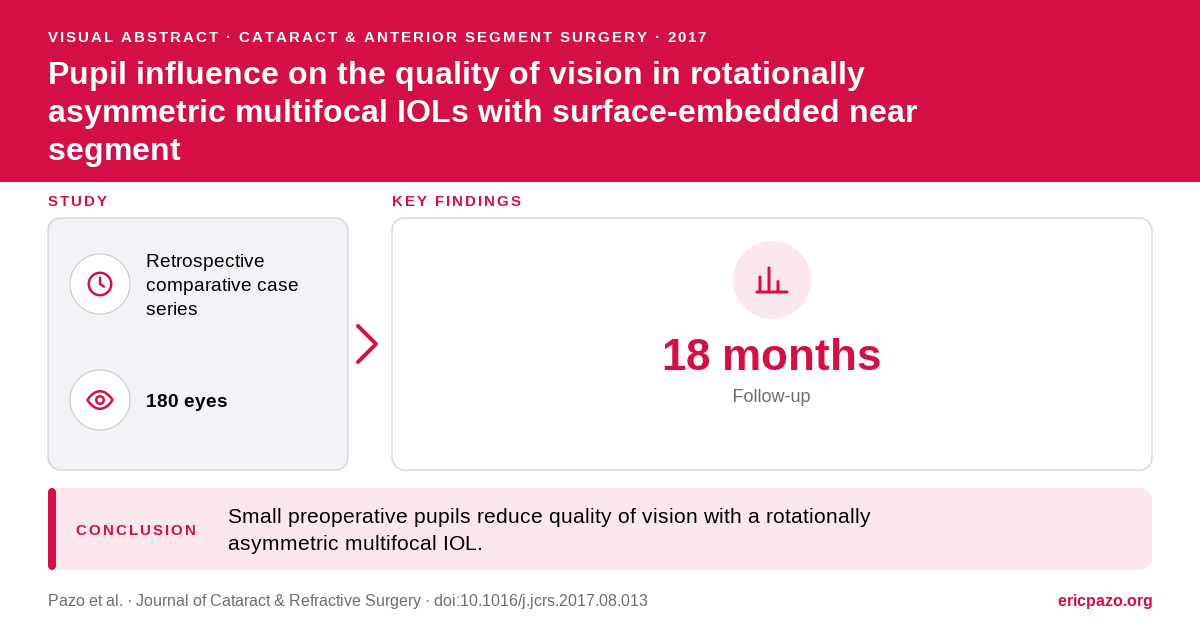
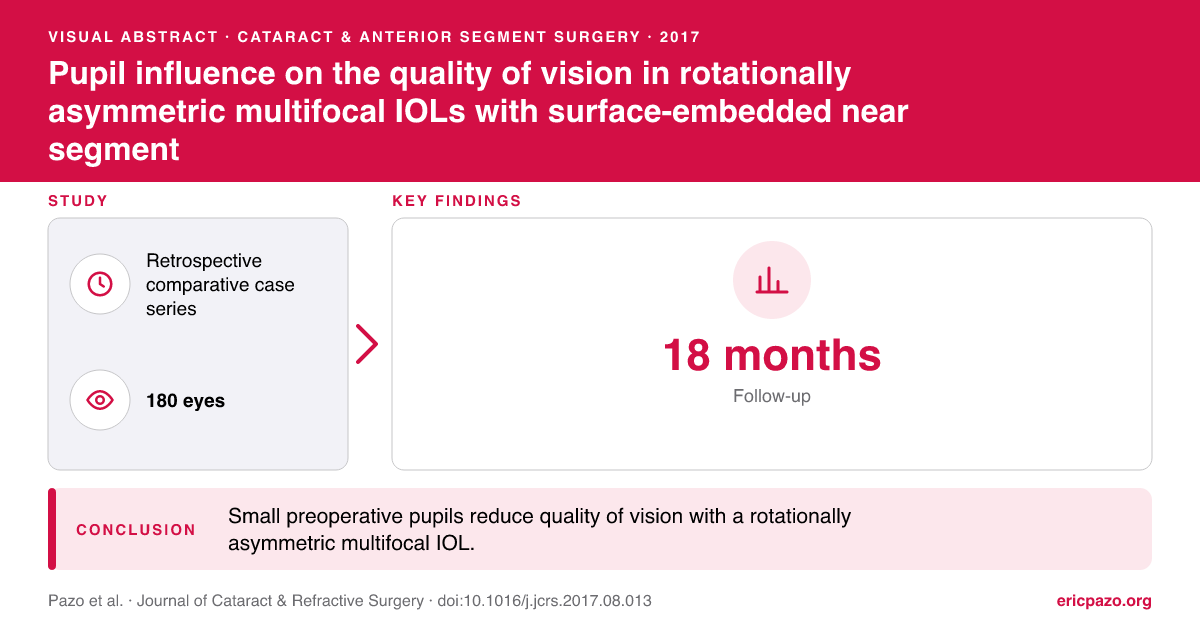
De petites pupilles préopératoires réduisent la qualité de vision avec un implant multifocal à asymétrie rotationnelle.
- Type d'étude
- Série de cas comparative rétrospective
- Échantillon
- 180 yeux
- Suivi
- 18 months
Résumé
Ce résumé est affiché dans sa langue d'origine, l'anglais, car l'article n'est pas publié sous une licence ouverte autorisant les traductions.
PURPOSE: To evaluate the influences of preoperative pupil parameters on the visual outcomes of the SBL-3, a rotationally asymmetric multifocal intraocular lens (IOL) with a surface-embedded near segment. SETTING: Cathedral Eye Clinic, Belfast, Northern Ireland, United Kingdom. DESIGN: Retrospective comparative case series. METHODS: Postoperatively, patients divided into 4 groups according to their pupil size as follows: Group A: 2.50 to 2.99 mm, Group B: 3.00 to 3.50 mm, Group C: 3.51 to 4.00 mm, and Group D: 4.01 to 4.50 mm. The uncorrected distance (UDVA), intermediate (UIVA), and near (UNVA) visual acuities, IOL centration and tilt, and quality of vision (QoV) questionnaires were compared between the 4 groups for 18 months postoperatively. RESULTS: The study comprised 90 patients (180 eyes). The mean preoperative pupil (photopic and mesopic) diameter was 4.3 mm ± 0.3 (SD) and 5.6 ± 1.4 mm, respectively, which decreased to 3.8 ± 0.7 mm and 4.9 ± 1.2 mm, respectively, at 18 months. Eighteen months postoperatively, both photopic and mesopic pupil groups had a statistically significant reduction in size from preoperative levels. No significant differences in UDVA, UIVA, and UNVA were found between the groups (P > .001). Significant differences in the QoV questionnaire day scores and night scores were found between the 4 groups (P < .001). CONCLUSIONS: The rotationally asymmetric multifocal IOL provided excellent optical performance during 18-months follow-up. The preoperative photopic pupil is an important parameter for consideration of this type of IOL because smaller pupils have a significant negative subjective impact on QoV.
Mots-clés : pupil size; visual quality; visual acuity; cataract surgery outcomes
Accès
Comment citer
Afficher le BibTeX
@article{pazo2017pupil,
  title = {{Pupil influence on the quality of vision in rotationally asymmetric multifocal IOLs with surface-embedded near segment}},
  author = {Pazo, Emmanuel Eric and McNeely, Richard N. and Richoz, Olivier and Nesbit, Andrew M. and Moore, Tara and Moore, Jonathan Edward},
  journal = {Journal of Cataract & Refractive Surgery},
  year = {2017},
  doi = {10.1016/j.jcrs.2017.08.013},
  url = {https://doi.org/10.1016/j.jcrs.2017.08.013},
}
Travaux liés
- Observance du suivi à long terme après implantation d'une lentille en collamer implantable chez des patients fortement myopes : une étude monocentrique de cohorte rétrospective et d'enquête CAP (2026)
- Prédiction de la réfraction sous cycloplégie par apprentissage automatique avec l'Eyerobo Vision Screener : plan, une étude transversale comparative d'appareils (2026)
- Évaluer l'impact des lampes à fente portables assistées par IA sur les soins ophtalmologiques primaires en milieu rural (2025)
- Caractéristiques des paramètres biologiques et choix de la taille de la lentille en collamer implantable (ICL) dans les yeux myopes modérés, forts et très forts (2025)
- Exploration de modèles d'apprentissage automatique pour la sécurité du vault dans l'implantation d'ICL : une analyse comparative de modèles de régression et de classification (2025)