
Influencia del diámetro pupilar en la calidad visual subjetiva tras el implante de lente de colámero implantable (ICL V4c): un estudio observacional
Título original: The influence of pupil diameter upon and subjective quality of vision following implantable collamer lens (ICL V4c) implantation: An observational study
Qing Zhang, He Huang, Yi Wu, Guanghao Qin, Liangzhe Li, Jiayan Chen, Huixin Che, Tao Yao, Chunhong Yan, Ling Xu, Jonathan E Moore, Wei He, Sile Yu, Emmanuel Eric Pazo, Xingru He
 Medicine, 2023 · artículo · doi:10.1097/md.0000000000035198 · citado 10 veces · Acceso abierto (CC BY-NC)
Cataratas y cirugía del segmento anterior
De un vistazo
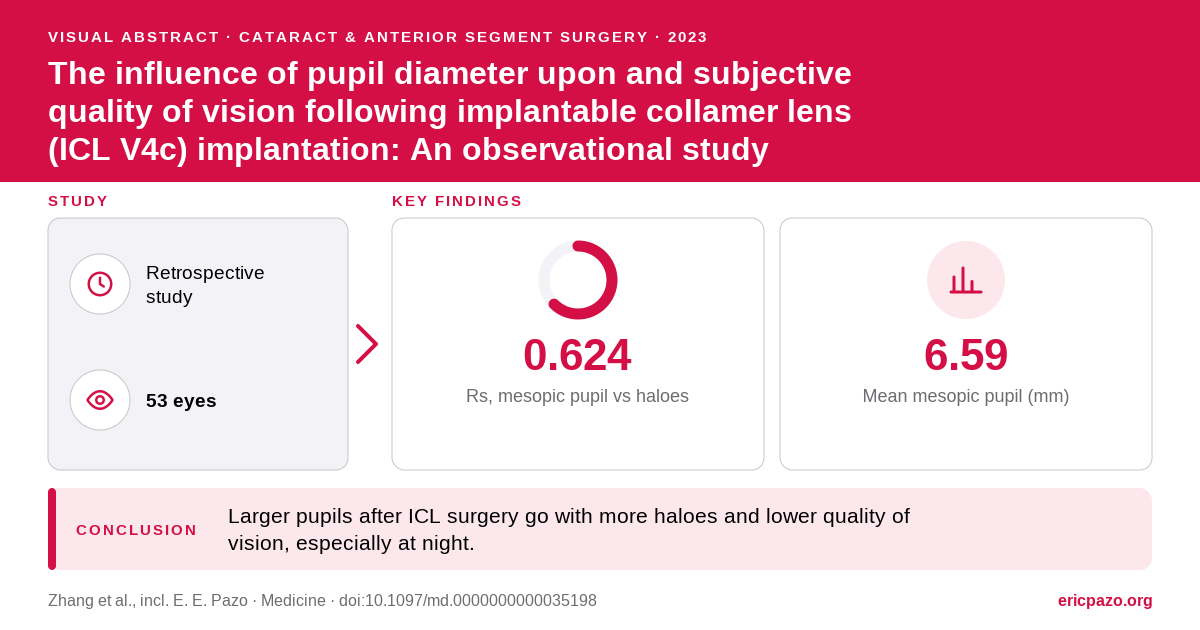
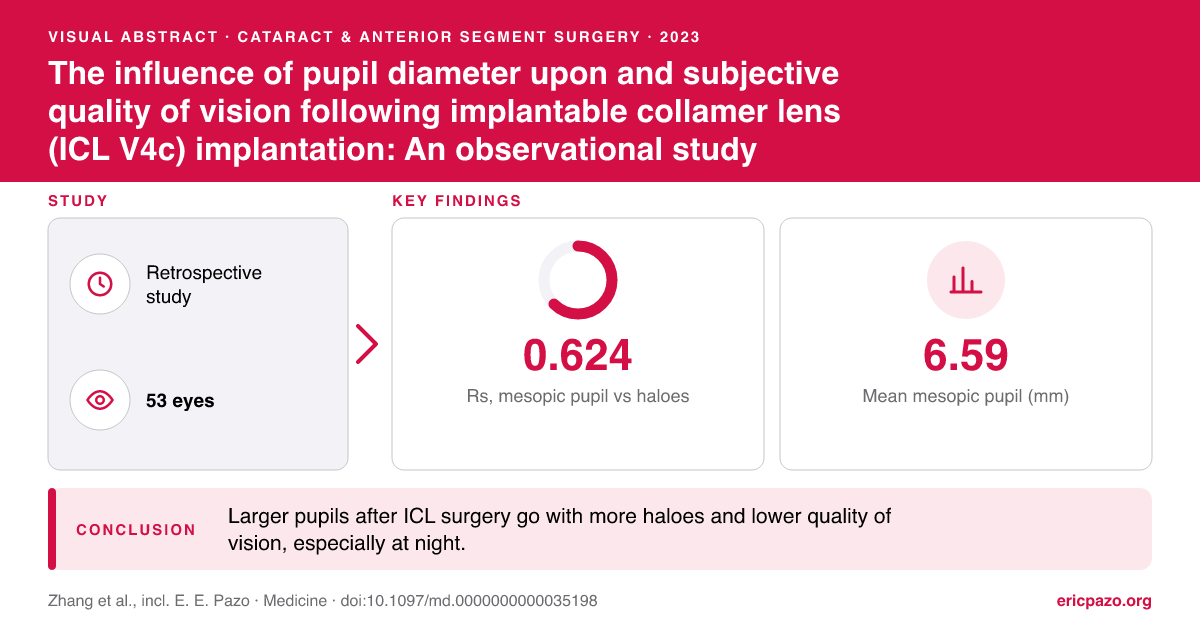
Las pupilas más grandes tras la cirugía ICL se asocian a más halos y menor calidad visual, sobre todo de noche.
- Diseño
- Estudio retrospectivo
- Muestra
- 53 ojos
- Rs, pupila mesópica frente a halos
- 0.624
- Pupila mesópica media (mm)
- 6.59
Resumen
Este estudio tuvo como objetivo evaluar el cambio del tamaño pupilar y su influencia en la calidad visual subjetiva (QoV) en sujetos con lentes de colámero implantables (ICL). Este estudio retrospectivo evaluó a 53 participantes (53 ojos) con implante de ICL (V4c) y los clasificó en grupos crecientes según el diámetro pupilar. Se evaluaron y compararon el diámetro pupilar fotópico y mesópico preoperatorio y posoperatorio, la agudeza visual de lejos sin corrección (UDVA) y las puntuaciones del cuestionario QoV. En el posoperatorio, a los 3 meses, la UDVA fue de -0.10 ± 0.06 logaritmo del ángulo mínimo de resolución (LogMAR), y la QoV media diurna y nocturna fue de 9.34 ± 0.76 y 8.58 ± 1.29, respectivamente. Los diámetros pupilares medios mesópico y fotópico fueron de 6.59 ± 0.79 mm y 4.61 ± 0.74 mm, respectivamente. El diámetro pupilar fotópico se correlacionó negativamente con la "QoV diurna" (Rs = -0.413, P = .001) y positivamente con los "halos" (Rs = 0.568*, P < .001) y la "visión borrosa" (Rs = 0.243, P = .04). El diámetro pupilar mesópico se correlacionó negativamente con la "QoV nocturna" (Rs = -0.426, P = .001) y positivamente con los "halos" (Rs = 0.624*, P < .001), los "destellos en estrella" (Rs = 0.233, P = .046) y la "dificultad para enfocar" (Rs = 0.27, P = .025). Los participantes tenían una AV excelente en el seguimiento a los 3 meses. Los diámetros pupilares fotópico y mesópico se correlacionaron negativamente con las puntuaciones de QoV diurna y nocturna, respectivamente. Se observó que el diámetro pupilar tenía un efecto más significativo sobre los síntomas visuales nocturnos, y la menor QoV debida a un mayor tamaño pupilar era más perceptible de noche. Se necesitan más investigaciones para estudiar la importancia del diámetro pupilar y su impacto en la QoV de los pacientes con ICL.
Traducido del resumen original en inglés (licencia: CC BY-NC).
Mostrar el resumen original
This study aimed to assess the change in pupil size and its influence on subjective quality of vision (QoV) in subjects with implanted collamer lenses (ICLs). This retrospective study assessed 53 participants (53 eyes) implanted with ICL (V4c) and categorized them into incremental groups according to pupil diameter. Preoperative and postoperative photopic and mesopic pupil diameter, uncorrected distance visual acuity (UDVA), and QoV questionnaire scores were assessed and compared. Postoperatively, at 3 months, UDVA was -0.10 ± 0.06 logarithm of the minimum angle of resolution (LogMAR), and mean QoV for day and night was 9.34 ± 0.76 and 8.58 ± 1.29, respectively. The mean mesopic and photopic pupil diameters were 6.59 ± 0.79 mm and 4.61 ± 0.74 mm, respectively. Photopic pupil diameter negatively correlated with "QoV day" (Rs = -0.413, P = .001), positively correlated with "haloes" (Rs = 0.568*, P < .001) and "blurred vision" (Rs = 0.243, P = .04) respectively. Mesopic pupil diameter negatively correlated with "QoV night" (Rs = -0.426, P = .001), positively correlated with "haloes" (Rs = 0.624*, P < .001), "starburst" (Rs = 0.233, P = .046) and "difficulty focusing" (Rs = 0.27, P = .025), respectively. Participants had excellent VA at 3-month follow-up. Photopic and mesonic pupil diameter negatively correlated with QoV day and QoV night scores, respectively. Pupil diameter was found to have a more significant effect on visual symptoms at night, and lower QoV due to larger pupil size was more noticeable at night. Further investigation is needed to explore the importance of pupil diameter and its impact on the QoV in ICL implanted patients.
Palabras clave: implantable collamer lens; ICL V4c; pupil size; mesopic vision; photopic vision; night vision; HALOE; visual disturbances
Acceso
Cómo citar
Mostrar BibTeX
@article{zhang2023the,
  title = {{The influence of pupil diameter upon and subjective quality of vision following implantable collamer lens (ICL V4c) implantation: An observational study}},
  author = {Zhang, Qing and Huang, He and Wu, Yi and Qin, Guanghao and Li, Liangzhe and Chen, Jiayan and Che, Huixin and Yao, Tao and Yan, Chunhong and Xu, Ling and Moore, Jonathan E and He, Wei and Yu, Sile and Pazo, Emmanuel Eric and He, Xingru},
  journal = {Medicine},
  year = {2023},
  doi = {10.1097/md.0000000000035198},
  url = {https://doi.org/10.1097/md.0000000000035198},
}
Trabajos relacionados
- Adherencia al seguimiento a largo plazo tras el implante de lente de colámero implantable en pacientes con miopía alta: un estudio unicéntrico de cohorte retrospectiva y encuesta CAP (2026)
- Predicción de la refracción ciclopléjica basada en aprendizaje automático con el Eyerobo Vision Screener: diseño, un estudio transversal comparativo de dispositivos (2026)
- Evaluación del impacto de las lámparas de hendidura portátiles asistidas por IA en la atención oftalmológica primaria rural (2025)
- Características de los parámetros biológicos y selección del tamaño de la lente de colámero implantable (ICL) en ojos con miopía moderada, alta y muy alta (2025)
- Exploración de modelos de aprendizaje automático para la seguridad del vault en el implante de ICL: un análisis comparativo de modelos de regresión y de clasificación (2025)