
Investigación del impacto de la orientación del astigmatismo corneal preoperatorio sobre la refracción en equivalente esférico posoperatoria tras el implante de lente intraocular
Título original: Investigating the impact of preoperative corneal astigmatism orientation on the postoperative spherical equivalent refraction following intraocular lens implantation
Richard N. McNeely, Salissou Moutari, Emmanuel Eric Pazo, Jonathan Edward Moore
 Eye and Vision, 2018 · artículo · doi:10.1186/s40662-018-0103-4 · citado 3 veces · Acceso abierto (CC BY)
Superficie ocular y ojo secoCataratas y cirugía del segmento anterior
De un vistazo
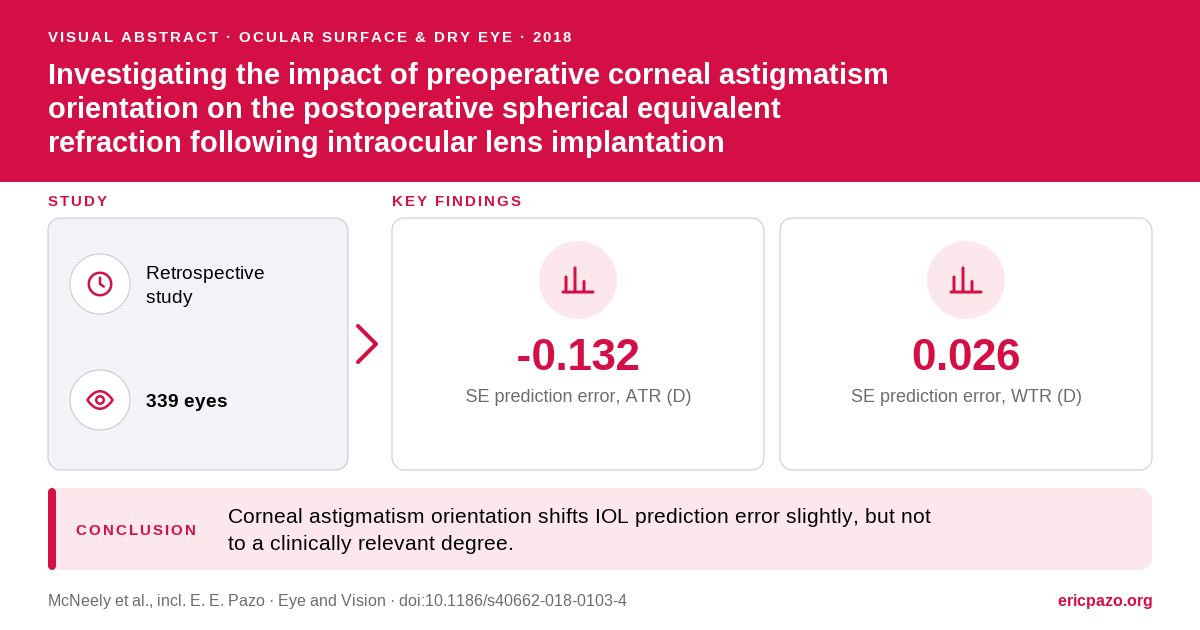
La orientación del astigmatismo corneal modifica ligeramente el error de predicción de la LIO, pero no en un grado clínicamente relevante.
- Diseño
- Estudio retrospectivo
- Muestra
- 339 ojos
- Error de predicción del EE, contra la regla (D)
- -0.132
- Error de predicción del EE, a favor de la regla (D)
- 0.026
Resumen
ANTECEDENTES: Investigar el impacto de la orientación del astigmatismo corneal preoperatorio en la consecución de la refracción objetivo posoperatoria tras el implante de una lente intraocular (LIO) monofocal. MÉTODOS: Este estudio incluyó 339 ojos sometidos sin incidencias a cirugía de catarata o a cambio de cristalino con fines refractivos (RLE), con implante posterior de una LIO monofocal. Los ojos se clasificaron primero según la longitud axial y después según la orientación del astigmatismo corneal anterior preoperatorio. El grupo 1 tenía astigmatismo corneal anterior contra la regla (ATR), el grupo 2 a favor de la regla (WTR) y el grupo 3 oblicuo (OB). El astigmatismo corneal preoperatorio se determinó con el IOLMaster (Carl Zeiss Meditec AG). Se realizó la refracción posoperatoria en todos los ojos y los resultados se calcularon y compararon por grupos. RESULTADOS: En los ojos con longitud axial mayor de 22.0 mm y menor de 25.0 mm hubo una diferencia significativa en la magnitud del astigmatismo corneal preoperatorio entre los grupos 2 y 3, con 0.827 ± 0.376 D en el grupo 2 y 0.677 ± 0.387 D en el grupo 3. El error medio de predicción del equivalente esférico (EE) posoperatorio fue de - 0.132 ± 0.475 D en el grupo 1, 0.026 ± 0.497 D en el grupo 2 y - 0.130 ± 0.477 D en el grupo 3. Hubo una diferencia significativa entre los grupos 1 y 2. En los ojos con longitud axial menor o igual a 22.0 mm y mayor o igual a 25.0 mm no hubo diferencias significativas en la magnitud del astigmatismo corneal preoperatorio ni en el error de predicción del EE posoperatorio entre los grupos de orientación del astigmatismo corneal anterior. CONCLUSIONES: La orientación del astigmatismo corneal anterior preoperatorio afectó significativamente al error de predicción biométrica posoperatorio en ojos con astigmatismo de 1.75 D o menos y longitud axial entre 22.0 mm y 25.0 mm. Sin embargo, los resultados no fueron clínicamente significativos.
Traducido del resumen original en inglés (licencia: CC BY).
Mostrar el resumen original
BACKGROUND: To investigate the impact of the orientation of preoperative corneal astigmatism on achieving the postoperative target refraction following monofocal intraocular lens (IOL) implantation. METHODS: This study enrolled 339 eyes who had uneventful cataract surgery or refractive lens exchange (RLE) with subsequent monofocal IOL implantation. Eyes were initially categorized dependent upon axial length and then on the orientation of preoperative anterior corneal astigmatism. Group 1 had against-the-rule (ATR) anterior corneal astigmatism, group 2 had with-the-rule (WTR) anterior corneal astigmatism, and group 3 had oblique (OB) anterior corneal astigmatism. The preoperative corneal astigmatism was determined by the IOLMaster (Carl Zeiss Meditec AG). Postoperative refraction was completed for all eyes, and the results were calculated and compared for the separate groups. RESULTS: In eyes with axial lengths greater than 22.0 mm and less than 25.0 mm there was a significant difference between the magnitude of preoperative corneal astigmatism between groups 2 and 3 with 0.827 ± 0.376 D in group 2, and 0.677 ± 0.387 D in group 3. The mean postoperative spherical equivalent (SE) prediction error was - 0.132 ± 0.475 D in group 1, 0.026 ± 0.497 D in group 2, and - 0.130 ± 0.477 D in group 3. There was a significant difference between groups 1 and 2. There was no significant difference in the magnitude of preoperative corneal astigmatism and postoperative SE prediction error between the anterior corneal astigmatism orientation groups in eyes with axial lengths of less than or equal to 22.0 mm and greater than or equal to 25.0 mm. CONCLUSIONS: The orientation of preoperative anterior corneal astigmatism significantly affected the postoperative biometry prediction error in eyes with astigmatism of 1.75 D or less in eyes with the axial length between 22.0 mm and 25.0 mm. However, the results were not clinically significant.
Palabras clave: monofocal intraocular lens; refractive lens exchange; cataract surgery; spherical equivalent refraction; axial length; against-the-rule astigmatism; with-the-rule astigmatism; oblique astigmatism
Acceso
Cómo citar
Mostrar BibTeX
@article{mcneely2018investigating,
  title = {{Investigating the impact of preoperative corneal astigmatism orientation on the postoperative spherical equivalent refraction following intraocular lens implantation}},
  author = {McNeely, Richard N. and Moutari, Salissou and Pazo, Emmanuel Eric and Moore, Jonathan Edward},
  journal = {Eye and Vision},
  year = {2018},
  doi = {10.1186/s40662-018-0103-4},
  url = {https://doi.org/10.1186/s40662-018-0103-4},
}
Trabajos relacionados
- Efectos de la remodelación epitelial corneal sobre la asfericidad corneal tras FS-LASIK y Trans-PRK: un estudio prospectivo (2024)
- Tratamiento del ojo seco post-LASIK con luz pulsada intensa combinada con hialuronato sódico al 0.1% y mascarilla ocular térmica (2021)
- Luz pulsada intensa para el tratamiento del ojo seco refractario post-LASIK (2020)
- Límite umbral del astigmatismo posoperatorio para la satisfacción del paciente tras el cambio de cristalino con fines refractivos y el implante de lente intraocular multifocal (2016)
- Análisis de la influencia del espacio del margen del colgajo en la regeneración de los nervios corneales tras LASIK asistido por láser de femtosegundo (2026)