
Luz pulsada intensa para el tratamiento del ojo seco refractario post-LASIK
Título original: Intense Pulse Light for Treating Post-LASIK Refractory Dry Eye
Emmanuel Eric Pazo, He Huang, Qing-Xia Fan, Can Zhang, Yue You, Lanting Yang, Ling Xu, Jonathan Edward Moore, Wei He
 Photobiomodulation Photomedicine and Laser Surgery, 2020 · artículo · doi:10.1089/photob.2020.4931 · citado 42 veces
Superficie ocular y ojo secoCataratas y cirugía del segmento anterior
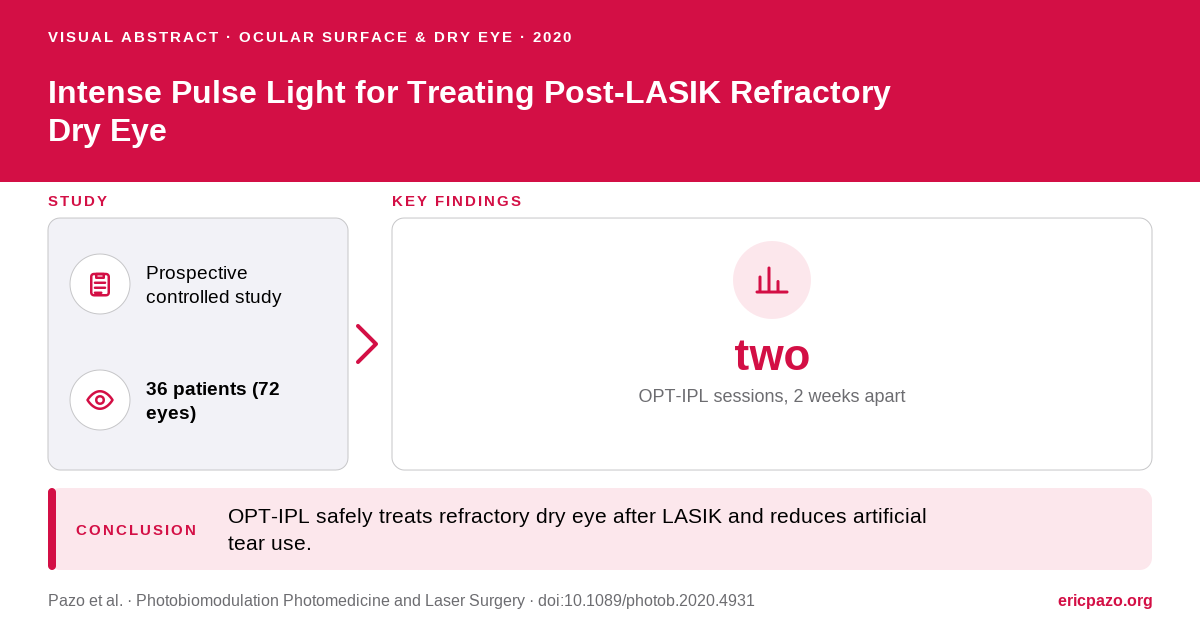
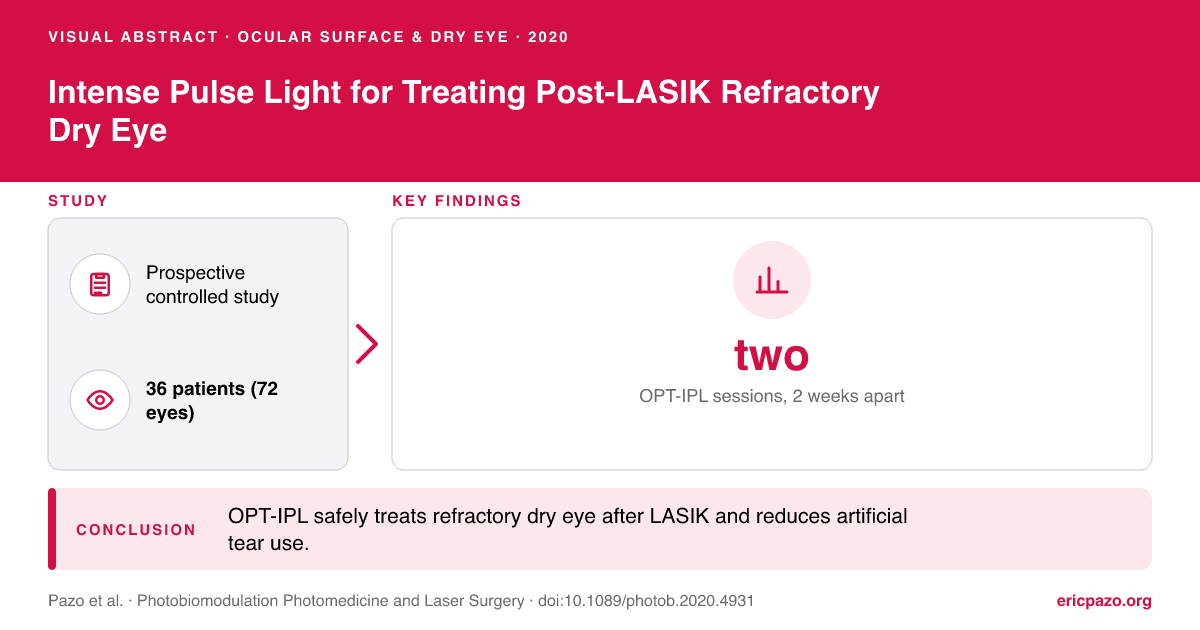
De un vistazo
La OPT-IPL trata de forma segura el ojo seco refractario tras LASIK y reduce el uso de lágrimas artificiales.
- Diseño
- Estudio prospectivo controlado
- Muestra
- 36 pacientes (72 ojos)
- Sesiones de OPT-IPL, cada 2 semanas
- two
Resumen
Este resumen se muestra en su idioma original, el inglés, porque el artículo no tiene una licencia abierta que permita traducciones.
Objective: Optimal pulse technology-intense pulse light (OPT-IPL) treatment on patients with post-LASIK refractory dry eye (DE). Background: The prevalence of dry eye disease is common and can lead to ocular discomfort, reduced visual acuity, lowered quality of vision and life. Materials and methods: A prospective study was conducted on 72 eyes of 36 patients (treatment group, n = 42 eyes; control group, n = 30 eyes) who had previously undergone myopic LASIK correction with subsequent refractory DE. All eyes fulfilled the Japanese DE criteria and had not responded to conventional DE treatment. The treatment group underwent two OPT-IPL treatment sessions at 2-week intervals, while the control group received no treatment. Best-corrected visual acuity (BCVA), ocular surface disease index (OSDI), noninvasive breakup time (NITBUT), tear film lipid layer (TFLL) quality, corneal fluorescein staining, meibum gland (MG), endothelial cell count (ECC), and intraocular pressure (IOP) were assessed at baseline (D0), day-14 (D14) and day-28 (D28) after OPT-IPL treatment. Results: The mean age of treatment group and control group was 30.48 ± 5.16 years (12 females, 57%) and 31.00 ± 4.33 years (8 females, 53%), respectively. Treatment group had clinically and statistically significant improvement in NITBUT and was observed at D14 ( p < 0.001) and D28 ( p < 0.001). OSDI, TFLL score, and MG quality and expressibility improved significantly ( p < 0.05) at D28, whereas BCVA, ECC, and IOP showed no significant changes at D14 and D28 between the groups. Conclusions: Our results suggest that post-LASIK refractory DE is safely treated with OPT-IPL treatment. OPT-IPL treatment reduced the severity of symptoms and improved the overall tear film stability in patients with severe refractory DE post-LASIK surgery. In addition, the frequency of artificial tears usage was significantly less and can be attributed to the reduction in OSDI scores due to improved TFLL and tear film stability.
Palabras clave: refractory dry eye; myopic LASIK; tear film stability; tear film lipid layer; Ocular Surface Disease Index; corneal fluorescein staining; endothelial cell count; artificial tears
Acceso
Cómo citar
Mostrar BibTeX
@article{pazo2020intense,
  title = {{Intense Pulse Light for Treating Post-LASIK Refractory Dry Eye}},
  author = {Pazo, Emmanuel Eric and Huang, He and Fan, Qing-Xia and Zhang, Can and You, Yue and Yang, Lanting and Xu, Ling and Moore, Jonathan Edward and He, Wei},
  journal = {Photobiomodulation Photomedicine and Laser Surgery},
  year = {2020},
  doi = {10.1089/photob.2020.4931},
  url = {https://doi.org/10.1089/photob.2020.4931},
}
Trabajos relacionados
- Efectos de la remodelación epitelial corneal sobre la asfericidad corneal tras FS-LASIK y Trans-PRK: un estudio prospectivo (2024)
- Tratamiento del ojo seco post-LASIK con luz pulsada intensa combinada con hialuronato sódico al 0.1% y mascarilla ocular térmica (2021)
- Investigación del impacto de la orientación del astigmatismo corneal preoperatorio sobre la refracción en equivalente esférico posoperatoria tras el implante de lente intraocular (2018)
- Límite umbral del astigmatismo posoperatorio para la satisfacción del paciente tras el cambio de cristalino con fines refractivos y el implante de lente intraocular multifocal (2016)
- Análisis de la influencia del espacio del margen del colgajo en la regeneración de los nervios corneales tras LASIK asistido por láser de femtosegundo (2026)