
Efectos de la remodelación epitelial corneal sobre la asfericidad corneal tras FS-LASIK y Trans-PRK: un estudio prospectivo
Título original: Effects of corneal epithelial remodeling on corneal asphericity after FS-LASIK and Trans-PRK: A prospective study
Mingyu Xu, Fan Yang, Emmanuel Eric Pazo, Qiwei Li, Zheng Kun Yang, Yue Huang, Shaozhen Zhao
 Indian Journal of Ophthalmology, 2024 · artículo · doi:10.4103/ijo.ijo_623_24 · citado 11 veces · Acceso abierto (CC BY-NC-SA)
Cataratas y cirugía del segmento anteriorSuperficie ocular y ojo seco
De un vistazo
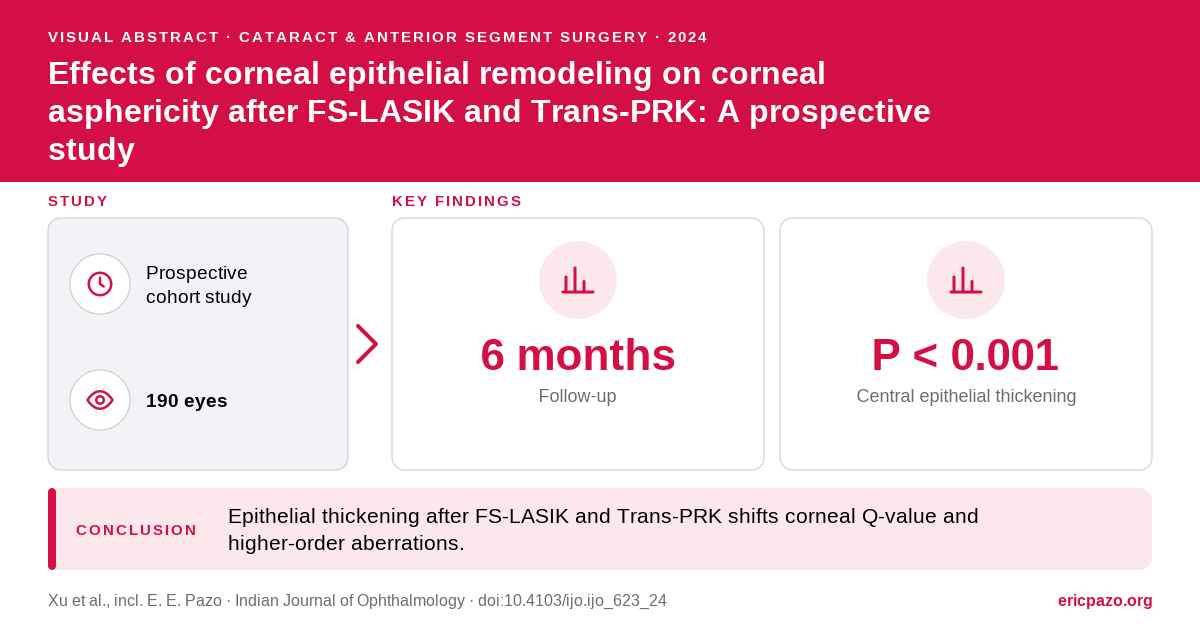
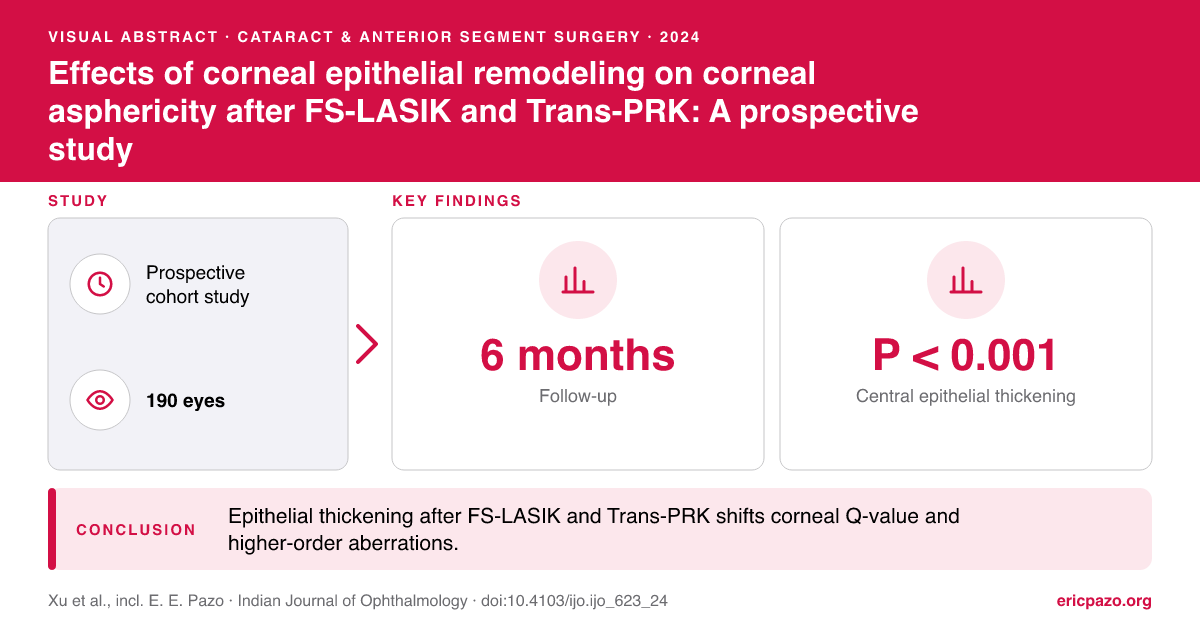
El engrosamiento epitelial tras FS-LASIK y Trans-PRK modifica el valor Q corneal y las aberraciones de alto orden.
- Diseño
- Estudio de cohortes prospectivo
- Muestra
- 190 ojos
- Seguimiento
- 6 months
- Engrosamiento epitelial central
- P < 0.001
Resumen
OBJETIVO: Observar los cambios del espesor epitelial corneal tras la cirugía FS-LASIK y Trans-PRK e investigar el impacto de la remodelación epitelial corneal sobre el valor Q y las HOA. MÉTODOS: En este estudio de cohortes prospectivo, 50 pacientes (100 ojos) se sometieron a FS-LASIK y 45 pacientes (90 ojos) a Trans-PRK. Se utilizó la OCT del segmento anterior para medir el espesor epitelial corneal en distintas zonas corneales (zona central: 0-2 mm; zona paracentral: 2-5 mm; y zona periférica media: 5-6 mm) antes de la cirugía y a la 1 semana, 1 mes, 3 meses y 6 meses después. Se analizó la correlación entre el △CET en las regiones superior, nasal, inferior y temporal a los 6 meses del posoperatorio y el △Q y el △HOA. RESULTADOS: A los 6 meses del posoperatorio, el espesor epitelial aumentó en las zonas central, paracentral y periférica media tanto en FS-LASIK como en Trans-PRK. El espesor epitelial central y las distintas regiones de la zona paracentral y de la periférica media mostraron un engrosamiento significativo ( P < 0.001). En la zona paracentral y en la periférica media, el △CET en las distintas regiones tras LASIK y Trans-PRK se correlacionó positivamente con el △Q ( P < 0.05) y el △HOA ( P < 0.05). CONCLUSIÓN: Tras FS-LASIK y Trans-PRK se observó un engrosamiento epitelial significativo. Los cambios epiteliales en las distintas regiones dan lugar a valores Q distintos en cada región y tienen efectos diferentes sobre las HOA. Esto tiene cierto valor orientativo para el diseño de la cirugía refractiva, y minimizar el aumento del valor Q podría mejorar la calidad visual posoperatoria.
Traducido del resumen original en inglés (licencia: CC BY-NC-SA).
Mostrar el resumen original
PURPOSE: To observe the changes in corneal epithelial thickness after FS-LASIK and Trans-PRK surgery and to investigate the impact of corneal epithelial remodeling on Q-value and HOA. METHODS: In this prospective cohort study, 50 patients (100 eyes) underwent FS-LASIK and 45 patients (90 eyes) underwent Trans-PRK. Anterior segment OCT was used to measure the corneal epithelial thickness in different corneal zones (central zone: 0-2 mm; paracentral zone: 2-5 mm; and mid-peripheral zone: 5-6 mm) preoperatively and postoperatively at 1 week, 1 month, 3 months, and 6 months. The correlation between △CET in the superior, nasal, inferior, and temporal region at 6 months postoperatively and △Q and △HOA was analyzed. RESULTS: At 6 months postoperatively, the epithelial thickness increased in the central, paracentral, and mid-peripheral zones in FS-LASIK and Trans-PRK. Central epithelial thickness and different regions of the paracentral zone and mid-peripheral exhibited significant thickening ( P < 0.001). In the para-central zone and mid-peripheral zone, the △CET in different regions after LASIK and Trans-PRK was positively correlated with △Q ( P < 0.05) and △HOA ( P < 0.05). CONCLUSION: After FS-LASIK and Trans-PRK, significant epithelial thickening was observed. Epithelial changes in different regions lead to different Q-values in different regions and have different effects on HOA. This has a certain guiding significance for the design of refractive surgery, and minimizing the increase of Q-value may improve the postoperative visual quality.
Palabras clave: corneal epithelial thickness; FS-LASIK; corneal asphericity; Q-value; higher-order aberrations; refractive surgery; postoperative visual quality; anterior segment OCT
Acceso
Cómo citar
Mostrar BibTeX
@article{xu2024effects,
  title = {{Effects of corneal epithelial remodeling on corneal asphericity after FS-LASIK and Trans-PRK: A prospective study}},
  author = {Xu, Mingyu and Yang, Fan and Pazo, Emmanuel Eric and Li, Qiwei and Yang, Zheng Kun and Huang, Yue and Zhao, Shaozhen},
  journal = {Indian Journal of Ophthalmology},
  year = {2024},
  doi = {10.4103/ijo.ijo_623_24},
  url = {https://doi.org/10.4103/ijo.ijo_623_24},
}
Trabajos relacionados
- Tratamiento del ojo seco post-LASIK con luz pulsada intensa combinada con hialuronato sódico al 0.1% y mascarilla ocular térmica (2021)
- Luz pulsada intensa para el tratamiento del ojo seco refractario post-LASIK (2020)
- Investigación del impacto de la orientación del astigmatismo corneal preoperatorio sobre la refracción en equivalente esférico posoperatoria tras el implante de lente intraocular (2018)
- Límite umbral del astigmatismo posoperatorio para la satisfacción del paciente tras el cambio de cristalino con fines refractivos y el implante de lente intraocular multifocal (2016)
- Análisis de la influencia del espacio del margen del colgajo en la regeneración de los nervios corneales tras LASIK asistido por láser de femtosegundo (2026)