
探索用于 ICL 植入术拱高安全性的机器学习模型:回归模型与分类模型的比较分析
原文标题: Exploring Machine Learning Models for Vault Safety in ICL Implantation: A Comparative Analysis of Regression and Classification Models
Qing Zhang, Qi Li, Zhilong Yu, Ruibo Yang, Emmanuel Eric Pazo, Yue Huang, Hui Liu, Chen Zhang, Salissou Moutari, Shaozhen Zhao
 Ophthalmology and Therapy, 2025 · 期刊论文 · doi:10.1007/s40123-025-01173-4 · 被引 5 次 · 开放获取(CC BY-NC)
要点速览
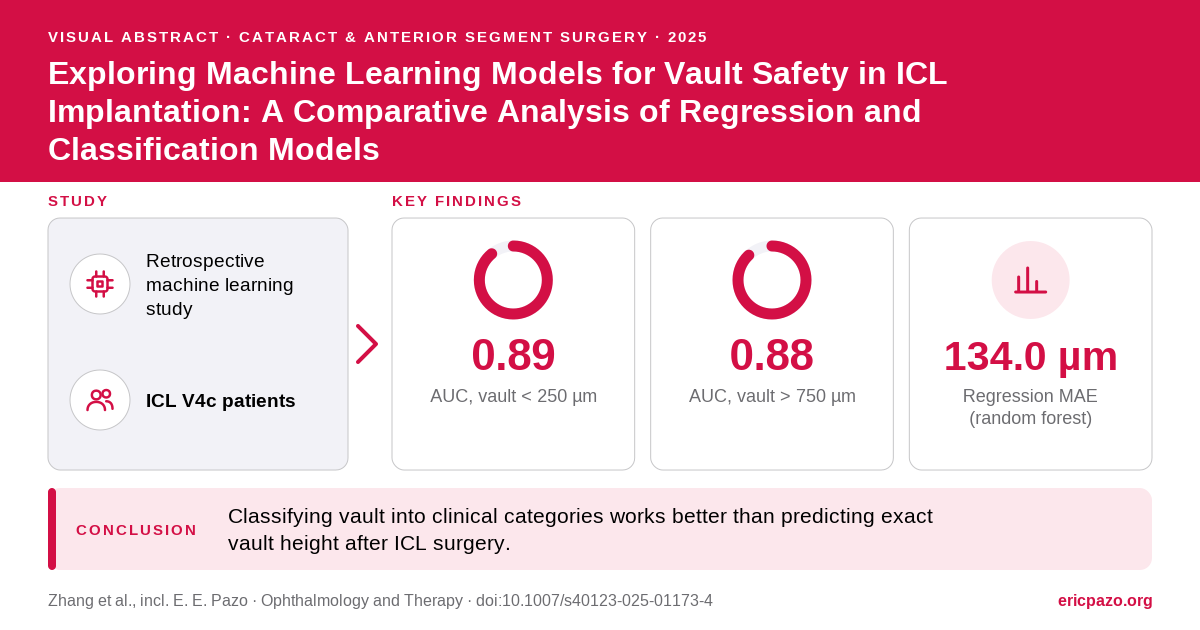
在 ICL 术后,将拱高划分为临床类别比预测精确的拱高数值效果更好。
- 研究设计
- 回顾性机器学习研究
- 样本
- ICL V4c 患者
- AUC(拱高 < 250 µm)
- 0.89
- AUC(拱高 > 750 µm)
- 0.88
- 回归 MAE(随机森林)
- 134.0 µm
摘要
引言:准确预测植入式胶原晶状体(ICL)V4c 植入术后的拱高,对减少并发症和获得最佳手术效果至关重要。本研究旨在评估机器学习模型预测术后拱高的性能,重点关注回归和分类两种方法。方法:这项回顾性研究分析了生物测量和人口学数据,包括前房深度、白到白距离和 ICL 尺寸等变量。使用梯度提升、随机森林和 CatBoost 算法构建回归模型和分类模型。回归模型将拱高作为连续变量进行预测,分类模型则将拱高划分为二分类和多分类任务。回归模型采用平均绝对误差(MAE)和均方根误差(RMSE)等指标评价,分类模型采用准确率、F1 分数和曲线下面积(AUC)评价。结果:回归模型的预测性能中等,其中随机森林表现最佳(MAE:134.0 µm,RMSE:171.3 µm,Pearson 相关系数:0.45)。另一方面,分类模型比回归方法具有更高的临床适用性。在二分类任务(拱高 < 250 µm 对 ≥ 250 µm)中,梯度提升的整体表现最好,准确率为 89 ± 12%,AUC 为 0.89。在预测拱高 > 750 µm 对 ≤ 750 µm 的任务中,随机森林是最有效的分类器,准确率为 86 ± 9%,AUC 为 0.88。在多分类任务中,模型预测中等拱高(250 µm ≤ 拱高 ≤ 750 µm)的表现更优,随机森林在该类别中的准确率最高,达 94.6%。然而,所有模型在准确划分极端拱高类别方面均存在困难。结论:分类模型,尤其是梯度提升和随机森林,在预测具有临床意义的拱高类别方面显示出很大潜力,可支持个性化手术规划并改进风险管理。回归模型虽能提供一定参考,但其局限性表明分类方法更适合临床应用。未来研究应着力提高极端拱高预测的准确性,并整合集成深度学习等先进技术以进一步优化结果。
译自英文原文摘要(许可协议:CC BY-NC)。
显示英文原文摘要
INTRODUCTION: Accurate prediction of postoperative vault height following implantable collamer lens (ICL) V4c implantation is critical for minimizing complications and achieving optimal surgical outcomes. This study aims to evaluate the performance of machine learning models in predicting postoperative vault height, focusing on both regression and classification approaches. METHODS: This retrospective study analyzed biometric and demographic data, including anterior chamber depth, white-to-white distance, and ICL size, among other variables. Regression and classification models were developed using gradient boosting, random forest, and CatBoost algorithms. Regression models predicted vault height as a continuous variable, while classification models categorized vault heights into binary and multi-class tasks. Model performance was evaluated using metrics including the mean absolute error (MAE) and root mean squared error (RMSE) for regression models, while accuracy, F1-score, and area under the curve (AUC) were used for classification models. RESULTS: Regression models demonstrated moderate predictive performance, with random forest delivering the best performance (MAE: 134.0 µm, RMSE: 171.3 µm, Pearson's correlation coefficient: 0.45). On the other hand, classification models exhibited greater clinical applicability than regression approaches. For the binary classification task (vault < 250 µm vs. ≥ 250 µm), gradient boosting achieved the highest overall performance, with accuracy of 89 ± 12% and an AUC of 0.89. In the task of predicting vault > 750 µm vs. ≤ 750 µm, random forest emerged as the most effective classifier, achieving accuracy of 86 ± 9% and an AUC of 0.88. In multi-class classification, models demonstrated superior performance in predicting intermediate vault heights (250 µm ≤ vault ≤ 750 µm). Random forest achieved the highest accuracy of 94.6% in this category. However, all models faced challenges in accurately classifying extreme vault categories. CONCLUSIONS: Classification models, particularly gradient boosting and random forest, demonstrated strong potential for predicting clinically significant vault categories, enabling personalized surgical planning and improved risk management. While regression models offered moderate insights, their limitations suggest that classification approaches are better suited for clinical applications. Future research should focus on enhancing model accuracy for extreme vault prediction and integrating advanced techniques, such as ensemble deep learning, to further refine outcomes.
关键词: implantable collamer lens; ICL V4c; classification models; regression models; gradient boosting; random forest; CatBoost; anterior chamber depth
获取全文
引用格式
显示 BibTeX
@article{zhang2025exploring,
  title = {{Exploring Machine Learning Models for Vault Safety in ICL Implantation: A Comparative Analysis of Regression and Classification Models}},
  author = {Zhang, Qing and Li, Qi and Yu, Zhilong and Yang, Ruibo and Pazo, Emmanuel Eric and Huang, Yue and Liu, Hui and Zhang, Chen and Moutari, Salissou and Zhao, Shaozhen},
  journal = {Ophthalmology and Therapy},
  year = {2025},
  doi = {10.1007/s40123-025-01173-4},
  url = {https://doi.org/10.1007/s40123-025-01173-4},
}