
基于机器学习和 Eyerobo 视力筛查仪的睫状肌麻痹验光预测:一项横断面设备比较研究
原文标题: Machine Learning-Based Prediction of Cycloplegic Refraction Using the Eyerobo Vision Screener: Design—A Cross-Sectional Comparative Device Study
Mengmeng Xia, Boxue Yao, Yumei Wang, Fengwei Liang, Wuxia Zhao, Li Qin, Shoukuan Liu, Muhammad Usama, Zhihui Zhang, Wu Guo, Emmanuel Eric Pazo, Xinjun Ren
 Ophthalmology and Therapy, 2026 · 期刊论文 · doi:10.1007/s40123-026-01482-2 · 开放获取(CC BY-NC)
要点速览
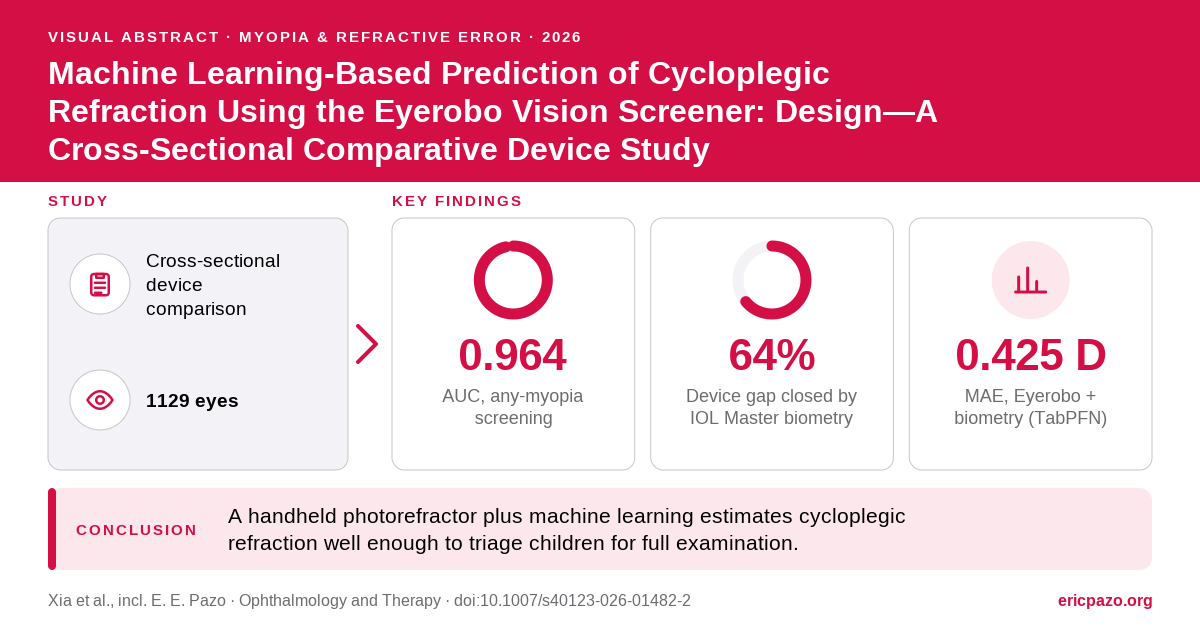
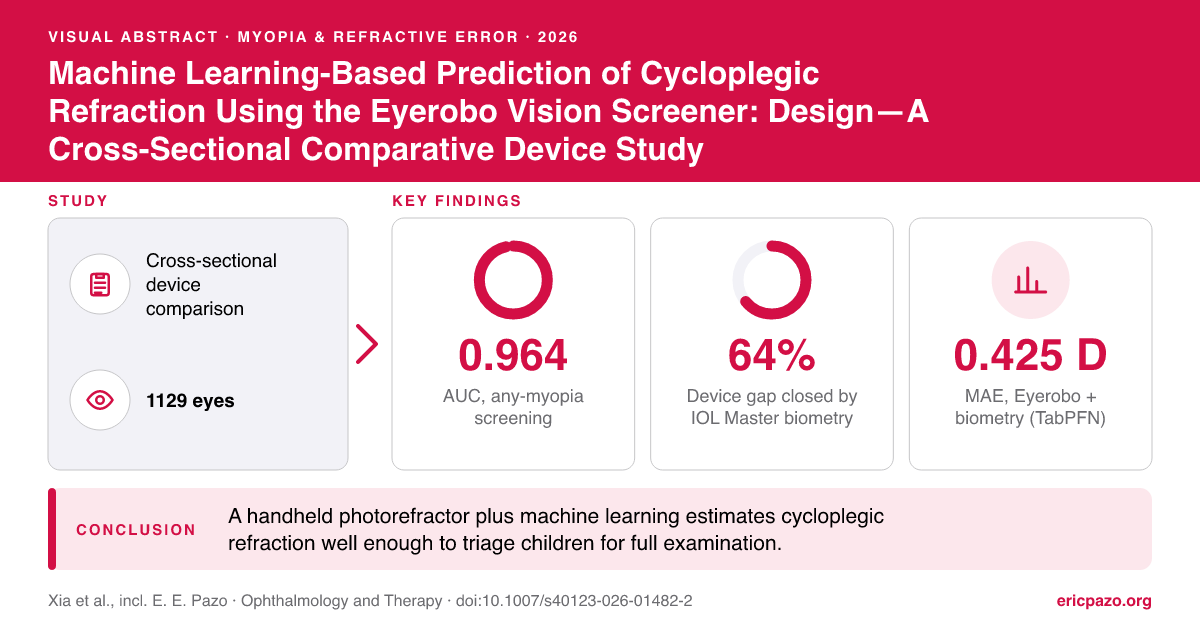
手持式摄影验光仪结合机器学习对睫状肌麻痹验光的估计足以用于筛选需要全面检查的儿童。
- 研究设计
- 横断面设备比较研究
- 样本
- 1129 只眼
- AUC(任意近视筛查)
- 0.964
- IOL Master 生物测量缩小的设备差距
- 64%
- MAE(Eyerobo + 生物测量,TabPFN)
- 0.425 D
摘要
这是一项横断面设备比较研究,旨在比较便携式手持摄影验光仪 Eyerobo 视力筛查仪(VS)与传统电脑验光仪在儿童近视队列中基于机器学习预测睫状肌麻痹后等效球镜度(SE)及屈光力矢量分量(J0、J45)的表现;评估补充 IOL Master 生物测量能否缩小设备间的性能差距;并在具有临床意义的转诊阈值下报告面向筛查的分类指标(灵敏度、特异度、阳性和阴性预测值、受试者工作特征曲线下面积 [AUC]),以量化设备与模型组合的分诊性能。研究收集了 574 名 6–18 岁患者共 1129 只眼在药物散瞳前后使用三种眼科设备获得的数据。按照 Thibos 等的方法,将所有屈光测量值分解为屈光力矢量(SE、J0、J45)。在比较 Eyerobo VS 与电脑验光仪(分别在散瞳前、散瞳后及两者合并条件下,并分为有无 IOL Master 生物测量)的对称框架下,构建了 12 种有临床依据的特征场景。TabPFN 是一种无需超参数调优的表格基础模型,研究将其与七种传统机器学习算法一同评估,采用患者水平的五折分组交叉验证,并重复三个随机种子。一致性采用 Bland–Altman 分析、Pearson 相关和临床阈值分析进行评估。除回归指标外,还在三个预先设定的临床阈值(睫状肌麻痹 SE $$\le -0.50$$ D、$$\le -3.00$$ D 和 $$\le -6.00$$ D)下进行了筛查分类分析,报告灵敏度、特异度、阳性预测值(PPV)、阴性预测值(NPV)和 AUC 及其 95% 配对自助法置信区间。研究还报告了 TabPFN 与次优算法的正式配对统计比较,以及每名患者仅取一只眼的敏感性分析。TabPFN 在所有 Eyerobo 场景中平均绝对误差(MAE)最低,在电脑验光仪场景中与 Ridge 回归相当;在主要的 Eyerobo 散瞳前 + IOL 场景中,TabPFN(0.425 D)与次优的梯度提升学习器(XGBoost,0.542 D)之间逐眼配对的 MAE 差值为 0.117 D,TabPFN 占优,配对 Wilcoxon 符号秩检验 $$p<0.001$$ 。对于散瞳前 SE 预测,电脑验光仪的 MAE 为 0.295 D(87.4% 在 ± 0.50 D 以内),而 Eyerobo VS 为 0.657 D(61.6%)。在 Eyerobo 基础上加入 IOL Master 生物测量使这一差距缩小 64%,MAE 降至 0.425 D(72.0%)。对于散光屈光力矢量分量,差距进一步缩小:J0 的 MAE 为 0.106 D(电脑验光仪)对 0.143 D(Eyerobo + IOL),J45 的 MAE 为 0.060 D 对 0.088 D。电脑验光仪散瞳后的预测接近睫状肌麻痹验光的准确度(MAE = 0.203 D,96.0% 在 ± 0.50 D 以内)。亚组分析显示,Eyerobo 在轻度近视中表现最佳(MAE = 0.398 D,75.6% 在 ± 0.50 D 以内),在高度近视和样本量较小的非近视亚组中表现下降。在筛查分类分析中,Eyerobo 与电脑验光仪在任意近视阈值下的实际表现相当(Eyerobo AUC 0.964 [95% CI 0.939–0.982],灵敏度 0.946,特异度 0.894;电脑验光仪 AUC 0.969 [0.948–0.986],灵敏度 0.960,特异度 0.886;配对 AUC 差值 0.005 [95% CI $$-0.022$$ 至 $$+0.034$$ ],在预设的 $$\delta =0.05$$ 界值下达到正式非劣效)。在这一单中心儿童转诊队列中,Eyerobo VS 结合机器学习得到的睫状肌麻痹 SE 估计值,其精度可作为分诊辅助手段,用于识别应进一步接受完整睫状肌麻痹检查的儿童;在散光分量方面,其表现与电脑验光仪接近。加入 IOL Master 生物测量使设备差距缩小了 64%。在本队列所评估的算法中,TabPFN 表现最佳且无需超参数调优,但其相对于线性和梯度提升基线的优势有限,且缺乏外部验证,因此不能将其推荐为最终首选算法。所提出的方法不能替代睫状肌麻痹验光;在临床应用前,需要在一般儿童筛查队列中进行前瞻性外部验证。
译自英文原文摘要(许可协议:CC BY-NC)。
显示英文原文摘要
A cross-sectional comparative device study to compare the Eyerobo Vision Screener (VS), a portable handheld photorefractor, against a conventional auto-refractor for machine-learning-based prediction of cycloplegic spherical equivalent (SE) and power vector components (J0, J45) in a pediatric myopia cohort, to evaluate whether supplementary IOL Master biometry narrows the performance gap between devices, and to report screening-oriented classification metrics (sensitivity, specificity, positive and negative predictive values, area under the receiver operating characteristic curve [AUC]) at clinically meaningful referral thresholds that quantify the device–model combination’s triage performance. Data from 1129 eyes of 574 patients aged 6–18 years were collected using three ophthalmic devices before and after pharmacological dilation. All refractive measurements were decomposed into power vectors (SE, J0, J45) following Thibos et al. Twelve clinically motivated feature scenarios were constructed from a symmetric framework comparing the Eyerobo VS and auto-refractor (each under predilation, post-dilation, and combined conditions), with and without IOL Master biometry. TabPFN, a tabular foundation model requiring no hyperparameter tuning, was evaluated alongside seven conventional machine-learning algorithms using patient-level five-fold grouped cross-validation repeated over three random seeds. Agreement was assessed using Bland–Altman analysis, Pearson correlation, and clinical threshold analysis. In addition to regression metrics, a screening-classification analysis was performed at three prespecified clinical thresholds (cycloplegic SE $$\le -0.50$$ D, $$\le -3.00$$ D, and $$\le -6.00$$ D), reporting sensitivity, specificity, positive predictive value (PPV), negative predictive value (NPV), and AUC with 95% paired bootstrap confidence intervals. Formal paired statistical comparison between TabPFN and the next-best algorithm and a one-eye-per-patient sensitivity analysis are also reported. TabPFN achieved the lowest mean absolute error (MAE) on all Eyerobo scenarios and was competitive with Ridge on auto-refractor scenarios; on the headline Eyerobo Pre + IOL scenario, the per-eye paired difference in MAE between TabPFN (0.425 D) and the next-best gradient-boosting learner (XGBoost, 0.542 D) was 0.117 D in favour of TabPFN, with paired Wilcoxon signed-rank $$p<0.001$$ . For predilation SE prediction, the auto-refractor achieved an MAE of 0.295 D (87.4% within ± 0.50 D), compared with 0.657 D (61.6%) for the Eyerobo VS. Adding IOL Master biometry to the Eyerobo reduced this gap by 64%, yielding an MAE of 0.425 D (72.0%). For astigmatic power vector components, the gap narrowed further: J0 MAE was 0.106 D (auto-refractor) versus 0.143 D (Eyerobo + IOL), and J45 MAE was 0.060 D versus 0.088 D. Auto-refractor post-dilation predictions approached cycloplegic accuracy (MAE = 0.203 D, 96.0% within ± 0.50 D). Subgroup analysis showed the Eyerobo performed best for mild myopia (MAE = 0.398 D, 75.6% within ± 0.50 D) and degraded for high myopia and the small nonmyopic stratum. In the screening-classification analysis, the Eyerobo and the auto-refractor were operationally equivalent at the any-myopia threshold (Eyerobo AUC 0.964 [95% CI 0.939–0.982], sensitivity 0.946, specificity 0.894; auto-refractor AUC 0.969 [0.948–0.986], sensitivity 0.960, specificity 0.886; paired AUC difference 0.005 [95% CI $$-0.022$$ to $$+0.034$$ ], formally noninferior under a prespecified $$\delta =0.05$$ margin). Within this single-center pediatric referral cohort, the Eyerobo VS combined with machine learning produced cycloplegic SE estimates of a precision consistent with use as a triage adjunct to identify children who should proceed to a full cycloplegic examination, with near-equivalent performance to the auto-refractor for astigmatic components. The addition of IOL Master biometry narrowed the device gap by 64%. TabPFN achieved the best performance among the evaluated algorithms within this cohort and requires no hyperparameter tuning, but the modest margin over linear and gradient-boosting baselines and the absence of external validation preclude any recommendation as the definitive algorithm of choice. The proposed approach is not a substitute for cycloplegic refraction; prospective external validation in a general pediatric screening cohort is required before clinical deployment.
关键词: cycloplegic refraction; childhood myopia; spherical equivalent; power vectors; TabPFN; machine learning prediction; refractive error screening; device comparison
获取全文
引用格式
显示 BibTeX
@article{xia2026machine,
  title = {{Machine Learning-Based Prediction of Cycloplegic Refraction Using the Eyerobo Vision Screener: Design—A Cross-Sectional Comparative Device Study}},
  author = {Xia, Mengmeng and Yao, Boxue and Wang, Yumei and Liang, Fengwei and Zhao, Wuxia and Qin, Li and Liu, Shoukuan and Usama, Muhammad and Zhang, Zhihui and Guo, Wu and Pazo, Emmanuel Eric and Ren, Xinjun},
  journal = {Ophthalmology and Therapy},
  year = {2026},
  doi = {10.1007/s40123-026-01482-2},
  url = {https://doi.org/10.1007/s40123-026-01482-2},
}