
强脉冲光治疗 LASIK 术后难治性干眼
原文标题: Intense Pulse Light for Treating Post-LASIK Refractory Dry Eye
Emmanuel Eric Pazo, He Huang, Qing-Xia Fan, Can Zhang, Yue You, Lanting Yang, Ling Xu, Jonathan Edward Moore, Wei He
 Photobiomodulation Photomedicine and Laser Surgery, 2020 · 期刊论文 · doi:10.1089/photob.2020.4931 · 被引 42 次
要点速览
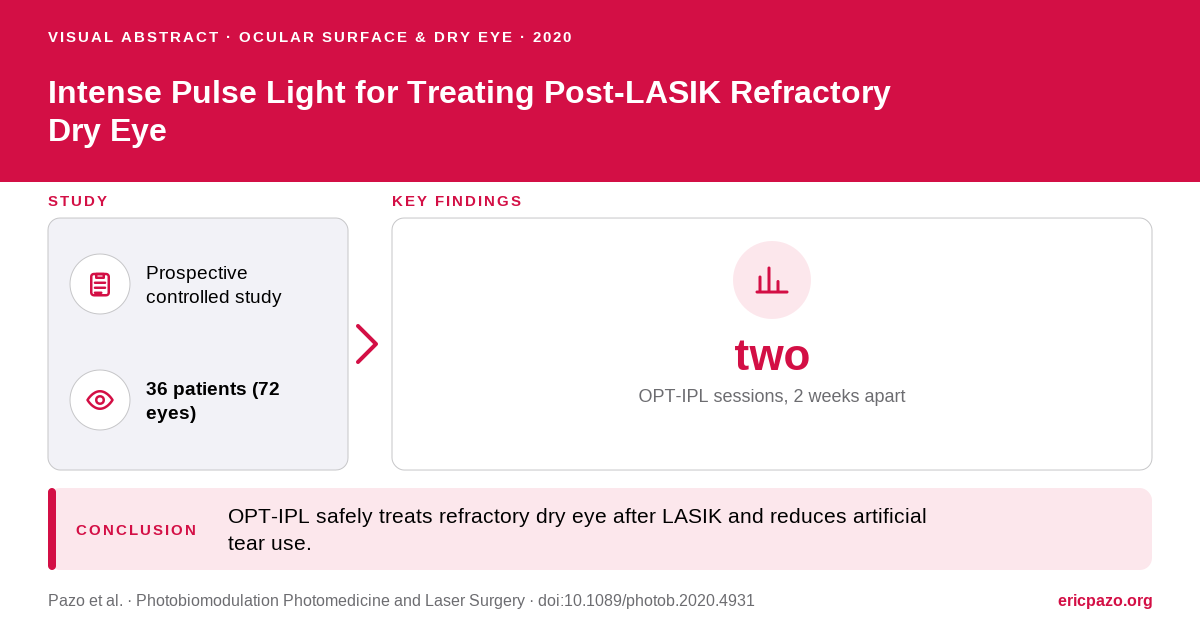
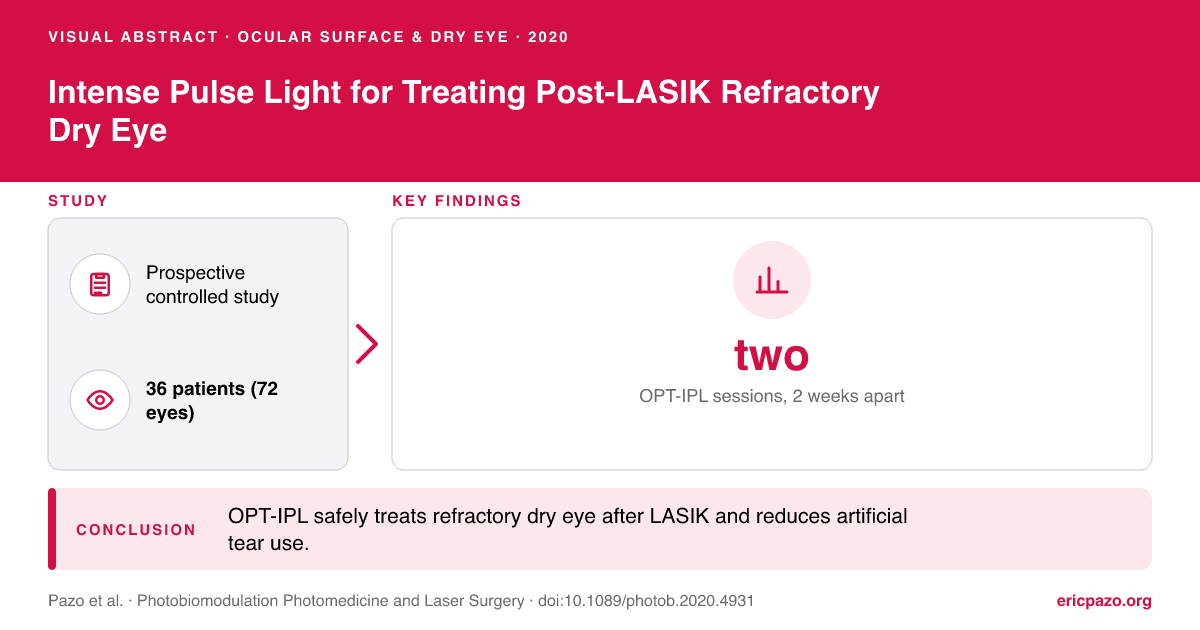
OPT 强脉冲光可安全治疗 LASIK 术后难治性干眼,并减少人工泪液的使用。
- 研究设计
- 前瞻性对照研究
- 样本
- 36 例患者(72 只眼)
- OPT-IPL 治疗次数(间隔 2 周)
- two
摘要
本文摘要以原文(英文)显示,因为该文章未采用允许翻译的开放许可协议。
Objective: Optimal pulse technology-intense pulse light (OPT-IPL) treatment on patients with post-LASIK refractory dry eye (DE). Background: The prevalence of dry eye disease is common and can lead to ocular discomfort, reduced visual acuity, lowered quality of vision and life. Materials and methods: A prospective study was conducted on 72 eyes of 36 patients (treatment group, n = 42 eyes; control group, n = 30 eyes) who had previously undergone myopic LASIK correction with subsequent refractory DE. All eyes fulfilled the Japanese DE criteria and had not responded to conventional DE treatment. The treatment group underwent two OPT-IPL treatment sessions at 2-week intervals, while the control group received no treatment. Best-corrected visual acuity (BCVA), ocular surface disease index (OSDI), noninvasive breakup time (NITBUT), tear film lipid layer (TFLL) quality, corneal fluorescein staining, meibum gland (MG), endothelial cell count (ECC), and intraocular pressure (IOP) were assessed at baseline (D0), day-14 (D14) and day-28 (D28) after OPT-IPL treatment. Results: The mean age of treatment group and control group was 30.48 ± 5.16 years (12 females, 57%) and 31.00 ± 4.33 years (8 females, 53%), respectively. Treatment group had clinically and statistically significant improvement in NITBUT and was observed at D14 ( p < 0.001) and D28 ( p < 0.001). OSDI, TFLL score, and MG quality and expressibility improved significantly ( p < 0.05) at D28, whereas BCVA, ECC, and IOP showed no significant changes at D14 and D28 between the groups. Conclusions: Our results suggest that post-LASIK refractory DE is safely treated with OPT-IPL treatment. OPT-IPL treatment reduced the severity of symptoms and improved the overall tear film stability in patients with severe refractory DE post-LASIK surgery. In addition, the frequency of artificial tears usage was significantly less and can be attributed to the reduction in OSDI scores due to improved TFLL and tear film stability.
关键词: refractory dry eye; myopic LASIK; tear film stability; tear film lipid layer; Ocular Surface Disease Index; corneal fluorescein staining; endothelial cell count; artificial tears
获取全文
引用格式
显示 BibTeX
@article{pazo2020intense,
  title = {{Intense Pulse Light for Treating Post-LASIK Refractory Dry Eye}},
  author = {Pazo, Emmanuel Eric and Huang, He and Fan, Qing-Xia and Zhang, Can and You, Yue and Yang, Lanting and Xu, Ling and Moore, Jonathan Edward and He, Wei},
  journal = {Photobiomodulation Photomedicine and Laser Surgery},
  year = {2020},
  doi = {10.1089/photob.2020.4931},
  url = {https://doi.org/10.1089/photob.2020.4931},
}