
Comparaison des performances et de la qualité visuelles avec une addition de près inféronasale symétrique combinée et avec un positionnement inféronasal et supérotemporal de lentilles intraoculaires multifocales réfractives à asymétrie rotationnelle
Titre original : Comparison of the visual performance and quality of vision with combined symmetrical inferonasal near addition versus inferonasal and superotemporal placement of rotationally asymmetric refractive multifocal intraocular lenses
Richard N. McNeely, Emmanuel Eric Pazo, Andrew Spence, Olivier Richoz, Andrew M. Nesbit, Tara Moore, Jonathan Edward Moore
 Journal of Cataract & Refractive Surgery, 2016 · article · doi:10.1016/j.jcrs.2016.10.016 · cité 27 fois
Cataracte et chirurgie du segment antérieur
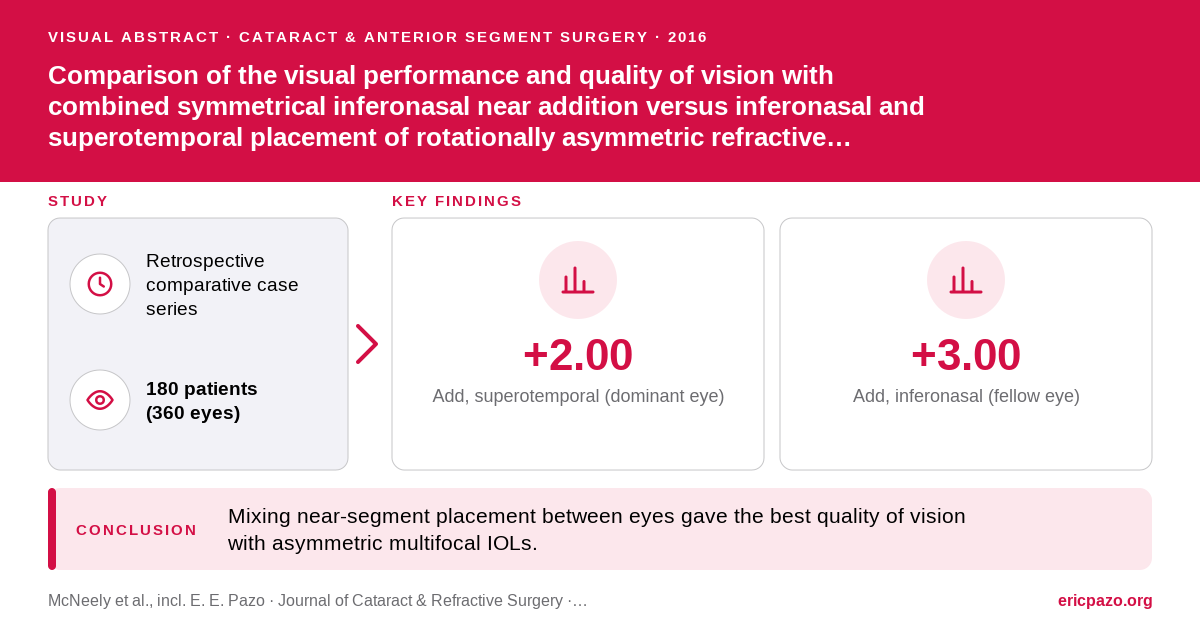
En bref
Alterner la position du segment de près entre les deux yeux a donné la meilleure qualité de vision avec les implants multifocaux asymétriques.
- Type d'étude
- Série de cas comparative rétrospective
- Échantillon
- 180 patients (360 yeux)
- Addition, supérotemporale (œil dominant)
- +2.00
- Addition, inféronasale (œil adelphe)
- +3.00
Résumé
Ce résumé est affiché dans sa langue d'origine, l'anglais, car l'article n'est pas publié sous une licence ouverte autorisant les traductions.
PURPOSE: To compare the postoperative quality of vision between different bilateral placements of near segments of rotationally asymmetric refractive multifocal intraocular lenses (IOLs) and to determine how this affects visual performance. SETTING: Cathedral Eye Clinic, Belfast, Northern Ireland, United Kingdom. DESIGN: Retrospective comparative case series. METHODS: The study enrolled consecutive patients having refractive lens exchange and implantation of rotationally asymmetric multifocal IOLs. Group 1 received bilateral SBL-3 IOLs and Group 2 received bilateral Lentis Mplus LS-312 MF30 IOLs, with the near segments placed inferonasally in each group. Group 3 received a Lentis Mplus LS-312 MF20 IOL in the dominant eye with the near segment positioned superotemporal and a Lenstec SBL-3 IOL positioned inferonasally in the fellow eye. Binocular uncorrected (UDVA) and corrected distance visual acuities, binocular uncorrected near (UNVA) and intermediate (UIVA) visual acuities, binocular distance-corrected near and intermediate visual acuities, and quality of vision were evaluated over 3 months postoperatively. RESULTS: The study enrolled 180 patients (360 eyes). There was no significant difference between the groups in binocular UDVA, UIVA, and UNVA; however, there was a significant difference between the groups in quality of vision (P ≤ .001). Group 3 had significantly better overall quality of vision. CONCLUSION: When implanting rotationally asymmetric multifocal IOLs, a combination of superotemporal placement of the near segment (+2.00 diopter [D] addition [add]) in the dominant eye with inferonasal placement of the near segment (+3.00 D add) in the fellow eye yielded consistent, high overall quality of vision and uncorrected visual acuity. FINANCIAL DISCLOSURE: None of the authors has a financial or proprietary interest in any material or method mentioned.
Mots-clés : refractive lens exchange; visual quality; visual performance; uncorrected visual acuity; intermediate vision
Accès
Comment citer
Afficher le BibTeX
@article{mcneely2016comparison,
  title = {{Comparison of the visual performance and quality of vision with combined symmetrical inferonasal near addition versus inferonasal and superotemporal placement of rotationally asymmetric refractive multifocal intraocular lenses}},
  author = {McNeely, Richard N. and Pazo, Emmanuel Eric and Spence, Andrew and Richoz, Olivier and Nesbit, Andrew M. and Moore, Tara and Moore, Jonathan Edward},
  journal = {Journal of Cataract & Refractive Surgery},
  year = {2016},
  doi = {10.1016/j.jcrs.2016.10.016},
  url = {https://doi.org/10.1016/j.jcrs.2016.10.016},
}
Travaux liés
- Observance du suivi à long terme après implantation d'une lentille en collamer implantable chez des patients fortement myopes : une étude monocentrique de cohorte rétrospective et d'enquête CAP (2026)
- Prédiction de la réfraction sous cycloplégie par apprentissage automatique avec l'Eyerobo Vision Screener : plan, une étude transversale comparative d'appareils (2026)
- Évaluer l'impact des lampes à fente portables assistées par IA sur les soins ophtalmologiques primaires en milieu rural (2025)
- Caractéristiques des paramètres biologiques et choix de la taille de la lentille en collamer implantable (ICL) dans les yeux myopes modérés, forts et très forts (2025)
- Exploration de modèles d'apprentissage automatique pour la sécurité du vault dans l'implantation d'ICL : une analyse comparative de modèles de régression et de classification (2025)