
Impacto de la solución oftálmica de diquafosol sobre la película lagrimal y los síntomas de ojo seco en el ojo seco diabético tipo 2: un estudio piloto
Título original: Impact of Diquafosol Ophthalmic Solution on Tear Film and Dry Eye Symptom in Type 2 Diabetic Dry Eye: A Pilot Study
Qing Zhang, Hongda Zhang, Guanghao Qin, Yi Wu, Yilin Song, Lanting Yang, Sile Yu, Xingru He, Jonathan Edward Moore, Salissou Moutari, Christoph Palme, Ling Xu, Wei He, Emmanuel Eric Pazo
 Journal of Ocular Pharmacology and Therapeutics, 2022 · artículo · doi:10.1089/jop.2021.0083 · citado 34 veces
De un vistazo
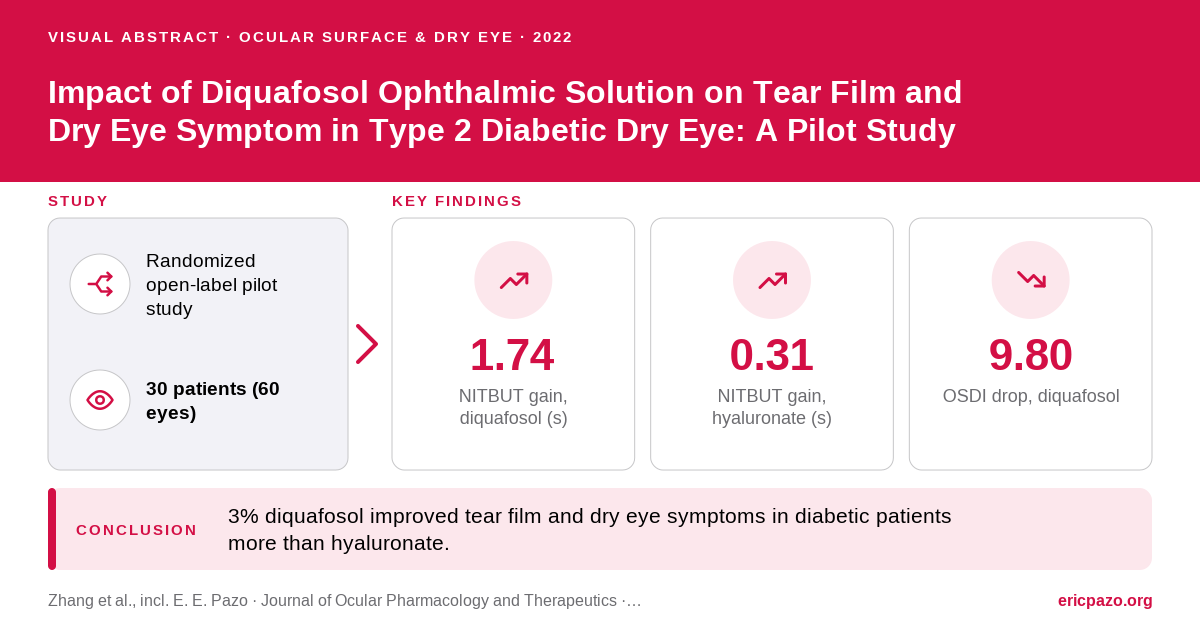
El diquafosol al 3% mejoró la película lagrimal y los síntomas de ojo seco en pacientes diabéticos más que el hialuronato.
- Diseño
- Estudio piloto aleatorizado abierto
- Muestra
- 30 pacientes (60 ojos)
- Aumento del NITBUT, diquafosol (s)
- 1.74
- Aumento del NITBUT, hialuronato (s)
- 0.31
- Descenso del OSDI, diquafosol
- 9.80
Resumen
Este resumen se muestra en su idioma original, el inglés, porque el artículo no tiene una licencia abierta que permita traducciones.
Purpose: Diquafosol ophthalmic solution (DQS) stimulates P2Y2 receptors on the ocular surface, which enhances mucin secretion from goblet cells. Therefore, tear film stability and hydration of the ocular surface can be achieved independent from lacrimal gland function. Methods: This prospective, open-label pilot study included 60 eyes of 30 diabetic patients diagnosed with dry eye disease (DED) and were randomly assigned to either DQS ( n = 30 eyes) or hyaluronate (HA) group ( n = 30 eyes). Participants in the DQS group received 3% diquafosol ophthalmic solution, whereas HA group received 0.1% sodium HA preservative-free artificial tears. The dosage for both drugs was 1 drop, 6 times per day for 4 weeks. Tear film lipid layer (TFLL), noninvasive breakup time (NITBUT), corneoconjunctival staining (CS) score, meibomian gland (MG), conjunctival hyperemia [redness score (RS)], ocular surface disease index (OSDI) was assessed and compared at baseline, day 14, and day 28. Results: Comparing baseline and day 28 measurements revealed that both groups found significant improvements in NITBUT, CS, MG quality, MG expressibility, and OSDI scores significantly ( P < 0.05), in addition TFLL improvements were only found in the DQS group. At day 28, the magnitude of change in mean NITBUT was 1.74 (DQS) versus 0.31 (HA), 1.16 (DQS) versus 0.37 (HA) point grade reduction in corneoconjunctival staining score and 9.80 (DQS) versus 4.80 (HA) point grade in mean OSDI score. Conclusion: Three percent diquafosol ophthalmic solution treatment demonstrated the ability to improve the tear film dry eye parameters and clinically reduced sign and symptoms of DED in diabetic dry eye patients. Clinical Trials.gov ID: NCT04980144.
Palabras clave: type 2 diabetes; tear film stability; meibomian gland dysfunction; Ocular Surface Disease Index; mucin secretion; tear film lipid layer
Acceso
Cómo citar
Mostrar BibTeX
@article{zhang2022impact,
  title = {{Impact of Diquafosol Ophthalmic Solution on Tear Film and Dry Eye Symptom in Type 2 Diabetic Dry Eye: A Pilot Study}},
  author = {Zhang, Qing and Zhang, Hongda and Qin, Guanghao and Wu, Yi and Song, Yilin and Yang, Lanting and Yu, Sile and He, Xingru and Moore, Jonathan Edward and Moutari, Salissou and Palme, Christoph and Xu, Ling and He, Wei and Pazo, Emmanuel Eric},
  journal = {Journal of Ocular Pharmacology and Therapeutics},
  year = {2022},
  doi = {10.1089/jop.2021.0083},
  url = {https://doi.org/10.1089/jop.2021.0083},
}
Trabajos relacionados
- Análisis de la influencia del espacio del margen del colgajo en la regeneración de los nervios corneales tras LASIK asistido por láser de femtosegundo (2026)
- Comparación entre el efecto de la luz pulsada intensa y la higiene palpebral sobre la película lagrimal y la superficie ocular: un estudio controlado aleatorizado (2026)
- Effects of 3% diquafosol sodium on tear film stability, corneal aberration parameters, and vision-related quality of life in pediatric orthokeratology-associated dry eye disease (2026)
- Asociación entre el índice de masa corporal materno previo al embarazo y el astigmatismo y la curvatura corneal de la descendencia: un estudio transversal (2025)
- Expresión diferencial de linfotoxina α, inmunoglobulina E y metaloproteinasa de matriz 9 en lágrimas en el ojo seco asociado a conjuntivitis alérgica (2025)