
Asociación entre el índice de masa corporal materno previo al embarazo y el astigmatismo y la curvatura corneal de la descendencia: un estudio transversal
Título original: Association Between Maternal Pre-Pregnancy Body Mass Index and Astigmatism and Corneal Curvature in Offspring: A Cross-Sectional Study
Yuanyuan Han, Hongyu Lv, Yidan Cao, Jing Tao Wu, Xiaoyu Zeng, Emmanuel Eric Pazo, Yaxin Zhao, Jia Lv, Wenli Lu, Xuehan Qian, Nan Wei
 Clinical ophthalmology, 2025 · artículo · doi:10.2147/opth.s532009 · citado 2 veces · Acceso abierto (CC BY-NC)
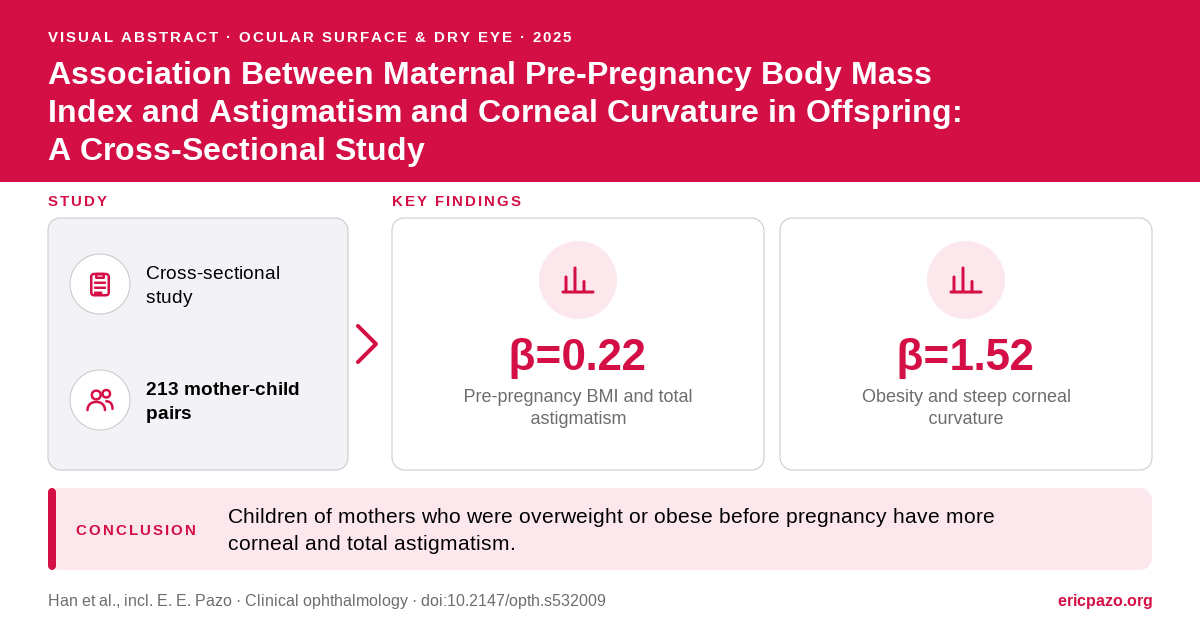
De un vistazo
Los hijos de madres con sobrepeso u obesidad antes del embarazo tienen más astigmatismo corneal y total.
- Diseño
- Estudio transversal
- Muestra
- 213 parejas madre-hijo
- IMC previo al embarazo y astigmatismo total
- β=0.22
- Obesidad y curvatura corneal más curva
- β=1.52
Resumen
Objetivo: Investigar la asociación entre el índice de masa corporal (IMC) materno previo al embarazo y el astigmatismo y la curvatura corneal de la descendencia. Pacientes y métodos: Se utilizaron una topografía corneal y un biómetro óptico para medir los parámetros oculares, y se realizó una autorrefracción ciclopléjica para evaluar la dioptría cilíndrica y el eje. Mediante cuestionarios se recogió información demográfica, del embarazo y de los hijos. Se realizaron análisis de regresión lineal múltiple para evaluar la asociación. Resultados: Se incluyeron 213 parejas madre-hijo. El IMC materno previo al embarazo se clasificó como bajo peso (11.3%), peso normal (66.7%), sobrepeso (16.0%) y obesidad (6.1%). La edad media de los hijos fue de 6.80 ± 2.44 años (varones 49.3%). Los hijos de madres con sobrepeso u obesidad antes del embarazo presentaron una curvatura corneal más curva, una curvatura corneal media, un astigmatismo corneal y un astigmatismo total significativamente mayores que los del grupo con IMC previo normal. En el análisis de regresión lineal múltiple, tras ajustar por las covariables pertinentes, el IMC previo al embarazo se asoció positivamente con la curvatura corneal más curva (β=0.35, P=0.005), el astigmatismo corneal (β=0.21, P=0.001) y el astigmatismo total (β=0.22, P<0.001). En comparación con un IMC previo normal, la obesidad previa al embarazo se asoció positivamente con la curvatura corneal más curva de los hijos (β=1.52, P=0.002), y los hijos de madres con sobrepeso u obesidad antes del embarazo tuvieron una prevalencia significativamente mayor de astigmatismo corneal (sobrepeso: β=0.56, P=0.001; obesidad: β=0.55, P=0.038) y de astigmatismo total (sobrepeso: β=0.47, P=0.002; obesidad: β=0.59, P=0.010). Conclusión: Los hijos de madres con sobrepeso u obesidad antes del embarazo muestran una mayor prevalencia de astigmatismo corneal y total que los de madres con peso normal.
Traducido del resumen original en inglés (licencia: CC BY-NC).
Mostrar el resumen original
Purpose: To investigate the association between maternal pre-pregnancy body mass index (BMI) and astigmatism and corneal curvature in offspring. Patients and Methods: Corneal topography and an optical biometer were used to measure ocular parameters, while cycloplegic autorefraction was performed to assess cylindrical diopter and axis. Demographic, pregnancy, and offspring-related information was collected through questionnaires. Multiple linear regression analyses were conducted to evaluate the association. Results: A total of 213 mother-child pairs were included. Maternal pre-pregnancy BMI was categorized as underweight (11.3%), normal weight (66.7%), overweight (16.0%), and obese (6.1%). The mean age of the offspring was 6.80 ± 2.44 years (males 49.3%). Offspring born to mothers with overweight or obese pre-pregnancy BMI exhibited significantly higher steep corneal curvature, average corneal curvature, corneal astigmatism, and total astigmatism compared to those in the normal pre-pregnancy BMI group. In multiple linear regression analysis, after adjusting for relevant covariates, pre-pregnancy BMI was positively associated with steep corneal curvature (β=0.35, P=0.005), corneal astigmatism (β=0.21, P=0.001), and total astigmatism (β=0.22, P<0.001). Compared to normal pre-pregnancy BMI, pre-pregnancy obesity was positively associated with offspring steep corneal curvature (β=1.52, P=0.002) and those born to mothers with overweight or obese pre-pregnancy BMI had a significantly higher prevalence of corneal astigmatism (overweight: β=0.56, P=0.001; obese: β=0.55, P=0.038) and total astigmatism (overweight: β=0.47, P=0.002; obese: β=0.59, P=0.010). Conclusion: Offspring of mothers with overweight or obese pre-pregnancy BMI show higher prevalence of developing corneal and total astigmatism compared to the normal.
Palabras clave: pre-pregnancy body mass index; maternal obesity; maternal overweight; corneal astigmatism; corneal curvature
Acceso
Cómo citar
Mostrar BibTeX
@article{han2025association,
  title = {{Association Between Maternal Pre-Pregnancy Body Mass Index and Astigmatism and Corneal Curvature in Offspring: A Cross-Sectional Study}},
  author = {Han, Yuanyuan and Lv, Hongyu and Cao, Yidan and Wu, Jing Tao and Zeng, Xiaoyu and Pazo, Emmanuel Eric and Zhao, Yaxin and Lv, Jia and Lu, Wenli and Qian, Xuehan and Wei, Nan},
  journal = {Clinical ophthalmology},
  year = {2025},
  doi = {10.2147/opth.s532009},
  url = {https://doi.org/10.2147/opth.s532009},
}
Trabajos relacionados
- Análisis de la influencia del espacio del margen del colgajo en la regeneración de los nervios corneales tras LASIK asistido por láser de femtosegundo (2026)
- Comparación entre el efecto de la luz pulsada intensa y la higiene palpebral sobre la película lagrimal y la superficie ocular: un estudio controlado aleatorizado (2026)
- Effects of 3% diquafosol sodium on tear film stability, corneal aberration parameters, and vision-related quality of life in pediatric orthokeratology-associated dry eye disease (2026)
- Expresión diferencial de linfotoxina α, inmunoglobulina E y metaloproteinasa de matriz 9 en lágrimas en el ojo seco asociado a conjuntivitis alérgica (2025)
- Influencia del diámetro corneal en la biomecánica y la biometría corneales en pacientes chinos: un estudio transversal (2025)