
Impact du collyre de diquafosol sur le film lacrymal et les symptômes de sécheresse oculaire dans la sécheresse oculaire liée au diabète de type 2 : une étude pilote
Titre original : Impact of Diquafosol Ophthalmic Solution on Tear Film and Dry Eye Symptom in Type 2 Diabetic Dry Eye: A Pilot Study
Qing Zhang, Hongda Zhang, Guanghao Qin, Yi Wu, Yilin Song, Lanting Yang, Sile Yu, Xingru He, Jonathan Edward Moore, Salissou Moutari, Christoph Palme, Ling Xu, Wei He, Emmanuel Eric Pazo
 Journal of Ocular Pharmacology and Therapeutics, 2022 · article · doi:10.1089/jop.2021.0083 · cité 34 fois
Surface oculaire et sécheresse oculaire
En bref
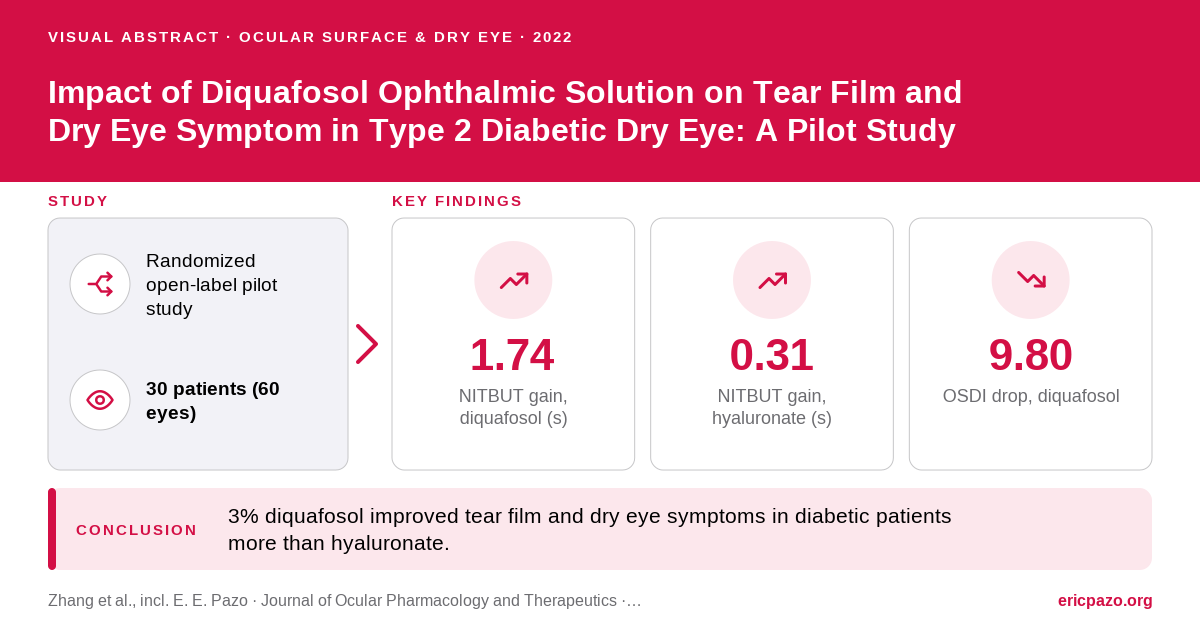
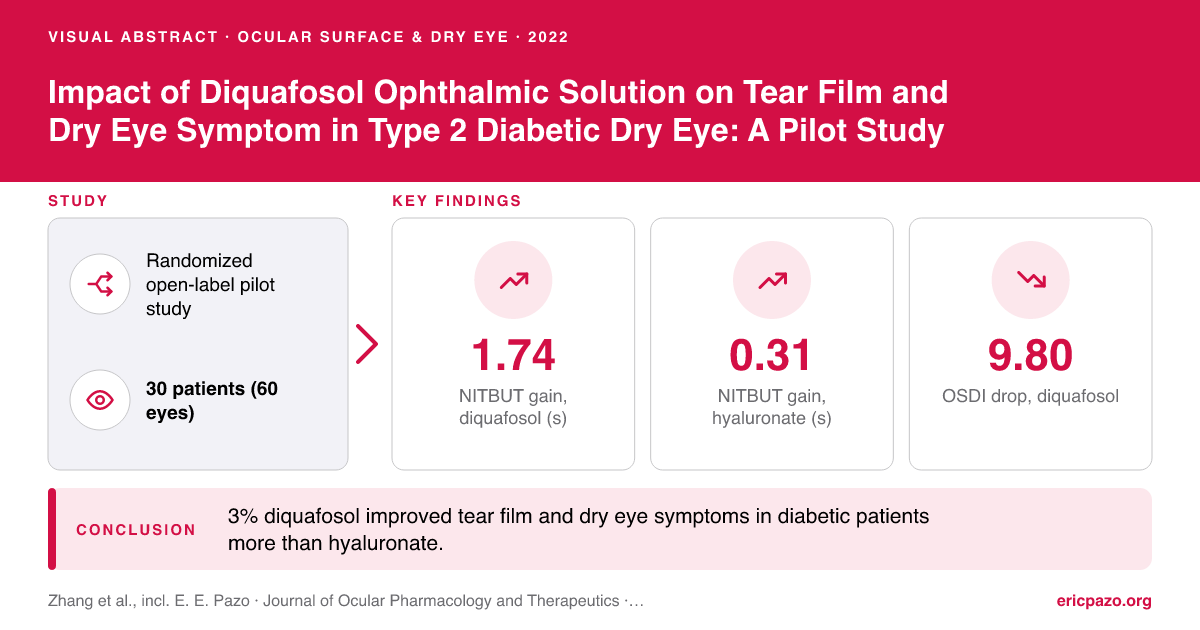
Le diquafosol à 3 % a davantage amélioré le film lacrymal et les symptômes de sécheresse oculaire que le hyaluronate chez les diabétiques.
- Type d'étude
- Étude pilote randomisée en ouvert
- Échantillon
- 30 patients (60 yeux)
- Gain de NITBUT, diquafosol (s)
- 1.74
- Gain de NITBUT, hyaluronate (s)
- 0.31
- Baisse de l'OSDI, diquafosol
- 9.80
Résumé
Ce résumé est affiché dans sa langue d'origine, l'anglais, car l'article n'est pas publié sous une licence ouverte autorisant les traductions.
Purpose: Diquafosol ophthalmic solution (DQS) stimulates P2Y2 receptors on the ocular surface, which enhances mucin secretion from goblet cells. Therefore, tear film stability and hydration of the ocular surface can be achieved independent from lacrimal gland function. Methods: This prospective, open-label pilot study included 60 eyes of 30 diabetic patients diagnosed with dry eye disease (DED) and were randomly assigned to either DQS ( n = 30 eyes) or hyaluronate (HA) group ( n = 30 eyes). Participants in the DQS group received 3% diquafosol ophthalmic solution, whereas HA group received 0.1% sodium HA preservative-free artificial tears. The dosage for both drugs was 1 drop, 6 times per day for 4 weeks. Tear film lipid layer (TFLL), noninvasive breakup time (NITBUT), corneoconjunctival staining (CS) score, meibomian gland (MG), conjunctival hyperemia [redness score (RS)], ocular surface disease index (OSDI) was assessed and compared at baseline, day 14, and day 28. Results: Comparing baseline and day 28 measurements revealed that both groups found significant improvements in NITBUT, CS, MG quality, MG expressibility, and OSDI scores significantly ( P < 0.05), in addition TFLL improvements were only found in the DQS group. At day 28, the magnitude of change in mean NITBUT was 1.74 (DQS) versus 0.31 (HA), 1.16 (DQS) versus 0.37 (HA) point grade reduction in corneoconjunctival staining score and 9.80 (DQS) versus 4.80 (HA) point grade in mean OSDI score. Conclusion: Three percent diquafosol ophthalmic solution treatment demonstrated the ability to improve the tear film dry eye parameters and clinically reduced sign and symptoms of DED in diabetic dry eye patients. Clinical Trials.gov ID: NCT04980144.
Mots-clés : type 2 diabetes; tear film stability; meibomian gland dysfunction; Ocular Surface Disease Index; mucin secretion; tear film lipid layer
Accès
Comment citer
Afficher le BibTeX
@article{zhang2022impact,
  title = {{Impact of Diquafosol Ophthalmic Solution on Tear Film and Dry Eye Symptom in Type 2 Diabetic Dry Eye: A Pilot Study}},
  author = {Zhang, Qing and Zhang, Hongda and Qin, Guanghao and Wu, Yi and Song, Yilin and Yang, Lanting and Yu, Sile and He, Xingru and Moore, Jonathan Edward and Moutari, Salissou and Palme, Christoph and Xu, Ling and He, Wei and Pazo, Emmanuel Eric},
  journal = {Journal of Ocular Pharmacology and Therapeutics},
  year = {2022},
  doi = {10.1089/jop.2021.0083},
  url = {https://doi.org/10.1089/jop.2021.0083},
}
Travaux liés
- Analyse de l'influence de l'espace au bord du volet sur la régénération des nerfs cornéens après LASIK assisté par laser femtoseconde (2026)
- Comparaison des effets de la lumière pulsée intense et de l'hygiène palpébrale sur le film lacrymal et la surface oculaire : une étude contrôlée randomisée (2026)
- Effects of 3% diquafosol sodium on tear film stability, corneal aberration parameters, and vision-related quality of life in pediatric orthokeratology-associated dry eye disease (2026)
- Association entre l'indice de masse corporelle maternel avant la grossesse et l'astigmatisme et la courbure cornéenne de l'enfant : une étude transversale (2025)
- Expression différentielle de la lymphotoxine α, de l'immunoglobuline E et de la métalloprotéinase matricielle 9 lacrymales dans la sécheresse oculaire associée à la conjonctivite allergique (2025)