
地夸磷索滴眼液对 2 型糖尿病干眼患者泪膜及干眼症状的影响:一项初步研究
原文标题: Impact of Diquafosol Ophthalmic Solution on Tear Film and Dry Eye Symptom in Type 2 Diabetic Dry Eye: A Pilot Study
Qing Zhang, Hongda Zhang, Guanghao Qin, Yi Wu, Yilin Song, Lanting Yang, Sile Yu, Xingru He, Jonathan Edward Moore, Salissou Moutari, Christoph Palme, Ling Xu, Wei He, Emmanuel Eric Pazo
 Journal of Ocular Pharmacology and Therapeutics, 2022 · 期刊论文 · doi:10.1089/jop.2021.0083 · 被引 34 次
要点速览
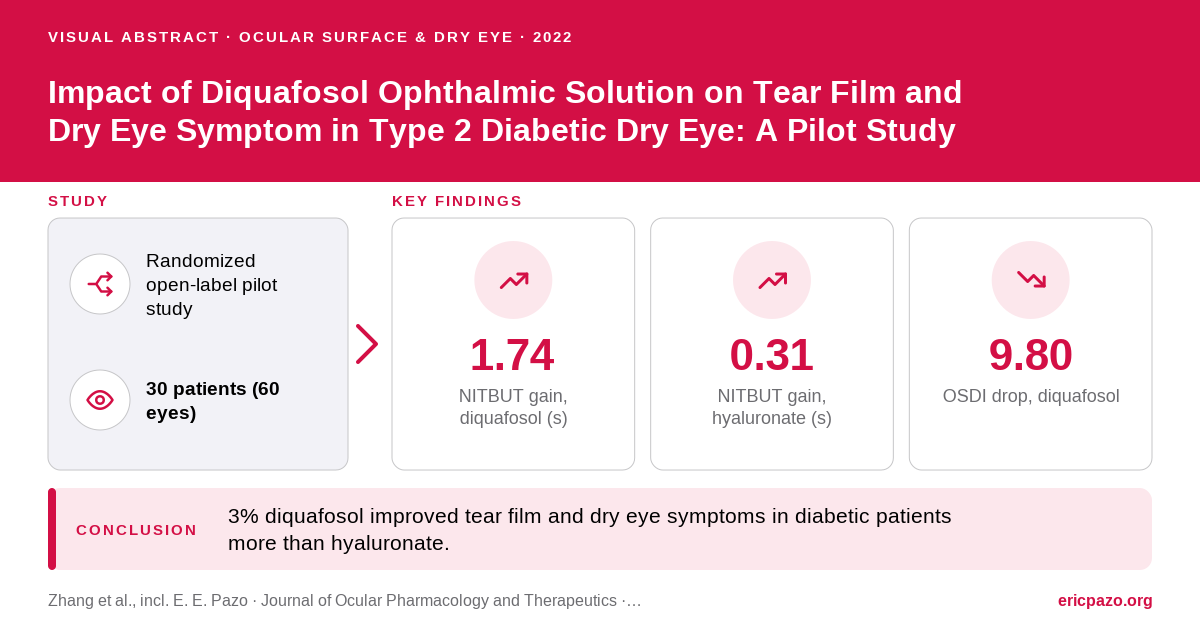
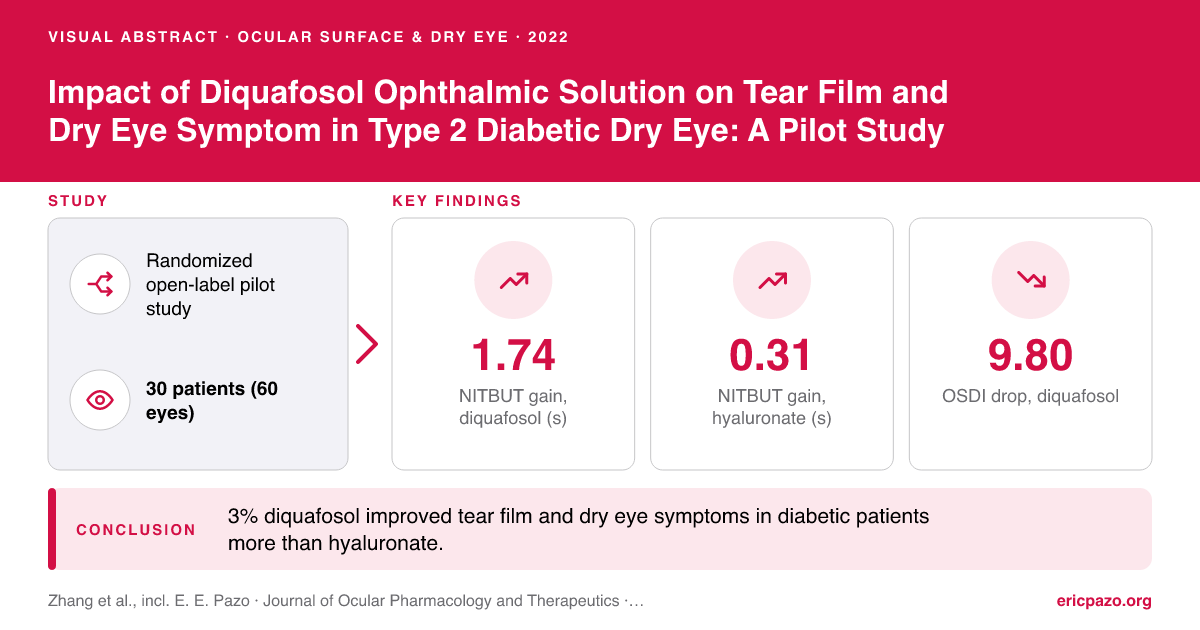
在糖尿病患者中,3% 地夸磷索对泪膜和干眼症状的改善优于玻璃酸钠。
- 研究设计
- 随机开放标签初步研究
- 样本
- 30 例患者(60 只眼)
- NITBUT 提升(地夸磷索,秒)
- 1.74
- NITBUT 提升(玻璃酸钠,秒)
- 0.31
- OSDI 下降(地夸磷索)
- 9.80
摘要
本文摘要以原文(英文)显示,因为该文章未采用允许翻译的开放许可协议。
Purpose: Diquafosol ophthalmic solution (DQS) stimulates P2Y2 receptors on the ocular surface, which enhances mucin secretion from goblet cells. Therefore, tear film stability and hydration of the ocular surface can be achieved independent from lacrimal gland function. Methods: This prospective, open-label pilot study included 60 eyes of 30 diabetic patients diagnosed with dry eye disease (DED) and were randomly assigned to either DQS ( n = 30 eyes) or hyaluronate (HA) group ( n = 30 eyes). Participants in the DQS group received 3% diquafosol ophthalmic solution, whereas HA group received 0.1% sodium HA preservative-free artificial tears. The dosage for both drugs was 1 drop, 6 times per day for 4 weeks. Tear film lipid layer (TFLL), noninvasive breakup time (NITBUT), corneoconjunctival staining (CS) score, meibomian gland (MG), conjunctival hyperemia [redness score (RS)], ocular surface disease index (OSDI) was assessed and compared at baseline, day 14, and day 28. Results: Comparing baseline and day 28 measurements revealed that both groups found significant improvements in NITBUT, CS, MG quality, MG expressibility, and OSDI scores significantly ( P < 0.05), in addition TFLL improvements were only found in the DQS group. At day 28, the magnitude of change in mean NITBUT was 1.74 (DQS) versus 0.31 (HA), 1.16 (DQS) versus 0.37 (HA) point grade reduction in corneoconjunctival staining score and 9.80 (DQS) versus 4.80 (HA) point grade in mean OSDI score. Conclusion: Three percent diquafosol ophthalmic solution treatment demonstrated the ability to improve the tear film dry eye parameters and clinically reduced sign and symptoms of DED in diabetic dry eye patients. Clinical Trials.gov ID: NCT04980144.
关键词: type 2 diabetes; tear film stability; meibomian gland dysfunction; Ocular Surface Disease Index; mucin secretion; tear film lipid layer
获取全文
引用格式
显示 BibTeX
@article{zhang2022impact,
  title = {{Impact of Diquafosol Ophthalmic Solution on Tear Film and Dry Eye Symptom in Type 2 Diabetic Dry Eye: A Pilot Study}},
  author = {Zhang, Qing and Zhang, Hongda and Qin, Guanghao and Wu, Yi and Song, Yilin and Yang, Lanting and Yu, Sile and He, Xingru and Moore, Jonathan Edward and Moutari, Salissou and Palme, Christoph and Xu, Ling and He, Wei and Pazo, Emmanuel Eric},
  journal = {Journal of Ocular Pharmacology and Therapeutics},
  year = {2022},
  doi = {10.1089/jop.2021.0083},
  url = {https://doi.org/10.1089/jop.2021.0083},
}
相关研究
- 飞秒激光辅助 LASIK 术后角膜瓣边缘间隙对角膜神经再生影响的分析 (2026)
- 强脉冲光与睑缘清洁对泪膜和眼表影响的比较:一项随机对照研究 (2026)
- Effects of 3% diquafosol sodium on tear film stability, corneal aberration parameters, and vision-related quality of life in pediatric orthokeratology-associated dry eye disease (2026)
- 母亲孕前体重指数与子代散光及角膜曲率的关联:一项横断面研究 (2025)
- 过敏性结膜炎相关干眼中泪液淋巴毒素-α、免疫球蛋白 E 及基质金属蛋白酶-9 的差异表达 (2025)