
2 型糖尿病ドライアイにおけるジクアホソル点眼液の涙液層とドライアイ症状への影響:パイロット研究
原題: Impact of Diquafosol Ophthalmic Solution on Tear Film and Dry Eye Symptom in Type 2 Diabetic Dry Eye: A Pilot Study
Qing Zhang, Hongda Zhang, Guanghao Qin, Yi Wu, Yilin Song, Lanting Yang, Sile Yu, Xingru He, Jonathan Edward Moore, Salissou Moutari, Christoph Palme, Ling Xu, Wei He, Emmanuel Eric Pazo
 Journal of Ocular Pharmacology and Therapeutics, 2022 · 原著論文 · doi:10.1089/jop.2021.0083 · 被引用 34 回
要点
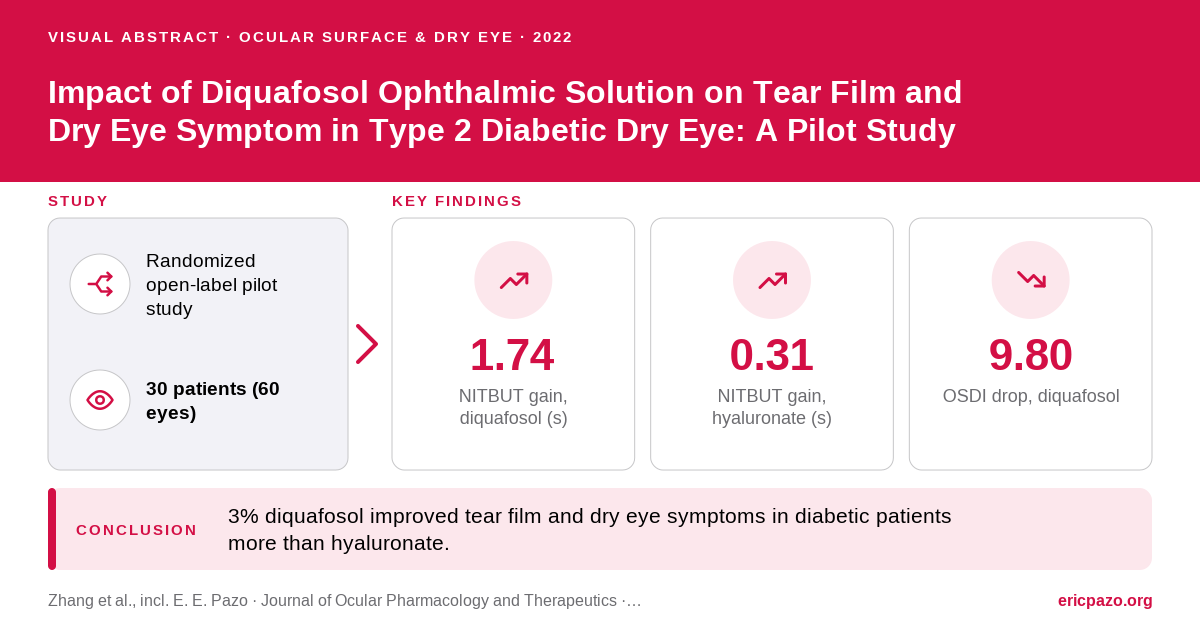
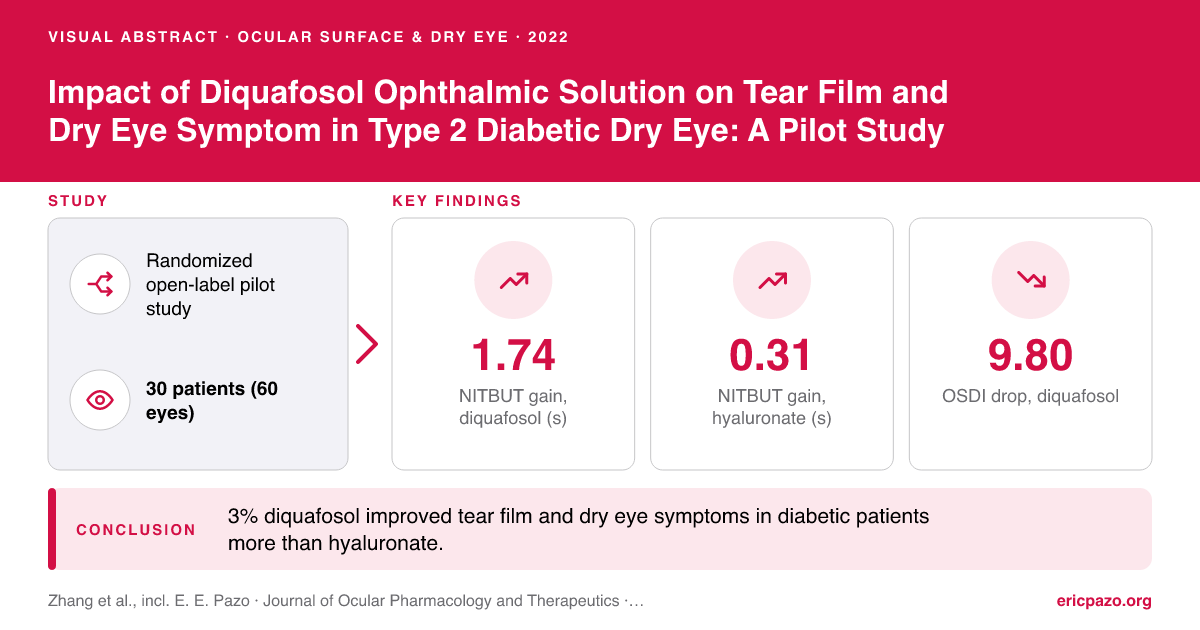
糖尿病患者において、3% ジクアホソルはヒアルロン酸より涙液層とドライアイ症状を改善した。
- 研究デザイン
- ランダム化非盲検パイロット研究
- 対象
- 患者 30 人(60 眼)
- NITBUT の延長(ジクアホソル、秒)
- 1.74
- NITBUT の延長(ヒアルロン酸、秒)
- 0.31
- OSDI の低下(ジクアホソル)
- 9.80
抄録
この抄録は原語(英語)で表示しています。論文が翻訳を認めるオープンライセンスで公開されていないためです。
Purpose: Diquafosol ophthalmic solution (DQS) stimulates P2Y2 receptors on the ocular surface, which enhances mucin secretion from goblet cells. Therefore, tear film stability and hydration of the ocular surface can be achieved independent from lacrimal gland function. Methods: This prospective, open-label pilot study included 60 eyes of 30 diabetic patients diagnosed with dry eye disease (DED) and were randomly assigned to either DQS ( n = 30 eyes) or hyaluronate (HA) group ( n = 30 eyes). Participants in the DQS group received 3% diquafosol ophthalmic solution, whereas HA group received 0.1% sodium HA preservative-free artificial tears. The dosage for both drugs was 1 drop, 6 times per day for 4 weeks. Tear film lipid layer (TFLL), noninvasive breakup time (NITBUT), corneoconjunctival staining (CS) score, meibomian gland (MG), conjunctival hyperemia [redness score (RS)], ocular surface disease index (OSDI) was assessed and compared at baseline, day 14, and day 28. Results: Comparing baseline and day 28 measurements revealed that both groups found significant improvements in NITBUT, CS, MG quality, MG expressibility, and OSDI scores significantly ( P < 0.05), in addition TFLL improvements were only found in the DQS group. At day 28, the magnitude of change in mean NITBUT was 1.74 (DQS) versus 0.31 (HA), 1.16 (DQS) versus 0.37 (HA) point grade reduction in corneoconjunctival staining score and 9.80 (DQS) versus 4.80 (HA) point grade in mean OSDI score. Conclusion: Three percent diquafosol ophthalmic solution treatment demonstrated the ability to improve the tear film dry eye parameters and clinically reduced sign and symptoms of DED in diabetic dry eye patients. Clinical Trials.gov ID: NCT04980144.
キーワード: type 2 diabetes; tear film stability; meibomian gland dysfunction; Ocular Surface Disease Index; mucin secretion; tear film lipid layer
アクセス
引用方法
BibTeX を表示
@article{zhang2022impact,
  title = {{Impact of Diquafosol Ophthalmic Solution on Tear Film and Dry Eye Symptom in Type 2 Diabetic Dry Eye: A Pilot Study}},
  author = {Zhang, Qing and Zhang, Hongda and Qin, Guanghao and Wu, Yi and Song, Yilin and Yang, Lanting and Yu, Sile and He, Xingru and Moore, Jonathan Edward and Moutari, Salissou and Palme, Christoph and Xu, Ling and He, Wei and Pazo, Emmanuel Eric},
  journal = {Journal of Ocular Pharmacology and Therapeutics},
  year = {2022},
  doi = {10.1089/jop.2021.0083},
  url = {https://doi.org/10.1089/jop.2021.0083},
}
関連する論文
- フェムトセカンドレーザー併用 LASIK 後の角膜神経再生に対するフラップ縁間隙の影響の解析 (2026)
- 強パルス光と眼瞼清拭が涙液層と眼表面に及ぼす効果の比較:ランダム化比較試験 (2026)
- Effects of 3% diquafosol sodium on tear film stability, corneal aberration parameters, and vision-related quality of life in pediatric orthokeratology-associated dry eye disease (2026)
- 母親の妊娠前 BMI と子の乱視および角膜曲率との関連:横断研究 (2025)
- アレルギー性結膜炎に伴うドライアイにおける涙液中リンホトキシン α、免疫グロブリン E、マトリックスメタロプロテイナーゼ-9 の発現の違い (2025)