
Comparación entre el efecto de la luz pulsada intensa y la higiene palpebral sobre la película lagrimal y la superficie ocular: un estudio controlado aleatorizado
Título original: Comparison between the Effect of Intense Pulsed Light and Lid Hygiene on the Tear Film and Ocular Surface: A Randomized Controlled Study
Shekhar Jha, Qiwei Li, Yan Jin, Zheng Yang, Hui Liu, Emmanuel Eric Pazo, Shaozhen Zhao, Charles Louis Dupin
 Photobiomodulation Photomedicine and Laser Surgery, 2026 · artículo · doi:10.1177/25785478261428958 · citado 1 vez
De un vistazo
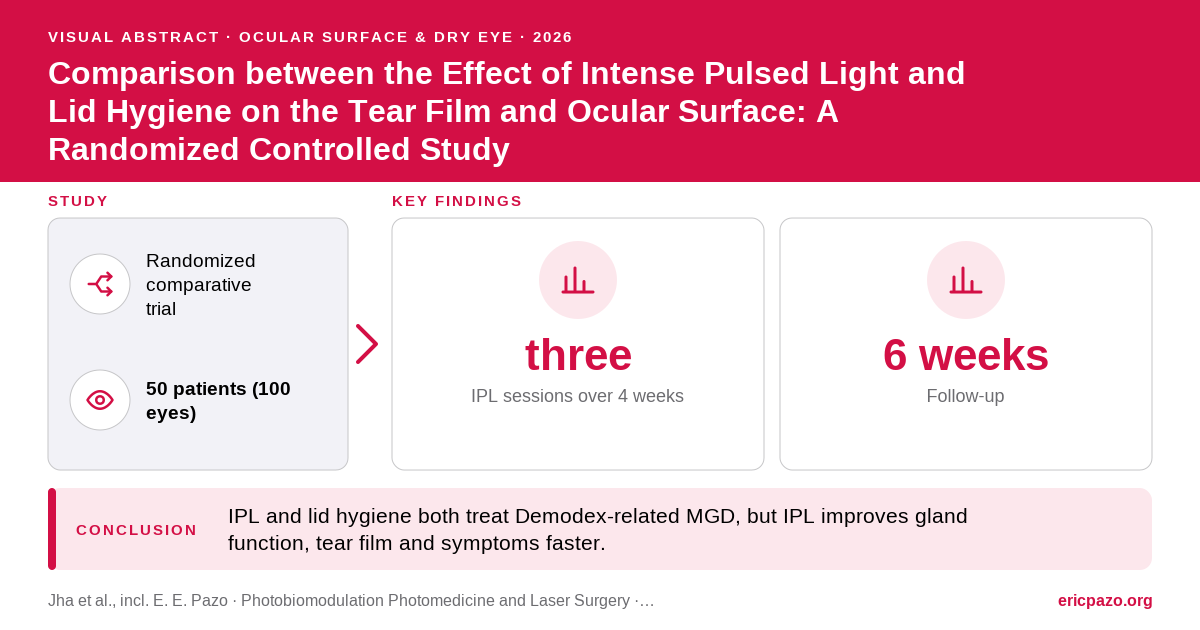
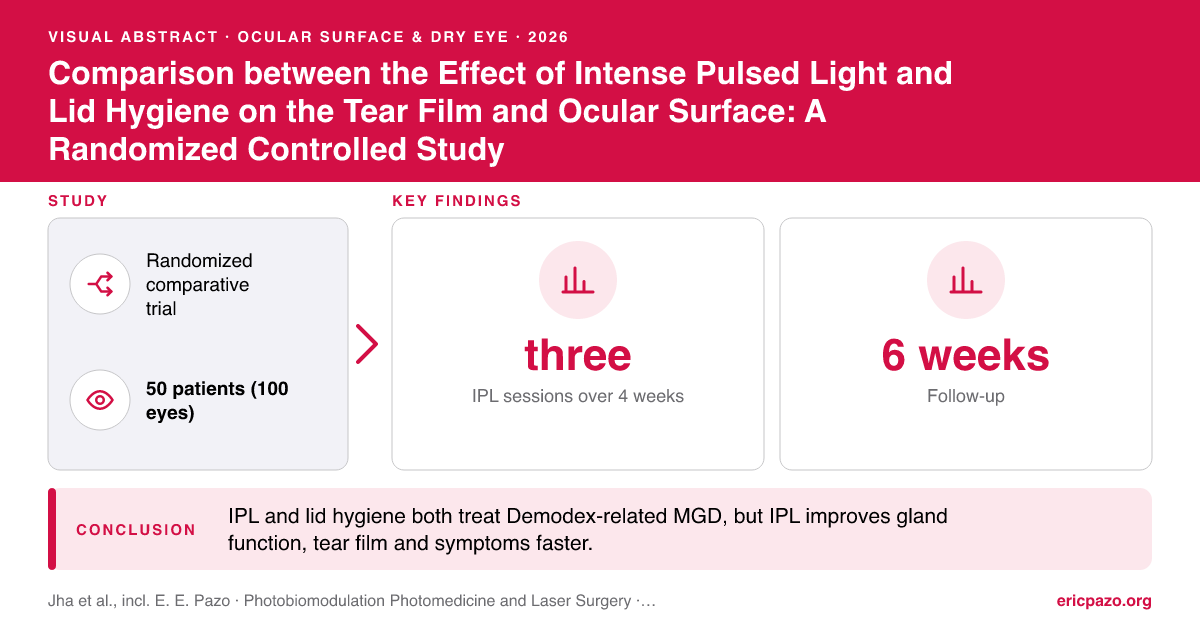
La IPL y la higiene palpebral tratan ambas la DGM relacionada con Demodex, pero la IPL mejora antes la función glandular, la película lagrimal y los síntomas.
- Diseño
- Ensayo comparativo aleatorizado
- Muestra
- 50 pacientes (100 ojos)
- Sesiones de IPL en 4 semanas
- three
- Seguimiento
- 6 weeks
Resumen
Este resumen se muestra en su idioma original, el inglés, porque el artículo no tiene una licencia abierta que permita traducciones.
Purpose: Demodex folliculorum infestation is an important contributor to meibomian gland dysfunction (MGD) and chronic ocular surface disease. This study evaluated and compared the therapeutic efficacy of intense pulsed light (IPL) and eyelid hygiene (ELH) for Demodex-associated MGD. Methods: In this prospective, randomized comparative trial, 50 patients (100 eyes) with Demodex-associated MGD were allocated to two arms. Group A ( n = 25) received three Eyesis IPL sessions at baseline, week 2, and week 4. Group B ( n = 25) performed daily eyelid hygiene with OCuSOFT Lid Scrub for 6 weeks. Ocular surface parameters, including ocular surface disease index (OSDI), tear film lipid layer thickness (TFLL), noninvasive tear film break-up time (NITBUT), meibomian gland dropout, meibum quality and expressibility, corneal fluorescein staining (CFS), Schirmer’s I, and Demodex count, were assessed from baseline to week 6. Best-corrected visual acuity (BCVA) and intraocular pressure (IOP) were recorded at each visit. Results: Both treatments significantly improved OSDI, NITBUT, TFLL, Schirmer’s I, and CFS over 6 weeks (all p < 0.001). Compared with ELH, IPL achieved larger and earlier reductions in symptoms, greater increases in TFLL, and superior improvements in meibum quality and expressibility from week 4 onward (between-group p ≤ 0.021). Demodex counts decreased significantly in both groups with no between-group difference at week 6. BCVA, IOP, and adverse events remained stable, indicating a favorable short-term safety profile. Conclusion: IPL and ELH are effective for Demodex-related MGD, but IPL provides faster and more pronounced improvements in meibomian gland function, tear film stability, and patient-reported symptoms over 6 weeks.
Palabras clave: intense pulsed light; eyelid hygiene; Demodex folliculorum; meibomian gland dysfunction; ocular surface disease; tear film lipid layer thickness; meibum quality; meibomian gland dropout
Acceso
Cómo citar
Mostrar BibTeX
@article{jha2026comparison,
  title = {{Comparison between the Effect of Intense Pulsed Light and Lid Hygiene on the Tear Film and Ocular Surface: A Randomized Controlled Study}},
  author = {Jha, Shekhar and Li, Qiwei and Jin, Yan and Yang, Zheng and Liu, Hui and Pazo, Emmanuel Eric and Zhao, Shaozhen and Dupin, Charles Louis},
  journal = {Photobiomodulation Photomedicine and Laser Surgery},
  year = {2026},
  doi = {10.1177/25785478261428958},
  url = {https://doi.org/10.1177/25785478261428958},
}
Trabajos relacionados
- Análisis de la influencia del espacio del margen del colgajo en la regeneración de los nervios corneales tras LASIK asistido por láser de femtosegundo (2026)
- Effects of 3% diquafosol sodium on tear film stability, corneal aberration parameters, and vision-related quality of life in pediatric orthokeratology-associated dry eye disease (2026)
- Asociación entre el índice de masa corporal materno previo al embarazo y el astigmatismo y la curvatura corneal de la descendencia: un estudio transversal (2025)
- Expresión diferencial de linfotoxina α, inmunoglobulina E y metaloproteinasa de matriz 9 en lágrimas en el ojo seco asociado a conjuntivitis alérgica (2025)
- Influencia del diámetro corneal en la biomecánica y la biometría corneales en pacientes chinos: un estudio transversal (2025)