
基于不规则纵向学校筛查数据预测儿童近视进展的时间感知 Transformer 模型的开发与内部验证
原文标题: Development and internal validation of a time-aware transformer model for predicting pediatric myopia progression from irregular longitudinal school screening data
Mingxuan Zhang, Tuluhong Wumaier, Aixianjiang Maimaiti, Yingxiang Zhao, Salissou Moutari, Muhammad Usama, Zhihui Zhang, Shaochong Bu, Emmanuel Eric Pazo, Xinjun Ren
 Journal of Translational Medicine, 2026 · 期刊论文 · doi:10.1186/s12967-026-09221-8 · 开放获取(CC BY)
要点速览
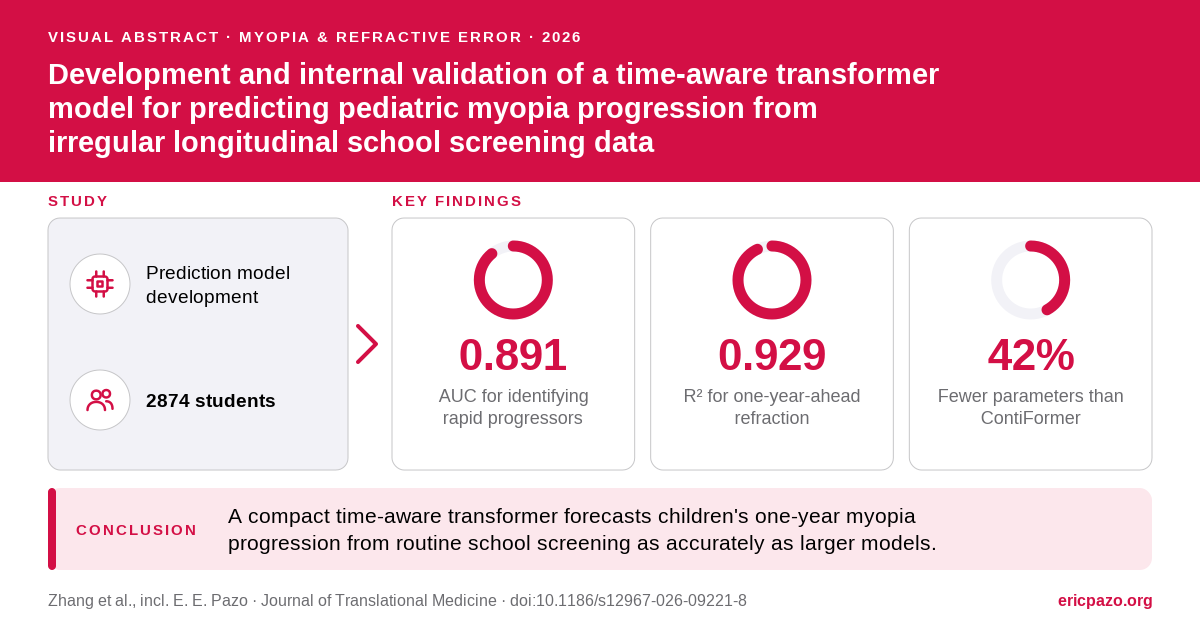
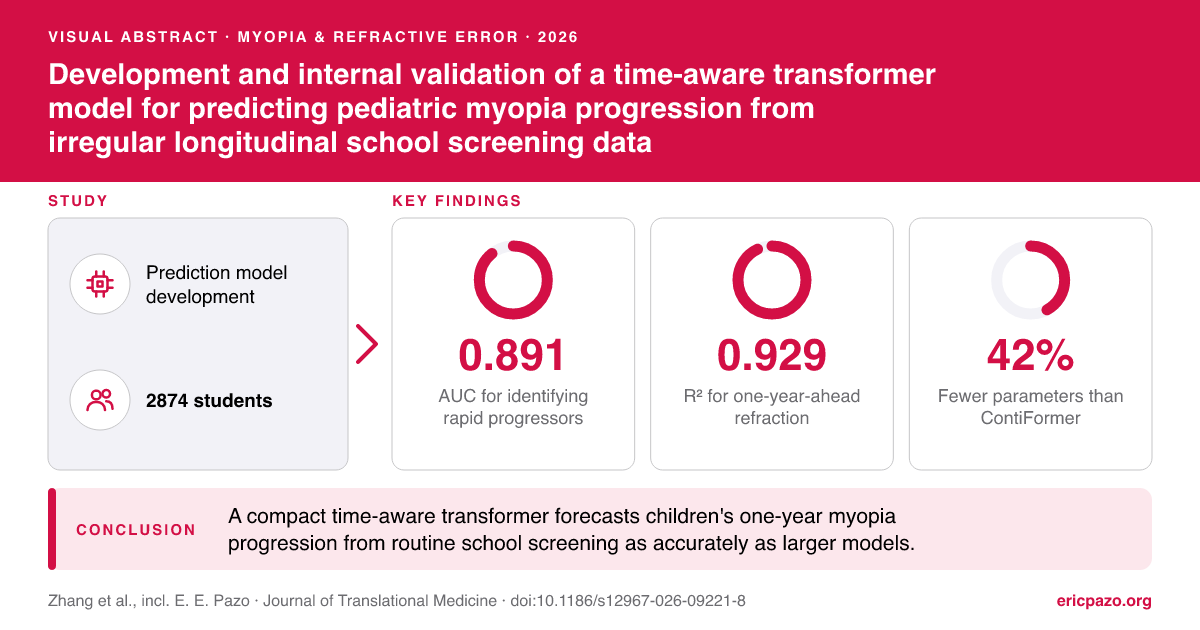
紧凑的时间感知 Transformer 可利用常规学校筛查数据预测儿童一年后的近视进展,准确度与更大型模型相当。
- 研究设计
- 预测模型开发研究
- 样本
- 2874 名学生
- 识别快速进展者的 AUC
- 0.891
- 一年后屈光度预测的 R²
- 0.929
- 参数量较 ContiFormer 减少
- 42%
摘要
背景:全球近视率不断上升,高度近视可导致不可逆的视力丧失,已成为重大公共卫生挑战,因此需要及早识别屈光进展迅速的儿童。学校筛查能够反映儿童当前的屈光状态,但无法预测其未来的变化趋势。本研究开发并内部验证了一种时间感知深度学习模型,可直接根据不规则采样的学校筛查记录预测屈光进展,并评估学校层面的地理空间信息是否能提供额外的预后信息。方法:对时间感知 Transformer 进行改造,使其无需插补即可处理不规则采样的屈光筛查序列。该模型结合了自适应频率时间嵌入(利用两个可学习参数将正弦频谱调整到临床采样间隔)和带温度缩放的门控残差网络(有选择地整合学校层面的环境指数)。模型在中国叶城县 2874 名学生组成的金标准队列中开发,这些学生拥有完整的四年筛查轨迹(2020 至 2023 年)。结局为一年后的等效球镜度(SER)以及快速近视进展分类(ΔSER ≤ -0.75 D/年)。内部验证采用留出测试集、五折交叉验证、十个随机种子的稳定性分析、按学校分组的划分以及留一学校验证。评估了区分度、校准度和净获益,并采用配对测试集自助法检验(经事后多重比较校正)与九种基线模型进行比较。结果:模型预测一年后 SER 的均方误差(MSE)为 0.168 D²,R² 为 0.929;识别快速进展者的受试者工作特征曲线下面积为 0.891,校准良好(校准斜率 0.968,截距 -0.014 D),且在 0.10 至 0.55 的转诊阈值范围内,净获益高于全部转诊或全不转诊。模型在五折交叉验证(MSE 0.171 ± 0.017)和十个随机种子(MSE 0.168 ± 0.004)中表现稳定。其准确度与最强的基线模型相当,而非明显更优:与 ContiFormer 的均方根误差差异为 0.010 D,远低于非睫状肌麻痹自动验光的精度,而本模型的参数量减少 42%(52 K 对 89 K),训练速度快 2.7 倍。当整所学校被留出时,MSE 升至 0.191,环境特征带来的获益从 0.027 降至 0.005 D²,表明表面上的地理空间信号大多反映的是学校身份,而非所测量的环境。对随访期间转为近视的儿童预测难度最大(MSE 0.243),对持续非近视儿童预测最容易(MSE 0.105)。结论:紧凑的时间感知 Transformer 可利用常规收集的学校筛查数据预测一年后的屈光不正,准确度与规模大得多的连续时间模型相当,并提供经过校准的风险估计和具有临床可解释性的注意力。该架构的价值在于效率、稳定性和可解释性,而非准确度优势。学校层面的环境指数应被理解为地理空间基线先验,而非个体层面的暴露。
译自英文原文摘要(许可协议:CC BY)。
显示英文原文摘要
Background Rising global myopia rates are a major public health challenge because of the risk of irreversible vision loss in high myopia, and this creates a need for early identification of children on rapidly progressing trajectories. School-based screening characterises a child’s current refractive state but does not forecast where that trajectory is heading. We developed and internally validated a time-aware deep learning model that forecasts refractive progression directly from irregularly sampled school screening records, and assessed whether school-level geospatial context adds prognostic information. Methods A Time-Aware Transformer was adapted to process irregularly sampled refractive screening sequences without imputation. It combines an Adaptive-Frequency Time Embedding, which tunes a sinusoidal frequency spectrum to clinical sampling intervals using two learnable parameters, with a temperature-scaled Gated Residual Network that selectively integrates school-level environmental indices. The model was developed on a Gold Standard cohort of 2874 students from Yecheng County, China with complete four-year screening trajectories (2020 to 2023). Outcomes were one-year-ahead spherical equivalent refraction (SER) and classification of rapid myopic progression (ΔSER ≤ -0.75 D/year). Internal validation used a held-out test set, five-fold cross-validation, a ten-seed stability analysis, a school-level grouped split and leave-one-school-out validation. Discrimination, calibration and net benefit were assessed, and nine baseline models were compared using paired test-set bootstrap tests with post hoc multiplicity control. Results The model achieved a mean squared error (MSE) of 0.168 D² and an R² of 0.929 for one-year-ahead SER, and an area under the receiver operating characteristic curve of 0.891 for identifying rapid progressors, with good calibration (calibration slope 0.968, intercept -0.014 D) and higher net benefit than referring all or no children across referral thresholds of 0.10 to 0.55. Performance was stable in five-fold cross-validation (MSE 0.171 ± 0.017) and across ten random seeds (MSE 0.168 ± 0.004). Accuracy was comparable to the strongest baselines rather than clearly superior: the difference from ContiFormer was 0.010 D in root mean squared error, well below the precision of non-cycloplegic autorefraction, while the proposed model used 42% fewer parameters (52 K versus 89 K) and trained 2.7 times faster. When whole schools were held out, MSE rose to 0.191 and the benefit attributable to environmental features fell from 0.027 to 0.005 D², indicating that most of the apparent geospatial signal reflects school identity rather than measured environment. Prediction was hardest for children who converted to myopia during follow-up (MSE 0.243) and easiest for persistent non-myopes (MSE 0.105). Conclusion A compact time-aware transformer forecasts one-year-ahead refractive error from routinely collected school screening data with accuracy comparable to substantially larger continuous-time models, with calibrated risk estimates and clinically interpretable attention. The case for this architecture rests on efficiency, stability and interpretability rather than on an accuracy advantage. School-level environmental indices should be understood as geospatial baseline priors rather than as individual-level exposures.
获取全文
引用格式
显示 BibTeX
@article{zhang2026development,
  title = {{Development and internal validation of a time-aware transformer model for predicting pediatric myopia progression from irregular longitudinal school screening data}},
  author = {Zhang, Mingxuan and Wumaier, Tuluhong and Maimaiti, Aixianjiang and Zhao, Yingxiang and Moutari, Salissou and Usama, Muhammad and Zhang, Zhihui and Bu, Shaochong and Pazo, Emmanuel Eric and Ren, Xinjun},
  journal = {Journal of Translational Medicine},
  year = {2026},
  doi = {10.1186/s12967-026-09221-8},
  url = {https://doi.org/10.1186/s12967-026-09221-8},
}