
不規則な縦断的学校健診データから小児の近視進行を予測する時間考慮型 Transformer モデルの開発と内部検証
原題: Development and internal validation of a time-aware transformer model for predicting pediatric myopia progression from irregular longitudinal school screening data
Mingxuan Zhang, Tuluhong Wumaier, Aixianjiang Maimaiti, Yingxiang Zhao, Salissou Moutari, Muhammad Usama, Zhihui Zhang, Shaochong Bu, Emmanuel Eric Pazo, Xinjun Ren
 Journal of Translational Medicine, 2026 · 原著論文 · doi:10.1186/s12967-026-09221-8 · オープンアクセス(CC BY)
要点
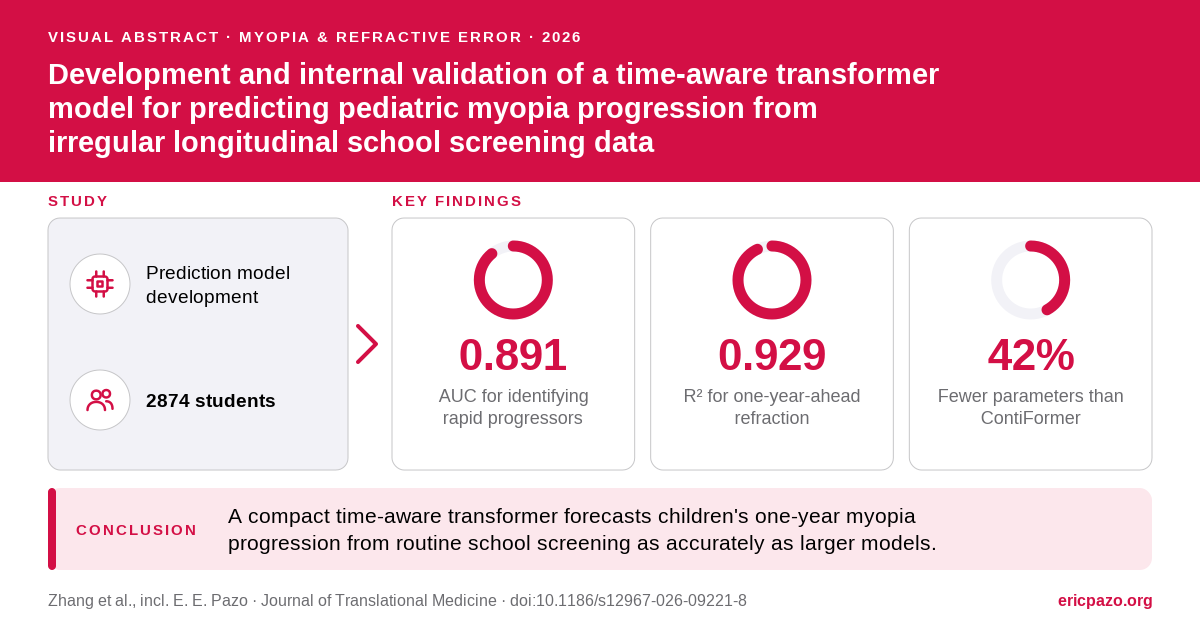
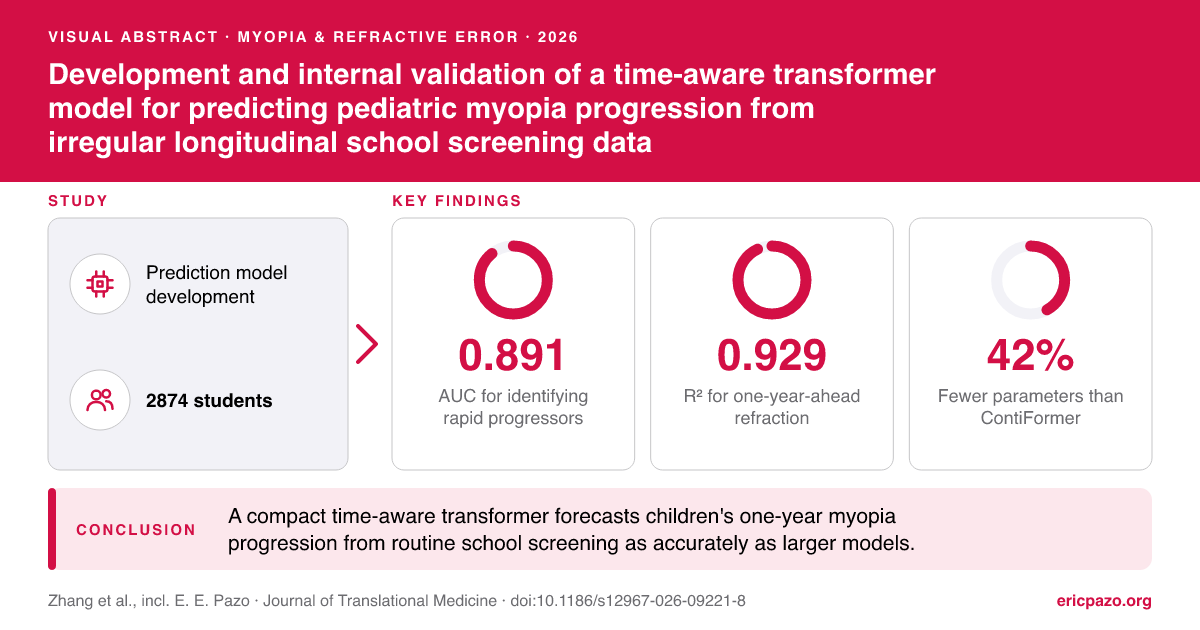
小型の時間考慮型 Transformer は、通常の学校健診データから小児の 1 年後の近視進行を、より大規模なモデルと同等の精度で予測する。
- 研究デザイン
- 予測モデルの開発
- 対象
- 児童生徒 2874 人
- 急速進行者を識別する AUC
- 0.891
- 1 年後の屈折値予測の R²
- 0.929
- ContiFormer と比べたパラメータ削減
- 42%
抄録
背景:世界的な近視の増加は、強度近視による不可逆的な視力低下のリスクから重大な公衆衛生上の課題であり、急速に進行する児童を早期に見つける必要がある。学校健診は現在の屈折状態を示すが、今後の推移は予測しない。本研究では、不規則な間隔で記録された学校健診データから屈折の進行を直接予測する時間考慮型深層学習モデルを開発・内部検証し、学校単位の地理空間情報が予後情報を追加するかを評価した。方法:補完を行わずに不規則な間隔の屈折健診系列を処理できるよう、Time-Aware Transformer を改良した。このモデルは、2 つの学習可能なパラメータで正弦波の周波数スペクトルを臨床的な測定間隔に合わせる Adaptive-Frequency Time Embedding と、学校単位の環境指標を選択的に統合する温度スケーリング付き Gated Residual Network を組み合わせたものである。モデルは、中国・葉城県の児童生徒 2874 人からなり、4 年間(2020 年から 2023 年)の健診記録がすべてそろったゴールドスタンダードコホートで開発した。アウトカムは 1 年後の等価球面度数(SER)と急速な近視進行の分類(ΔSER ≤ -0.75 D/年)とした。内部検証には、ホールドアウトテストセット、5 分割交差検証、10 種類のシードによる安定性解析、学校単位のグループ分割、および 1 校ずつ除外する検証を用いた。識別能、キャリブレーション、ネットベネフィットを評価し、9 つのベースラインモデルとテストセット上の対応のあるブートストラップ検定(事後の多重性調整あり)で比較した。結果:1 年後の SER について平均二乗誤差(MSE)は 0.168 D²、R² は 0.929 であり、急速進行者の識別における ROC 曲線下面積は 0.891 であった。キャリブレーションは良好で(キャリブレーション傾き 0.968、切片 -0.014 D)、0.10 から 0.55 の紹介閾値において、全員紹介または全員非紹介よりも高いネットベネフィットを示した。性能は 5 分割交差検証(MSE 0.171 ± 0.017)でも 10 種類の乱数シード(MSE 0.168 ± 0.004)でも安定していた。精度は最良のベースラインと同程度であり、明確に上回るものではなかった。ContiFormer との二乗平均平方根誤差の差は 0.010 D で、調節麻痺薬を用いないオートレフラクトメータの精度を大きく下回った一方、提案モデルのパラメータ数は 42% 少なく(52 K 対 89 K)、学習は 2.7 倍速かった。学校全体を除外すると MSE は 0.191 に上昇し、環境特徴量による改善は 0.027 から 0.005 D² に低下した。このことは、見かけ上の地理空間的シグナルの大部分が、測定された環境ではなく学校そのものの違いを反映していることを示す。予測が最も難しかったのは経過観察中に近視へ移行した児童(MSE 0.243)、最も容易だったのは非近視のままの児童(MSE 0.105)であった。結論:小型の時間考慮型 Transformer は、日常的に収集される学校健診データから 1 年後の屈折異常を、はるかに大規模な連続時間モデルと同等の精度で予測し、キャリブレーションされたリスク推定と臨床的に解釈可能なアテンションを提供する。このアーキテクチャの価値は、精度の優位性ではなく、効率性、安定性、解釈可能性にある。学校単位の環境指標は、個人単位の曝露ではなく、地理空間的なベースラインの事前情報として理解すべきである。
英語の原文抄録からの翻訳です(ライセンス:CC BY)。
原文の抄録を表示
Background Rising global myopia rates are a major public health challenge because of the risk of irreversible vision loss in high myopia, and this creates a need for early identification of children on rapidly progressing trajectories. School-based screening characterises a child’s current refractive state but does not forecast where that trajectory is heading. We developed and internally validated a time-aware deep learning model that forecasts refractive progression directly from irregularly sampled school screening records, and assessed whether school-level geospatial context adds prognostic information. Methods A Time-Aware Transformer was adapted to process irregularly sampled refractive screening sequences without imputation. It combines an Adaptive-Frequency Time Embedding, which tunes a sinusoidal frequency spectrum to clinical sampling intervals using two learnable parameters, with a temperature-scaled Gated Residual Network that selectively integrates school-level environmental indices. The model was developed on a Gold Standard cohort of 2874 students from Yecheng County, China with complete four-year screening trajectories (2020 to 2023). Outcomes were one-year-ahead spherical equivalent refraction (SER) and classification of rapid myopic progression (ΔSER ≤ -0.75 D/year). Internal validation used a held-out test set, five-fold cross-validation, a ten-seed stability analysis, a school-level grouped split and leave-one-school-out validation. Discrimination, calibration and net benefit were assessed, and nine baseline models were compared using paired test-set bootstrap tests with post hoc multiplicity control. Results The model achieved a mean squared error (MSE) of 0.168 D² and an R² of 0.929 for one-year-ahead SER, and an area under the receiver operating characteristic curve of 0.891 for identifying rapid progressors, with good calibration (calibration slope 0.968, intercept -0.014 D) and higher net benefit than referring all or no children across referral thresholds of 0.10 to 0.55. Performance was stable in five-fold cross-validation (MSE 0.171 ± 0.017) and across ten random seeds (MSE 0.168 ± 0.004). Accuracy was comparable to the strongest baselines rather than clearly superior: the difference from ContiFormer was 0.010 D in root mean squared error, well below the precision of non-cycloplegic autorefraction, while the proposed model used 42% fewer parameters (52 K versus 89 K) and trained 2.7 times faster. When whole schools were held out, MSE rose to 0.191 and the benefit attributable to environmental features fell from 0.027 to 0.005 D², indicating that most of the apparent geospatial signal reflects school identity rather than measured environment. Prediction was hardest for children who converted to myopia during follow-up (MSE 0.243) and easiest for persistent non-myopes (MSE 0.105). Conclusion A compact time-aware transformer forecasts one-year-ahead refractive error from routinely collected school screening data with accuracy comparable to substantially larger continuous-time models, with calibrated risk estimates and clinically interpretable attention. The case for this architecture rests on efficiency, stability and interpretability rather than on an accuracy advantage. School-level environmental indices should be understood as geospatial baseline priors rather than as individual-level exposures.
アクセス
引用方法
BibTeX を表示
@article{zhang2026development,
  title = {{Development and internal validation of a time-aware transformer model for predicting pediatric myopia progression from irregular longitudinal school screening data}},
  author = {Zhang, Mingxuan and Wumaier, Tuluhong and Maimaiti, Aixianjiang and Zhao, Yingxiang and Moutari, Salissou and Usama, Muhammad and Zhang, Zhihui and Bu, Shaochong and Pazo, Emmanuel Eric and Ren, Xinjun},
  journal = {Journal of Translational Medicine},
  year = {2026},
  doi = {10.1186/s12967-026-09221-8},
  url = {https://doi.org/10.1186/s12967-026-09221-8},
}