
機械学習による薄肉レンズ式(MM)と前眼部光干渉断層計内蔵の光線追跡式を含む 8 種類の眼内レンズ計算式の多重比較
原題: A Multi Comparison of 8 Different Intraocular Lens Biometry Formulae, Including a Machine Learning Thin Lens Formula (MM) and an Inbuilt Anterior Segment Optical Coherence Tomography Ray Tracing Formula
Richard N. McNeely, Katherine McGinnity, Stephen Stewart, Emmanuel Eric Pazo, Salissou Moutari, Jonathan Edward Moore
 Vision, 2024 · 原著論文 · doi:10.3390/vision8030049 · 被引用 3 回 · オープンアクセス(CC BY)
要点
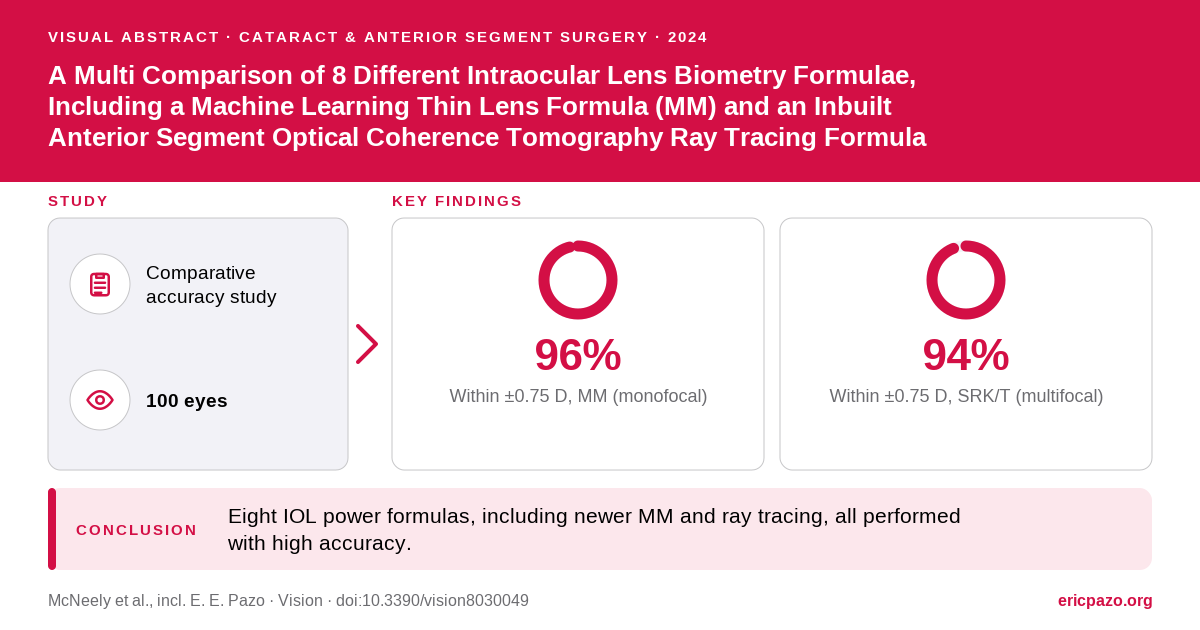
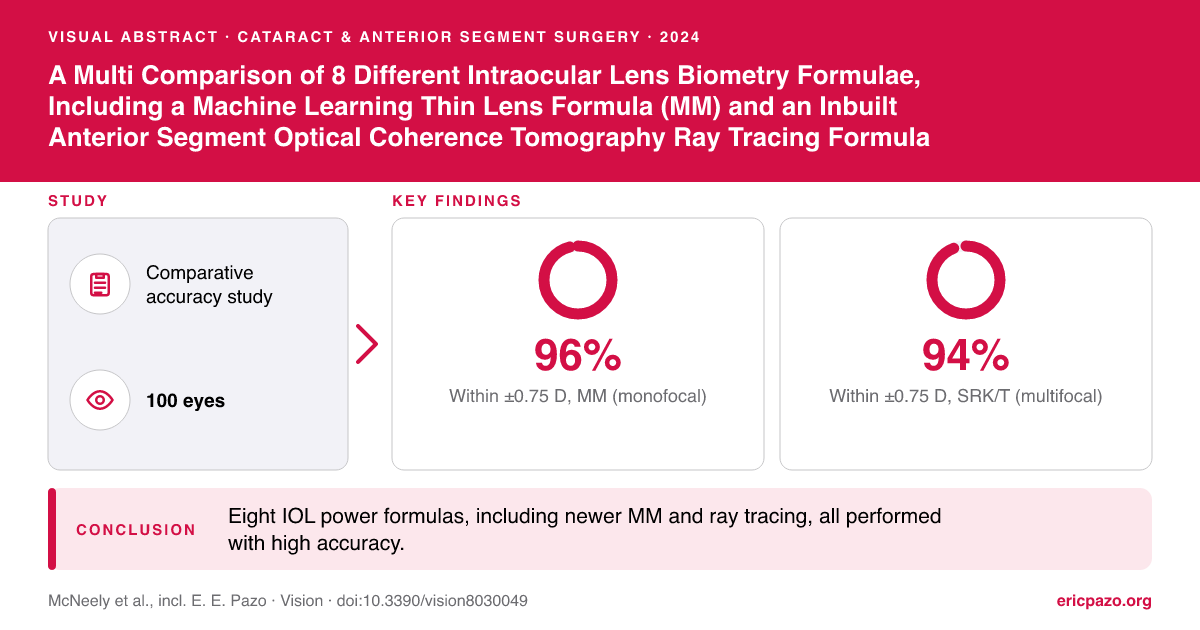
新しい MM 式や光線追跡式を含む 8 種類の IOL 度数計算式は、いずれも高い精度を示した。
- 研究デザイン
- 比較精度研究
- 対象
- 100 眼
- ±0.75 D 以内(MM、単焦点)
- 96%
- ±0.75 D 以内(SRK/T、多焦点)
- 94%
抄録
SRK/T、HofferQ、Holladay 1、Haigis、MM、Barrett Universal II(BUII)、Emmetropia Verifying Optical(EVO)、AS-OCT 光線追跡を含む眼内レンズ(IOL)度数計算式の精度を比較した。Rayone EMV RAO200E(Rayner Intraocular Lenses Limited、英国ワージング)または Artis Symbiose(Cristalens Industrie、フランス・ラニオン)IOL を挿入した 100 眼を対象とした。生体計測には IOLMaster 700(Carl Zeiss Meditec AG、ドイツ・イエナ)と MS-39 AS-OCT(CSO、イタリア・フィレンツェ)を用いた。平均絶対誤差(MAE)と中央絶対誤差(MedAE)、および目標屈折値の ±0.25D、±0.50D、±0.75D、±1.00D 以内の眼の割合を比較し、±0.75D を主要指標とした。高機能単焦点 IOL では、±0.75D 以内の割合が最も高かったのは MM(96%)で、次いで Haigis(94%)であった。多焦点 IOL では、SRK/T(94%)が ±0.75D 以内の割合が最も高く、次いで Holladay 1、MM、BUII、光線追跡(いずれも 90%)であった。いずれの IOL でも MAE に統計学的有意差はなかった。MAE は高機能単焦点では EVO、多焦点 IOL では光線追跡が最小であった。MedAE はそれぞれの IOL で EVO と光線追跡が最小であった。計算式全体で高精度の同等な性能が認められた。MM と光線追跡は、確立された計算式と同等の精度をもつとみられ、±0.75D 以内の眼の割合も高かった。
英語の原文抄録からの翻訳です(ライセンス:CC BY)。
原文の抄録を表示
A comparison of the accuracy of intraocular lens (IOL) power calculation formulae, including SRK/T, HofferQ, Holladay 1, Haigis, MM, Barrett Universal II (BUII), Emmetropia Verifying Optical (EVO), and AS-OCT ray tracing, was performed. One hundred eyes implanted with either the Rayone EMV RAO200E (Rayner Intraocular Lenses Limited, Worthing, UK) or the Artis Symbiose (Cristalens Industrie, Lannion, France) IOL were included. Biometry was obtained using IOLMaster 700 (Carl Zeiss Meditec AG, Jena, Germany) and MS-39 AS-OCT (CSO, Firenze, Italy). Mean (MAE) and median (MedAE) absolute errors and percentage of eyes within ±0.25D, ±0.50D, ±0.75D, and ±1.00D of the target were compared, with ±0.75D considered a key metric. The highest percentage within ±0.75D was found with MM (96%) followed by the Haigis (94%) for the enhanced monofocal IOL. SRK/T (94%) had the highest percentage within ±0.75D, followed by Holladay 1, MM, BUII, and ray tracing (all 90%) for the multifocal IOL. No statistically significant difference in MAE was found with both IOLs. EVO showed the lowest MAE for the enhanced monofocal and ray tracing for the multifocal IOL. EVO and ray tracing showed the lowest MedAE for the two respective IOLs. A similar performance with high accuracy across formulae was found. MM and ray tracing appear to have similar accuracy to the well-established formulae and displayed a high percentage of eyes within ±0.75D.
キーワード: intraocular lens power calculation; anterior segment optical coherence tomography; ray tracing; SRK/T formula; Haigis formula; Holladay 1 formula; Barrett Universal II formula; multifocal intraocular lens
アクセス
引用方法
BibTeX を表示
@article{mcneely2024a,
  title = {{A Multi Comparison of 8 Different Intraocular Lens Biometry Formulae, Including a Machine Learning Thin Lens Formula (MM) and an Inbuilt Anterior Segment Optical Coherence Tomography Ray Tracing Formula}},
  author = {McNeely, Richard N. and McGinnity, Katherine and Stewart, Stephen and Pazo, Emmanuel Eric and Moutari, Salissou and Moore, Jonathan Edward},
  journal = {Vision},
  year = {2024},
  doi = {10.3390/vision8030049},
  url = {https://doi.org/10.3390/vision8030049},
}