
Mesure automatisée par apprentissage profond du volume de rétinoschisis et de décollement dans la myopie pathologique avec contraction sclérale postérieure
Titre original : Automated deep learning-based retinoschisis and detachment volume measurement in pathological myopia with posterior scleral contraction
Mengdi Chai, Hua Rong, Danyang Yu, Xiu Wang, Di Wu, Emmanuel Eric Pazo, Jiachen Zhang, Ying Liu, Yifan Zhou, Yanhui Chen, Anquan Xue, Ruihua Wei
 British Journal of Ophthalmology, 2026 · article · doi:10.1136/bjo-2025-328592 · cité 1 fois
Rétine et imagerie vasculaireMyopie et erreurs réfractivesIA et apprentissage profond
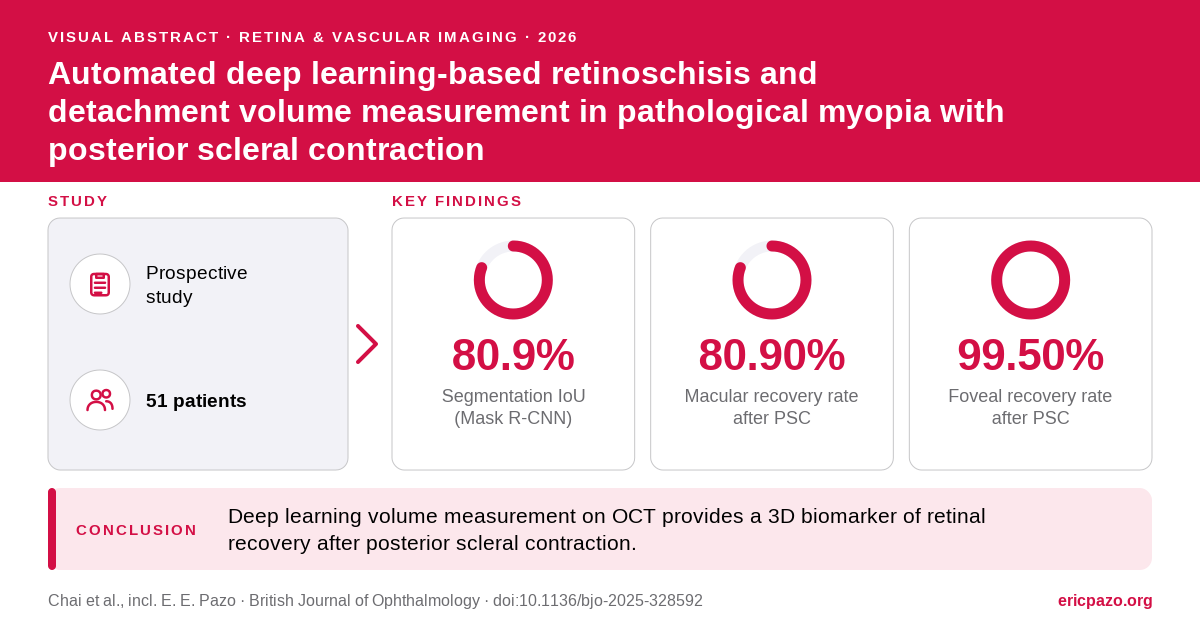
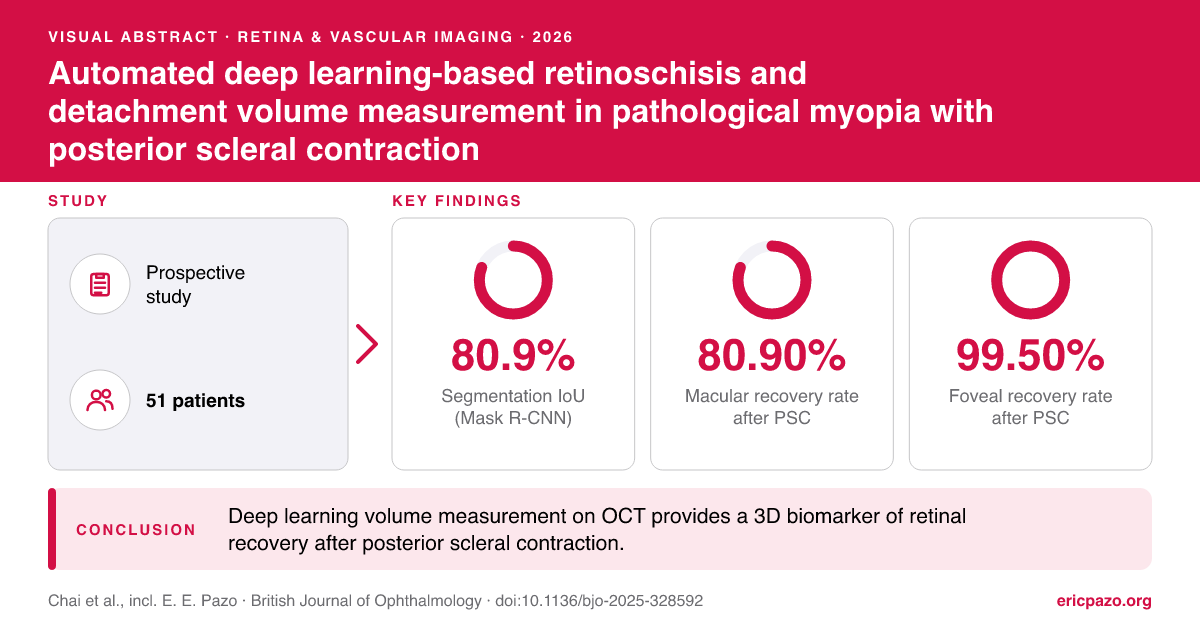
En bref
La mesure volumétrique par apprentissage profond sur l'OCT fournit un biomarqueur 3D de la récupération rétinienne après contraction sclérale postérieure.
- Type d'étude
- Étude prospective
- Échantillon
- 51 patients
- IoU de segmentation (Mask R-CNN)
- 80.9%
- Taux de récupération maculaire après PSC
- 80.90%
- Taux de récupération fovéolaire après PSC
- 99.50%
Résumé
Ce résumé est affiché dans sa langue d'origine, l'anglais, car l'article n'est pas publié sous une licence ouverte autorisant les traductions.
Purpose This study developed an automated deep learning-based system to quantify retinoschisis and detachment volume (RDV) in pathological myopia (PM) patients undergoing posterior scleral contraction (PSC). Methods A prospective study included 51 PM patients (36 PSC-treated and 15 controls). Based on the myopic traction maculopathy staging system classification, PSC-treated patients were divided into retinoschisis (RS, Stage 2, n=21) and retinal detachment (RD, Stages 3–4, n=15), while controls were classified as Stage 1 (n=15). Swept-source optical coherence tomography (OCT) and angiography imaging was used to acquire retinal data, and a Mask R-CNN model was trained to segment and calculate RDV. The primary outcome measures were regional macular recovery rate, defined as the percentage reduction in RDV at 12 months postoperatively. Clinical parameters such as axial length (AL) and best-corrected visual acuity (BCVA) were analysed. Result The model achieved an Intersection over Union of 80.9%. RDV increased with more advanced stages of myopic traction maculopathy (MTM). As MTM stage advanced, RDV distribution shifted from predominantly parafoveal/perifoveal involvement to foveal involvement. Macular RDV increased progressively with MTM stage (control: 0.94 mm 3 , RS: 5.24 mm 3 , RD: 9.50 mm 3 ; p<0.001). Postoperative AL decreased significantly and BCVA improved significantly (all p<0.001). Postoperative RDV decreased significantly, achieving macular and foveal recovery rates as 80.90% and 99.50%, respectively. AL reduction demonstrated the strongest correlation with foveal RDV changes (r=0.479, p=0.003). Conclusion The Mask R-CNN-based RDV measurement provides a sensitive 3D biomarker for assessing PSC efficacy and monitoring MTM progression. The system offers objective, high-precision quantification of retinal structural changes, addressing limitations of manual OCT analysis. Trial registration number ChiCTR2200065561.
Mots-clés : retinoschisis; pathologic myopia; myopic traction maculopathy; Mask R-CNN; retinal segmentation; automated volume measurement; axial length; foveal involvement
Accès
Comment citer
Afficher le BibTeX
@article{chai2026automated,
  title = {{Automated deep learning-based retinoschisis and detachment volume measurement in pathological myopia with posterior scleral contraction}},
  author = {Chai, Mengdi and Rong, Hua and Yu, Danyang and Wang, Xiu and Wu, Di and Pazo, Emmanuel Eric and Zhang, Jiachen and Liu, Ying and Zhou, Yifan and Chen, Yanhui and Xue, Anquan and Wei, Ruihua},
  journal = {British Journal of Ophthalmology},
  year = {2026},
  doi = {10.1136/bjo-2025-328592},
  url = {https://doi.org/10.1136/bjo-2025-328592},
}
Travaux liés
- Association des connaissances et des attitudes vis-à-vis du traitement anti-VEGF avec l'interruption autodéclarée du traitement : une étude de classification à séparation temporelle (2026)
- Développement et validation interne d'un modèle transformer sensible au temps pour prédire la progression de la myopie de l'enfant à partir de données longitudinales irrégulières de dépistage scolaire (2026)
- Développement d'un modèle prédictif fondé sur les cytokines de l'humeur aqueuse pour la réponse au traitement anti-VEGF dans l'œdème maculaire diabétique (2026)
- Prédiction de la réfraction sous cycloplégie par apprentissage automatique avec l'Eyerobo Vision Screener : plan, une étude transversale comparative d'appareils (2026)
- Prédire la progression de la myopie pédiatrique à partir d'une seule visite de dépistage : une étude de développement et de validation multi-critères (2026)