
Évaluer les effets des larmes artificielles sur les paramètres biologiques oculaires chez des patients avec et sans sécheresse oculaire
Titre original : To evaluate the effects of artificial tears on ocular biological parameters in dry eye and non-dry eye patients
Yimeng Chen, Mingze Li, Jiayan Chen, Jiahui Zhao, Emmanuel Eric Pazo, Guanghao Qin, Xingru He
 Scientific Reports, 2025 · article · doi:10.1038/s41598-025-95801-5 · cité 8 fois · Accès libre (CC BY-NC-ND)
Surface oculaire et sécheresse oculaire
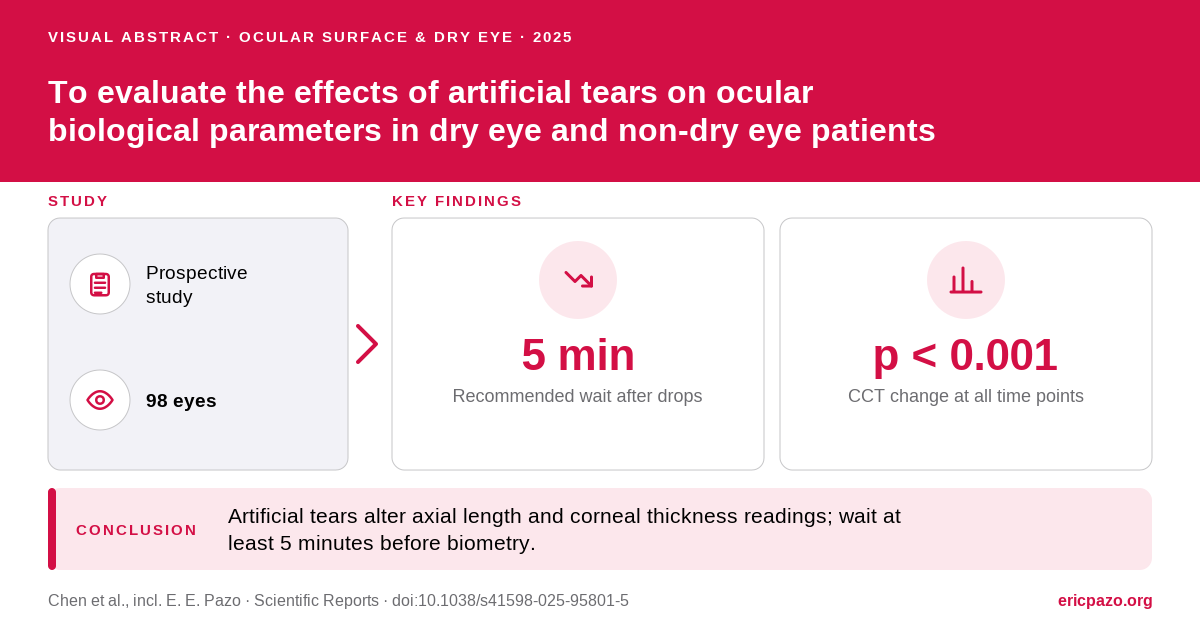
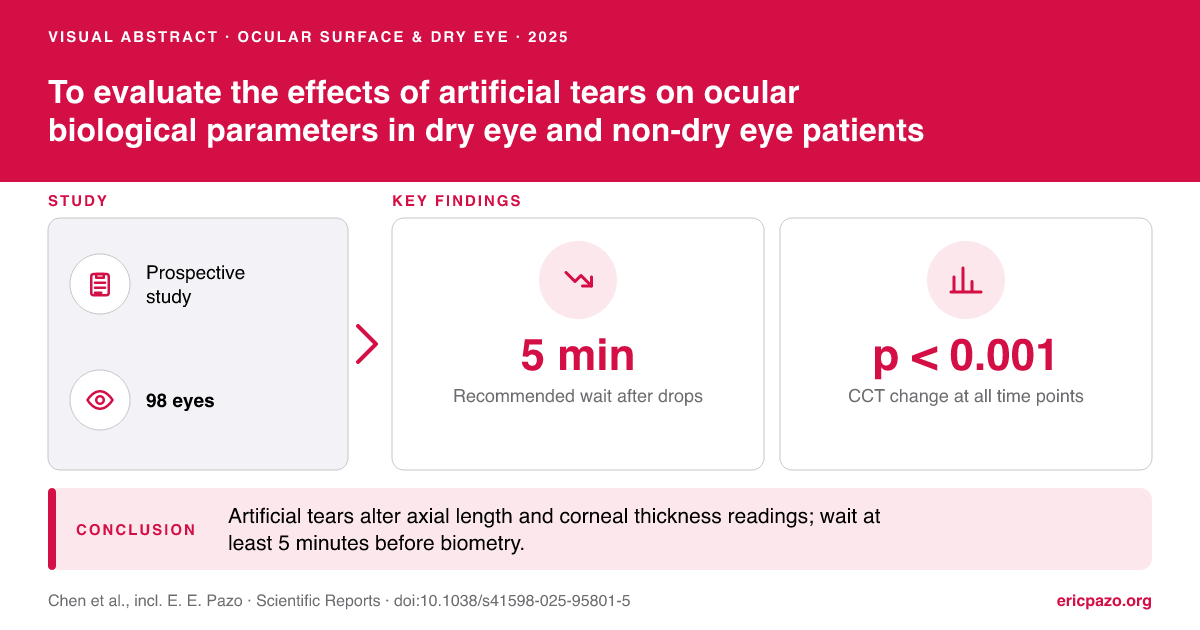
En bref
Les larmes artificielles modifient les mesures de longueur axiale et d'épaisseur cornéenne ; attendez au moins 5 minutes avant la biométrie.
- Type d'étude
- Étude prospective
- Échantillon
- 98 yeux
- Délai recommandé après les gouttes
- 5 min
- Variation de l'ECC à tous les temps
- p < 0.001
Résumé
Ce résumé est affiché dans sa langue d'origine, l'anglais, car la licence de l'article (CC BY-NC-ND) ne permet pas de publier des traductions.
To analyze the changes in ocular biometry readings in patients with dry eye (DE) and non-dry eye (NDE) after instilling artificial tear drop (ATD). A prospective study was conducted on 98 eyes of 98 patients (DE group, n = 54 eyes; NDE group, n = 44 eyes) who underwent ocular biometry with four consecutive measurements using the IOL Master 700. The baseline flat meridian of the anterior corneal surface (K1), steep meridian of the anterior corneal surface (K2), corneal curvature radius(R1, R2), axial length (AL), anterior chamber depth (ACD), central corneal thickness (CCT), white-to-white corneal diameter (WTW), pupil diameter, non-invasive tear break-up time (NITBUT) and tear meniscus height, (TMH) was measured at baseline, 30-s, 2-min, and 5-min intervals after instilling one drop of ATD. Variability in biometry measurements was assessed and compared. The mean age of the NDE group and DE group was 27.09 ± 10.21 years (30 females, 68.18%) and 29.96 ± 12.08 years (38 females, 70.37%), respectively. Following the application of ATD, intergroup comparisons revealed significant changes in K1 at 2 min and 5 min (p = 0.043, p = 0.043, and p = 0.038, respectively), and significant changes in R1 and R2 at 2 min. Intragroup comparisons showed that AL exhibited significant changes at 30 s (p < 0.001), while CCT demonstrated significant alterations across all time points (p < 0.001). Changes in ACD were observed at 30 s and 2 min in the dry eye group, and pupil diameter showed significant changes at 2 min in both the DE and NDE groups. No significant changes were detected in WTW at any point (all p > 0.05). Artificial tears significantly affect the readings of AL and CCT during ocular biometry. It is recommended to wait for at least 5 min after the installation of eye drops before performing ocular biometry measurements.
Mots-clés : artificial tears; dry eye; ocular biometry; axial length; central corneal thickness; anterior chamber depth; corneal curvature; pupil size
Accès
Comment citer
Afficher le BibTeX
@article{chen2025to,
  title = {{To evaluate the effects of artificial tears on ocular biological parameters in dry eye and non-dry eye patients}},
  author = {Chen, Yimeng and Li, Mingze and Chen, Jiayan and Zhao, Jiahui and Pazo, Emmanuel Eric and Qin, Guanghao and He, Xingru},
  journal = {Scientific Reports},
  year = {2025},
  doi = {10.1038/s41598-025-95801-5},
  url = {https://doi.org/10.1038/s41598-025-95801-5},
}
Travaux liés
- Analyse de l'influence de l'espace au bord du volet sur la régénération des nerfs cornéens après LASIK assisté par laser femtoseconde (2026)
- Comparaison des effets de la lumière pulsée intense et de l'hygiène palpébrale sur le film lacrymal et la surface oculaire : une étude contrôlée randomisée (2026)
- Effects of 3% diquafosol sodium on tear film stability, corneal aberration parameters, and vision-related quality of life in pediatric orthokeratology-associated dry eye disease (2026)
- Association entre l'indice de masse corporelle maternel avant la grossesse et l'astigmatisme et la courbure cornéenne de l'enfant : une étude transversale (2025)
- Expression différentielle de la lymphotoxine α, de l'immunoglobuline E et de la métalloprotéinase matricielle 9 lacrymales dans la sécheresse oculaire associée à la conjonctivite allergique (2025)