
Comparaison des effets de la lumière pulsée intense et de l'hygiène palpébrale sur le film lacrymal et la surface oculaire : une étude contrôlée randomisée
Titre original : Comparison between the Effect of Intense Pulsed Light and Lid Hygiene on the Tear Film and Ocular Surface: A Randomized Controlled Study
Shekhar Jha, Qiwei Li, Yan Jin, Zheng Yang, Hui Liu, Emmanuel Eric Pazo, Shaozhen Zhao, Charles Louis Dupin
 Photobiomodulation Photomedicine and Laser Surgery, 2026 · article · doi:10.1177/25785478261428958 · cité 1 fois
Surface oculaire et sécheresse oculaire
En bref
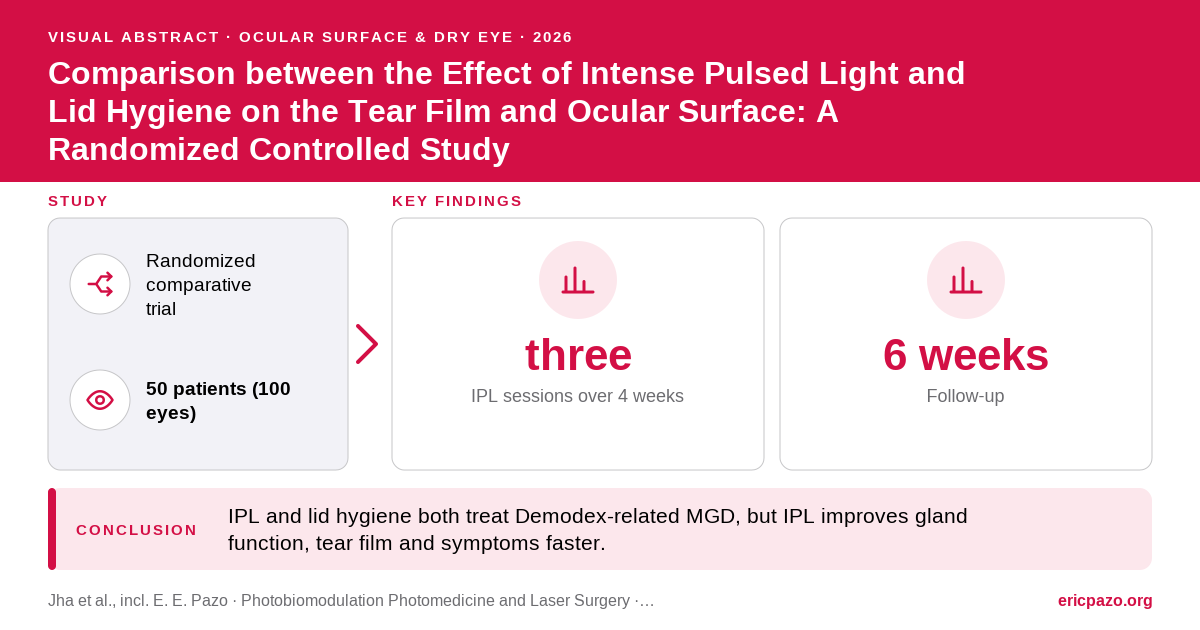
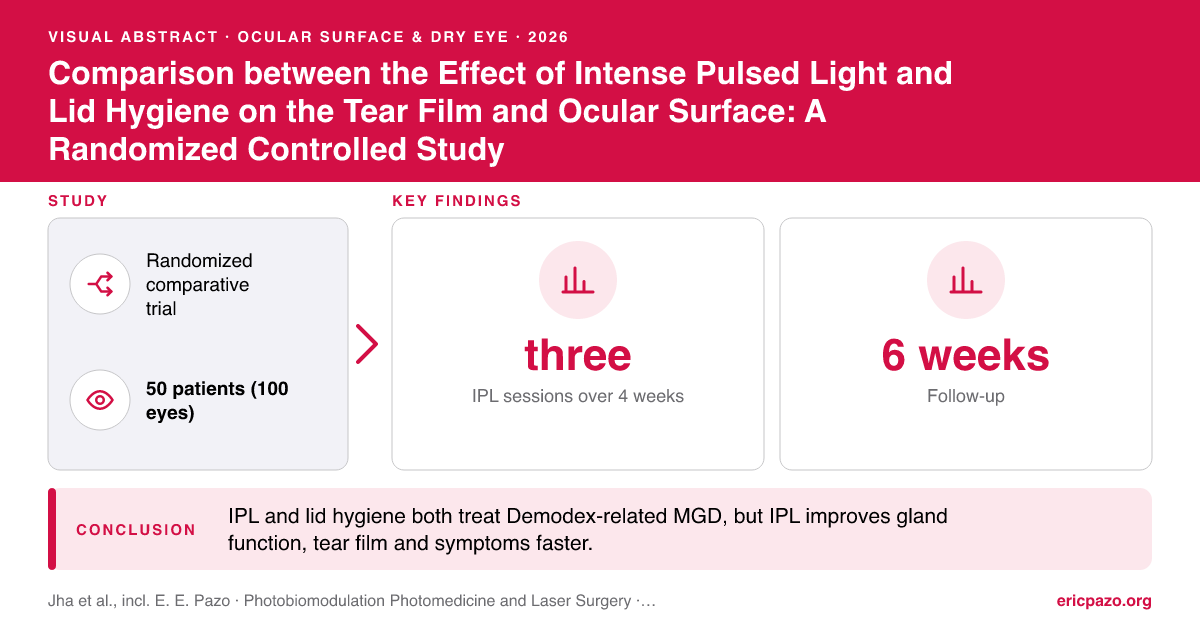
La LPI et l'hygiène palpébrale traitent toutes deux le DGM lié à Demodex, mais la LPI améliore plus vite la fonction glandulaire, le film lacrymal et les symptômes.
- Type d'étude
- Essai comparatif randomisé
- Échantillon
- 50 patients (100 yeux)
- Séances de LPI sur 4 semaines
- three
- Suivi
- 6 weeks
Résumé
Ce résumé est affiché dans sa langue d'origine, l'anglais, car l'article n'est pas publié sous une licence ouverte autorisant les traductions.
Purpose: Demodex folliculorum infestation is an important contributor to meibomian gland dysfunction (MGD) and chronic ocular surface disease. This study evaluated and compared the therapeutic efficacy of intense pulsed light (IPL) and eyelid hygiene (ELH) for Demodex-associated MGD. Methods: In this prospective, randomized comparative trial, 50 patients (100 eyes) with Demodex-associated MGD were allocated to two arms. Group A ( n = 25) received three Eyesis IPL sessions at baseline, week 2, and week 4. Group B ( n = 25) performed daily eyelid hygiene with OCuSOFT Lid Scrub for 6 weeks. Ocular surface parameters, including ocular surface disease index (OSDI), tear film lipid layer thickness (TFLL), noninvasive tear film break-up time (NITBUT), meibomian gland dropout, meibum quality and expressibility, corneal fluorescein staining (CFS), Schirmer’s I, and Demodex count, were assessed from baseline to week 6. Best-corrected visual acuity (BCVA) and intraocular pressure (IOP) were recorded at each visit. Results: Both treatments significantly improved OSDI, NITBUT, TFLL, Schirmer’s I, and CFS over 6 weeks (all p < 0.001). Compared with ELH, IPL achieved larger and earlier reductions in symptoms, greater increases in TFLL, and superior improvements in meibum quality and expressibility from week 4 onward (between-group p ≤ 0.021). Demodex counts decreased significantly in both groups with no between-group difference at week 6. BCVA, IOP, and adverse events remained stable, indicating a favorable short-term safety profile. Conclusion: IPL and ELH are effective for Demodex-related MGD, but IPL provides faster and more pronounced improvements in meibomian gland function, tear film stability, and patient-reported symptoms over 6 weeks.
Mots-clés : intense pulsed light; eyelid hygiene; Demodex folliculorum; meibomian gland dysfunction; ocular surface disease; tear film lipid layer thickness; meibum quality; meibomian gland dropout
Accès
Comment citer
Afficher le BibTeX
@article{jha2026comparison,
  title = {{Comparison between the Effect of Intense Pulsed Light and Lid Hygiene on the Tear Film and Ocular Surface: A Randomized Controlled Study}},
  author = {Jha, Shekhar and Li, Qiwei and Jin, Yan and Yang, Zheng and Liu, Hui and Pazo, Emmanuel Eric and Zhao, Shaozhen and Dupin, Charles Louis},
  journal = {Photobiomodulation Photomedicine and Laser Surgery},
  year = {2026},
  doi = {10.1177/25785478261428958},
  url = {https://doi.org/10.1177/25785478261428958},
}
Travaux liés
- Analyse de l'influence de l'espace au bord du volet sur la régénération des nerfs cornéens après LASIK assisté par laser femtoseconde (2026)
- Effects of 3% diquafosol sodium on tear film stability, corneal aberration parameters, and vision-related quality of life in pediatric orthokeratology-associated dry eye disease (2026)
- Association entre l'indice de masse corporelle maternel avant la grossesse et l'astigmatisme et la courbure cornéenne de l'enfant : une étude transversale (2025)
- Expression différentielle de la lymphotoxine α, de l'immunoglobuline E et de la métalloprotéinase matricielle 9 lacrymales dans la sécheresse oculaire associée à la conjonctivite allergique (2025)
- Influence du diamètre cornéen sur la biomécanique et la biométrie cornéennes chez des patients chinois : une étude transversale (2025)