
Nouvelle approche pour l'évaluation quantitative du staphylome scléral : analyse de mesures de courbure discrète de la sclère
Titre original : New Approach for the Quantitative Assessment of Scleral Staphyloma: Discrete Curvature Measure Analysis of the Sclera
Di Wu, Xu Chu, Qing He, Mengdi Chai, Haoru Li, Xu He, Danyang Yu, Hua Rong, Emmanuel Eric Pazo, Xuejun Zhang, Yue Huang, Ruihua Wei
 Translational Vision Science & Technology, 2026 · article · doi:10.1167/tvst.15.1.8 · cité 1 fois · Accès libre (CC BY-NC-ND)
En bref
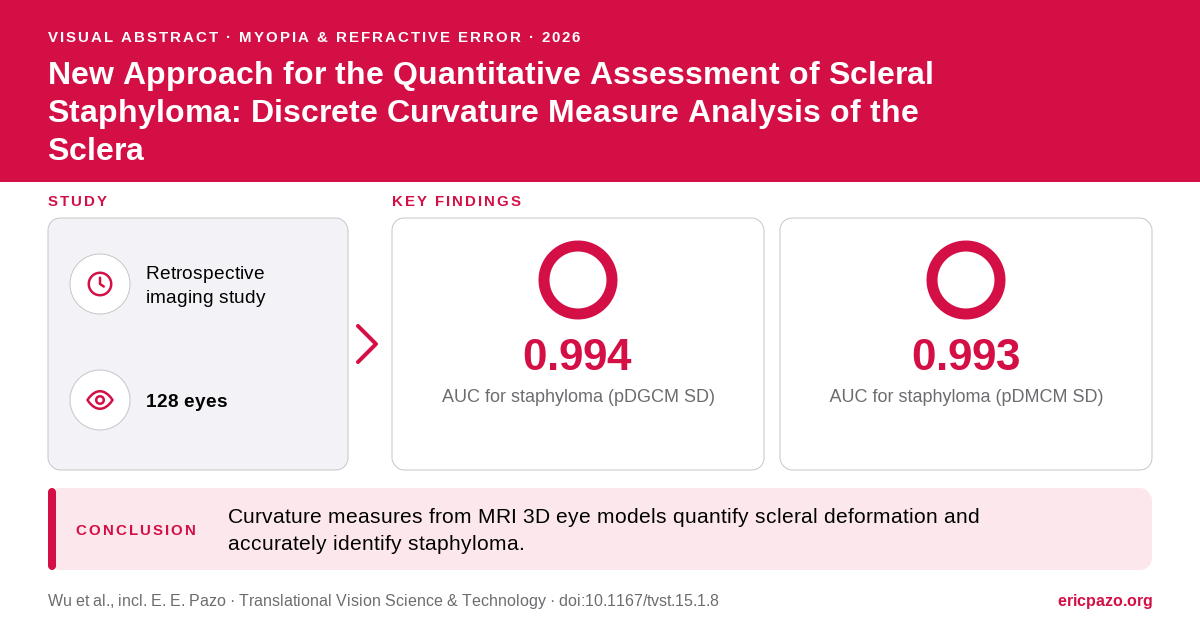
Des mesures de courbure sur des modèles oculaires 3D issus de l'IRM quantifient la déformation sclérale et identifient précisément le staphylome.
- Type d'étude
- Étude d'imagerie rétrospective
- Échantillon
- 128 yeux
- AUC pour le staphylome (ET de pDGCM)
- 0.994
- AUC pour le staphylome (ET de pDMCM)
- 0.993
Résumé
Ce résumé est affiché dans sa langue d'origine, l'anglais, car la licence de l'article (CC BY-NC-ND) ne permet pas de publier des traductions.
Purpose: Current methods for evaluating scleral staphyloma morphology fail to provide curvature data of global scleral deformation. This study aimed to develop a quantitative method based on discrete differential geometry for analyzing scleral deformation caused by staphyloma. Methods: This study retrospectively analyzed 128 eyes of 73 patients with pathological myopia. All patients underwent orbital magnetic resonance imaging and three-dimensional (3D) reconstruction. The discrete Gaussian curvature measures (DGCMs) and discrete mean curvature measures (DMCMs) of all vertices on the ocular 3D model were calculated. We further established a computational method for the degree of scleral staphyloma expansion (E/U ratio). Results: The posterior scleral DGCM (pDGCM) and DMCM (pDMCM) standard deviations (SDs) were significantly greater in the staphyloma group than in the non-staphyloma group (0.069 ± 0.026 vs. 0.025 ± 0.005 and 0.335 ± 0.096 vs. 0.154 ± 0.027, respectively; both P < 0.0001). The E/U ratio was strongly linearly correlated with both the pDGCM and pDMCM SDs (both P < 0.01). For staphyloma diagnosis, the areas under the receiver operating characteristic (ROC) curves for pDGCM and pDMCM SDs were 0.994 (95% confidence interval [CI], 0.984-1.000) and 0.993 (95% CI, 0.982-1.000), respectively (both P < 0.001). Conclusions: The variation in the curvature of the posterior sclera is significantly greater in eyes with staphyloma than in those without. This variation is highly specific and sensitive for staphyloma diagnosis. Translational Relevance: This method, based on discrete differential geometry, enables the direct quantification of scleral deformation, potentially providing a quantitative basis for the diagnosis and evaluation of staphyloma.
Mots-clés : scleral staphyloma; discrete differential geometry; pathologic myopia; posterior sclera; orbital MRI
Accès
Comment citer
Afficher le BibTeX
@article{wu2026new,
  title = {{New Approach for the Quantitative Assessment of Scleral Staphyloma: Discrete Curvature Measure Analysis of the Sclera}},
  author = {Wu, Di and Chu, Xu and He, Qing and Chai, Mengdi and Li, Haoru and He, Xu and Yu, Danyang and Rong, Hua and Pazo, Emmanuel Eric and Zhang, Xuejun and Huang, Yue and Wei, Ruihua},
  journal = {Translational Vision Science & Technology},
  year = {2026},
  doi = {10.1167/tvst.15.1.8},
  url = {https://doi.org/10.1167/tvst.15.1.8},
}
Travaux liés
- Mesure automatisée par apprentissage profond du volume de rétinoschisis et de décollement dans la myopie pathologique avec contraction sclérale postérieure (2026)
- Développement et validation interne d'un modèle transformer sensible au temps pour prédire la progression de la myopie de l'enfant à partir de données longitudinales irrégulières de dépistage scolaire (2026)
- Observance du suivi à long terme après implantation d'une lentille en collamer implantable chez des patients fortement myopes : une étude monocentrique de cohorte rétrospective et d'enquête CAP (2026)
- Prédiction de la réfraction sous cycloplégie par apprentissage automatique avec l'Eyerobo Vision Screener : plan, une étude transversale comparative d'appareils (2026)
- Prédire la progression de la myopie pédiatrique à partir d'une seule visite de dépistage : une étude de développement et de validation multi-critères (2026)