
Bénéfices des lentilles de contact sclérales chez les patients myopes à cornée régulière : une étude prospective randomisée
Titre original : Scleral Contact Lens Benefits for Myopic Patients With Regular Corneas: A Prospective Randomized Study
Ruixue Liang, Na Li, Lin Liu, Bei Du, Emmanuel Eric Pazo, Ruihua Wei
 Eye & Contact Lens Science & Clinical Practice, 2024 · article · doi:10.1097/icl.0000000000001151
Myopie et erreurs réfractivesSurface oculaire et sécheresse oculaire
En bref
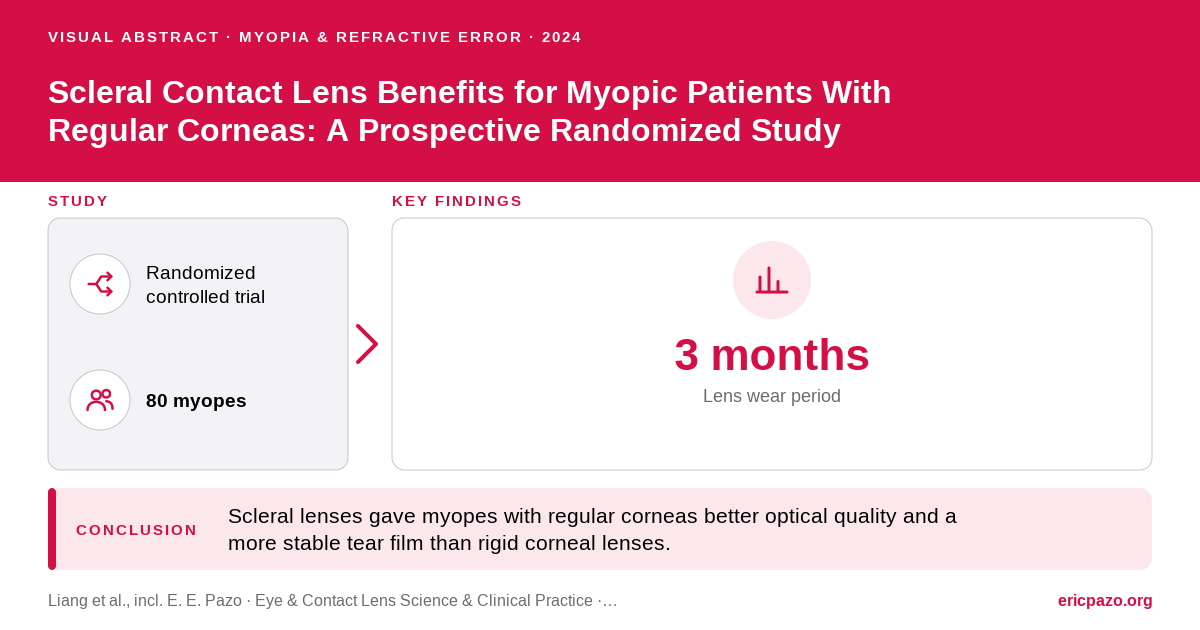
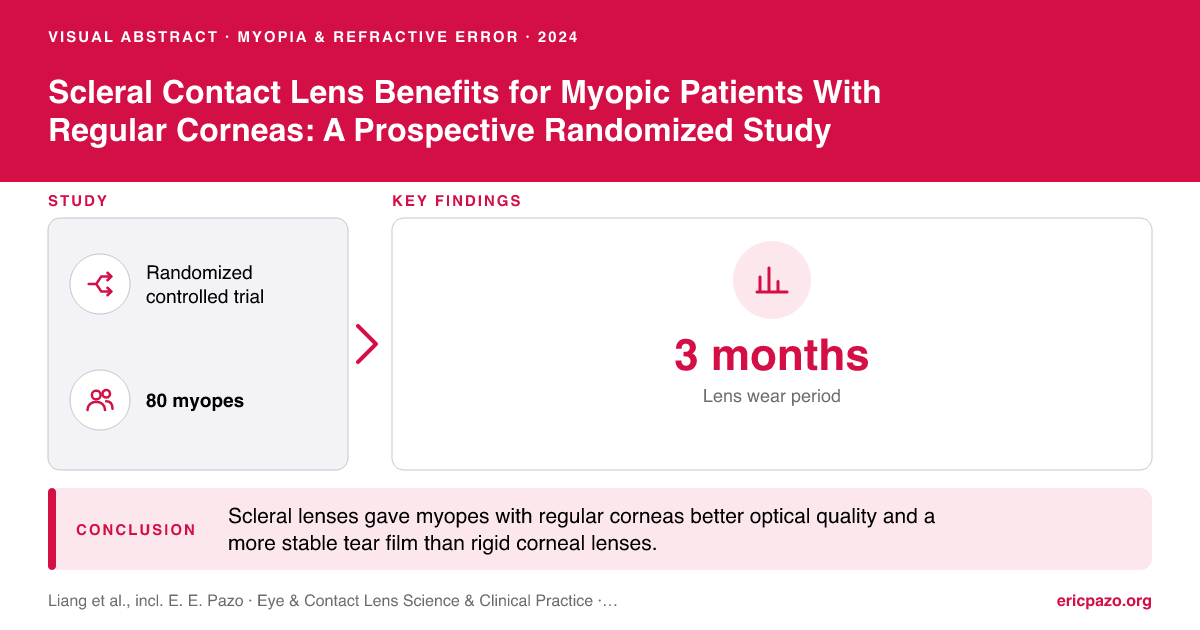
Les lentilles sclérales ont apporté aux myopes à cornée régulière une meilleure qualité optique et un film lacrymal plus stable que les lentilles cornéennes rigides.
- Type d'étude
- Essai contrôlé randomisé
- Échantillon
- 80 myopes
- Période de port des lentilles
- 3 months
Résumé
Ce résumé est affiché dans sa langue d'origine, l'anglais, car l'article n'est pas publié sous une licence ouverte autorisant les traductions.
OBJECTIVES: To evaluate the impact of scleral contact lens (SL) wear on the visual quality and the ocular surface wettability in myopic patients with regular corneas. METHODS: This prospective, randomized, controlled study enrolled a total of 80 myopes with regular corneas. Subjects were randomly allocated to wear SL or rigid corneal lens (RCL) for 3 months. The objective optical quality parameters were detected using the Optical Quality Analysis System-II, and the ocular surface wettability was assessed using the Keratograph 5M noninvasive ocular surface analyzer. The National Eye Institute 25-Item Visual Function Questionnaire and Ocular Surface Disease Index questionnaire were performed. RESULTS: Both SL and RCL wear could obtain good best-corrected visual acuity. Strehl ratio, modulation transfer function cutoff frequency, objective scattering index, and Optical Quality Analysis System values (Optical Quality Analysis System values at 100%, 20%, and 9% contrasts) in the SL group significantly improved from baseline to the third month (both P <0.05), but not in the RCL group. At the third month, tear meniscus height and noninvasive tear break-up time showed a significant increase in the SL wearers from baseline (both P <0.05), but exhibited no significant changes in the RCL group. At the third month, SL wearers had significantly higher noninvasive tear break-up time compared with RCL wearers ( P <0.05). Besides, after 3-month SL wear, the National Eye Institute 25-Item Visual Function Questionnaire score and the Ocular Surface Disease Index score both remarkably improved from baseline (both P <0.05). CONCLUSION: Short-term SL wear could provide satisfactory visual quality, ocular comfort, and stable tear film for myopic patients.
Mots-clés : scleral lenses; myopia; visual quality; optical quality; tear film stability; tear film break-up time; tear meniscus height; ocular comfort
Accès
Comment citer
Afficher le BibTeX
@article{liang2024scleral,
  title = {{Scleral Contact Lens Benefits for Myopic Patients With Regular Corneas: A Prospective Randomized Study}},
  author = {Liang, Ruixue and Li, Na and Liu, Lin and Du, Bei and Pazo, Emmanuel Eric and Wei, Ruihua},
  journal = {Eye & Contact Lens Science & Clinical Practice},
  year = {2024},
  doi = {10.1097/icl.0000000000001151},
  url = {https://doi.org/10.1097/icl.0000000000001151},
}
Travaux liés
- Protocole d'un essai monocentrique, randomisé et contrôlé évaluant les effets des lunettes ou de l'orthokératologie sur les paramètres de sécheresse oculaire chez l'enfant et l'adolescent (2024)
- Effets à court terme de l'atropine topique ophtalmique à 0.01 % sur la surface oculaire, la taille pupillaire et la qualité de vision subjective chez de jeunes adultes chinois myopes (2024)
- Analyse de l'influence de l'espace au bord du volet sur la régénération des nerfs cornéens après LASIK assisté par laser femtoseconde (2026)
- Mesure automatisée par apprentissage profond du volume de rétinoschisis et de décollement dans la myopie pathologique avec contraction sclérale postérieure (2026)
- Comparaison des effets de la lumière pulsée intense et de l'hygiène palpébrale sur le film lacrymal et la surface oculaire : une étude contrôlée randomisée (2026)