
Beneficios de las lentes de contacto esclerales en pacientes miopes con córneas regulares: un estudio prospectivo aleatorizado
Título original: Scleral Contact Lens Benefits for Myopic Patients With Regular Corneas: A Prospective Randomized Study
Ruixue Liang, Na Li, Lin Liu, Bei Du, Emmanuel Eric Pazo, Ruihua Wei
 Eye & Contact Lens Science & Clinical Practice, 2024 · artículo · doi:10.1097/icl.0000000000001151
Miopía y errores refractivosSuperficie ocular y ojo seco
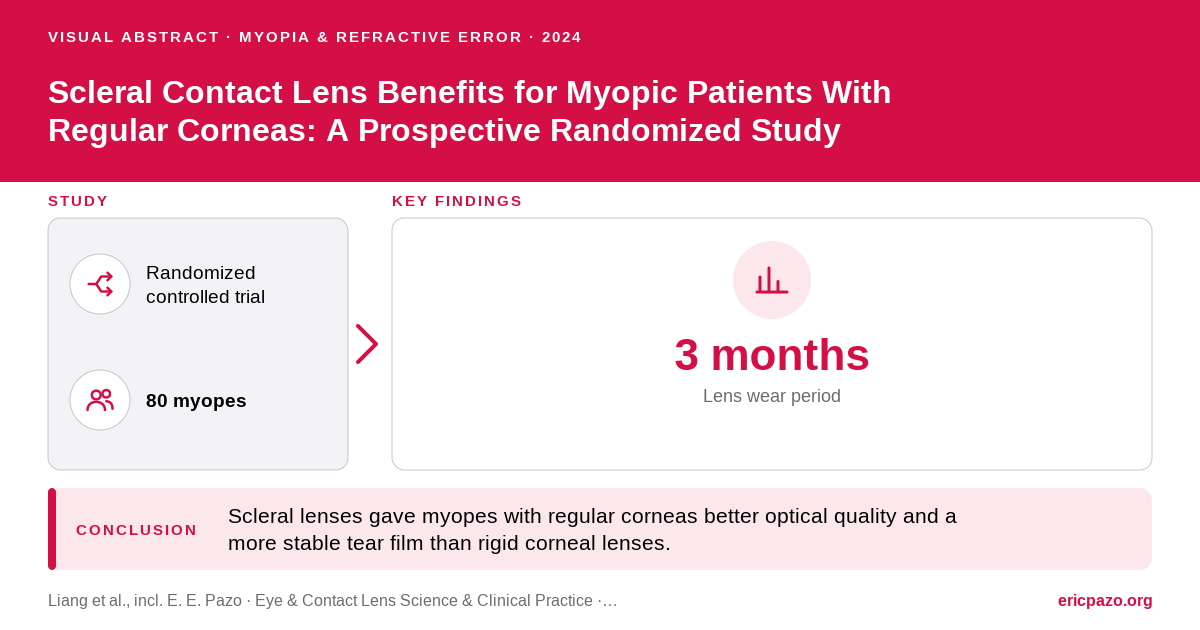
De un vistazo
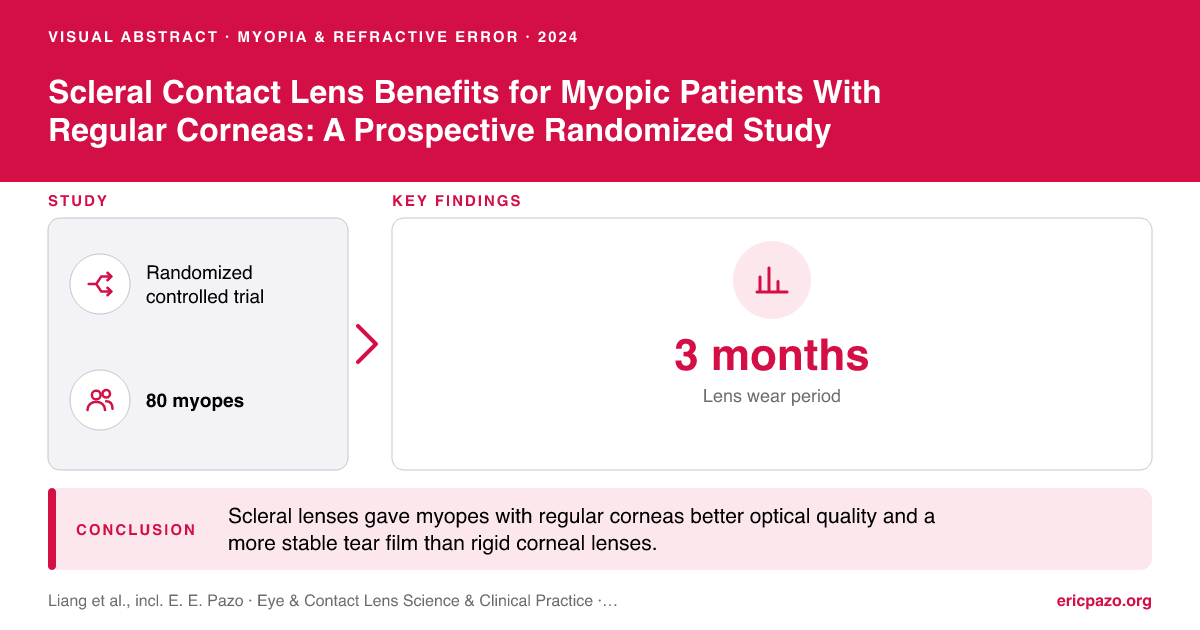
Las lentes esclerales dieron a los miopes con córneas regulares mejor calidad óptica y una película lagrimal más estable que las lentes corneales rígidas.
- Diseño
- Ensayo controlado aleatorizado
- Muestra
- 80 miopes
- Periodo de uso de la lente
- 3 months
Resumen
Este resumen se muestra en su idioma original, el inglés, porque el artículo no tiene una licencia abierta que permita traducciones.
OBJECTIVES: To evaluate the impact of scleral contact lens (SL) wear on the visual quality and the ocular surface wettability in myopic patients with regular corneas. METHODS: This prospective, randomized, controlled study enrolled a total of 80 myopes with regular corneas. Subjects were randomly allocated to wear SL or rigid corneal lens (RCL) for 3 months. The objective optical quality parameters were detected using the Optical Quality Analysis System-II, and the ocular surface wettability was assessed using the Keratograph 5M noninvasive ocular surface analyzer. The National Eye Institute 25-Item Visual Function Questionnaire and Ocular Surface Disease Index questionnaire were performed. RESULTS: Both SL and RCL wear could obtain good best-corrected visual acuity. Strehl ratio, modulation transfer function cutoff frequency, objective scattering index, and Optical Quality Analysis System values (Optical Quality Analysis System values at 100%, 20%, and 9% contrasts) in the SL group significantly improved from baseline to the third month (both P <0.05), but not in the RCL group. At the third month, tear meniscus height and noninvasive tear break-up time showed a significant increase in the SL wearers from baseline (both P <0.05), but exhibited no significant changes in the RCL group. At the third month, SL wearers had significantly higher noninvasive tear break-up time compared with RCL wearers ( P <0.05). Besides, after 3-month SL wear, the National Eye Institute 25-Item Visual Function Questionnaire score and the Ocular Surface Disease Index score both remarkably improved from baseline (both P <0.05). CONCLUSION: Short-term SL wear could provide satisfactory visual quality, ocular comfort, and stable tear film for myopic patients.
Palabras clave: scleral lenses; myopia; visual quality; optical quality; tear film stability; tear film break-up time; tear meniscus height; ocular comfort
Acceso
Cómo citar
Mostrar BibTeX
@article{liang2024scleral,
  title = {{Scleral Contact Lens Benefits for Myopic Patients With Regular Corneas: A Prospective Randomized Study}},
  author = {Liang, Ruixue and Li, Na and Liu, Lin and Du, Bei and Pazo, Emmanuel Eric and Wei, Ruihua},
  journal = {Eye & Contact Lens Science & Clinical Practice},
  year = {2024},
  doi = {10.1097/icl.0000000000001151},
  url = {https://doi.org/10.1097/icl.0000000000001151},
}
Trabajos relacionados
- Protocolo de un ensayo unicéntrico, aleatorizado y controlado que evalúa los efectos de las gafas o la ortoqueratología sobre los parámetros de ojo seco en niños y adolescentes (2024)
- Efectos a corto plazo de la atropina tópica oftálmica al 0.01% sobre la superficie ocular, el tamaño pupilar y la calidad visual subjetiva en adultos jóvenes chinos miopes (2024)
- Análisis de la influencia del espacio del margen del colgajo en la regeneración de los nervios corneales tras LASIK asistido por láser de femtosegundo (2026)
- Medición automatizada basada en aprendizaje profundo del volumen de retinosquisis y desprendimiento en la miopía patológica con contracción escleral posterior (2026)
- Comparación entre el efecto de la luz pulsada intensa y la higiene palpebral sobre la película lagrimal y la superficie ocular: un estudio controlado aleatorizado (2026)