
Metaloproteinasa de matriz 9 lagrimal y parámetros de la superficie ocular en diabéticos: un estudio transversal en Shenyang, China
Título original: Tear matrix metalloproteinases-9 and ocular surface parameters in diabetics: a cross-sectional study in Shenyang, China
Zhe Qu, Emmanuel Eric Pazo, Ling Yang, Jiayan Chen, Guanghao Qin, Wei He
 BMJ Open, 2025 · artículo · doi:10.1136/bmjopen-2024-087530 · citado 8 veces · Acceso abierto (CC BY-NC)
De un vistazo
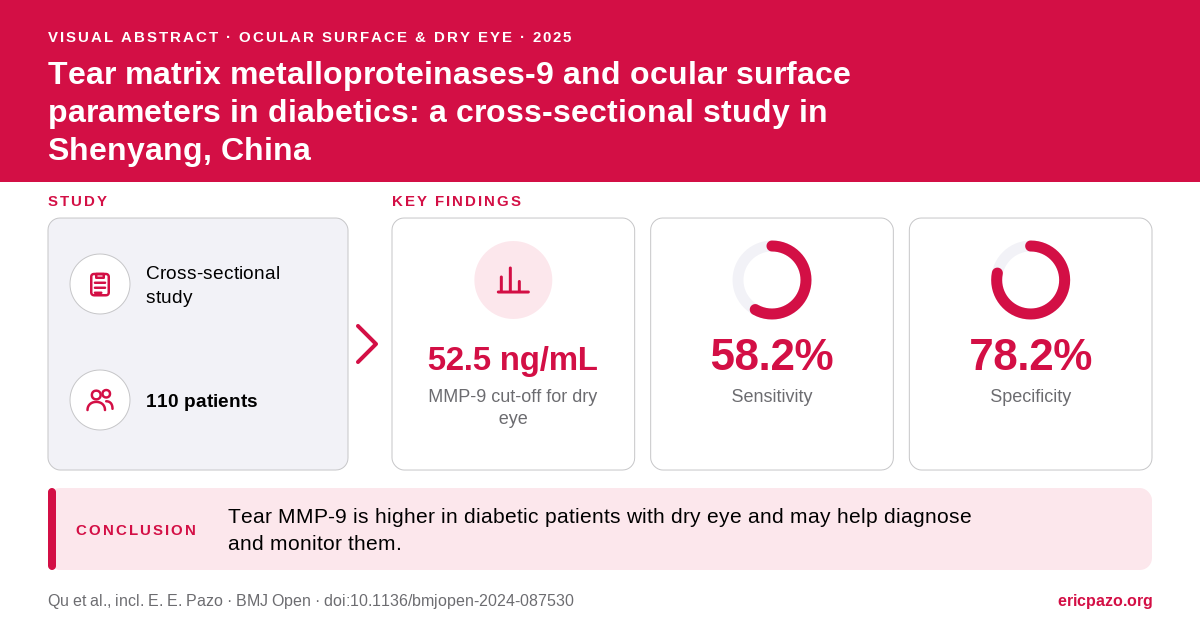
La MMP-9 lagrimal es más alta en los pacientes diabéticos con ojo seco y puede ayudar a diagnosticarlos y controlarlos.
- Diseño
- Estudio transversal
- Muestra
- 110 pacientes
- Punto de corte de MMP-9 para ojo seco
- 52.5 ng/mL
- Sensibilidad
- 58.2%
- Especificidad
- 78.2%
Resumen
ANTECEDENTES: Se ha descrito que la sobreexpresión de la metaloproteinasa de matriz 9 (MMP-9) lagrimal en los tejidos de la superficie ocular provoca daño en dicha superficie. Los niveles lagrimales de MMP-9 figuran entre las numerosas herramientas para confirmar la enfermedad de ojo seco (EOS). OBJETIVO: Esta investigación tuvo como objetivo comparar los niveles de MMP-9 y los parámetros de la superficie ocular en pacientes diabéticos con y sin EOS. DISEÑO: Estudio transversal. ÁMBITO: He Eye Specialist Hospital, Shenyang, China. PARTICIPANTES: Este estudio reclutó 144 ojos derechos de 144 pacientes diabéticos entre noviembre y diciembre de 2023, y se incluyeron en los análisis 110 pacientes con puntuaciones de propensión similares. MEDIDAS DE RESULTADO PRINCIPALES: Se evaluaron el tiempo de ruptura lagrimal no invasivo (NITBUT), la capa lipídica de la película lagrimal (TFLL), la hiperemia conjuntival (puntuación de enrojecimiento [RS]), la tinción corneoconjuntival (CS), la sensibilidad corneal y el cuestionario Ocular Surface Disease Index (OSDI). La MMP-9 se midió mediante un ensayo de inmunocromatografía. RESULTADOS: En total, 55 pacientes (55 ojos) se agruparon como ojo seco diabético (DDE) y 55 pacientes (55 ojos) como diabéticos sin ojo seco (DNDE). Las concentraciones medias de MMP-9 fueron más altas en los pacientes con DDE que en los DNDE (70.63±52.06 ng/mL frente a 33.98±33.93 ng/mL; p<0.001). El punto de corte óptimo de MMP-9 para predecir la EOS en pacientes diabéticos fue >52.5 ng/mL, con una sensibilidad del 58.2% y una especificidad del 78.2%. CONCLUSIONES: La concentración de MMP-9 fue mayor en los pacientes con DDE que en los DNDE. La prueba de MMP-9 es una posible herramienta diagnóstica para el DDE. Puede ayudar en el seguimiento de los pacientes diabéticos con EOS y orientar a los clínicos al decidir tratamientos antiinflamatorios para estos pacientes.
Traducido del resumen original en inglés (licencia: CC BY-NC).
Mostrar el resumen original
BACKGROUND: Overexpression of tear matrix metalloproteinases-9 (MMP-9) on the ocular surface tissues has been reported to result in ocular surface damage. MMP-9 levels in tears have been listed as one of many tools for confirming dry eye disease (DED). OBJECTIVE: This investigation aimed to compare MMP-9 levels and ocular surface parameters in diabetic patients with and without DED. DESIGN: A cross-sectional study. SETTING: He Eye Specialist Hospital, Shenyang, China. PARTICIPANTS: This study recruited 144 right eyes of 144 diabetic patients between November and December of 2023, and 110 patients with similar propensity scores were included in the analyses. MAIN OUTCOME MEASURES: Non-invasive breakup time (NITBUT), tear film lipid layer (TFLL), conjunctival hyperaemia (redness score (RS)), corneoconjunctival staining (CS), corneal sensitivity and Ocular Surface Disease Index (OSDI) questionnaire were evaluated. MMP-9 was measured using an immunochromatography assay. RESULTS: In total, 55 patients (55 eyes) were grouped as diabetic dry eye (DDE) and 55 patients (55 eyes) as diabetic non-dry eye (DNDE). The mean MMP-9 concentrations were higher in patients with DDE than DNDE (70.63±52.06 ng/mL vs 33.98±33.93 ng/mL; p<0.001). The optimal cut-off value of MMP-9 to predict DED in diabetic patients was>52.5 ng/mL, with 58.2% sensitivity and 78.2% specificity. CONCLUSIONS: MMP-9 concentration was higher in patients with DDE than DNDE. The MMP-9 test is a potential diagnostic tool for DDE. It may help follow-up diabetic patients with DED and guide clinicians in deciding on anti-inflammatory treatments for these patients.
Palabras clave: MMP-9; ocular surface disease; dry eye diagnosis; tear film lipid layer; conjunctival hyperemia; corneal sensitivity; Ocular Surface Disease Index; diabetic patients
Acceso
Cómo citar
Mostrar BibTeX
@article{qu2025tear,
  title = {{Tear matrix metalloproteinases-9 and ocular surface parameters in diabetics: a cross-sectional study in Shenyang, China}},
  author = {Qu, Zhe and Pazo, Emmanuel Eric and Yang, Ling and Chen, Jiayan and Qin, Guanghao and He, Wei},
  journal = {BMJ Open},
  year = {2025},
  doi = {10.1136/bmjopen-2024-087530},
  url = {https://doi.org/10.1136/bmjopen-2024-087530},
}
Trabajos relacionados
- Análisis de la influencia del espacio del margen del colgajo en la regeneración de los nervios corneales tras LASIK asistido por láser de femtosegundo (2026)
- Comparación entre el efecto de la luz pulsada intensa y la higiene palpebral sobre la película lagrimal y la superficie ocular: un estudio controlado aleatorizado (2026)
- Effects of 3% diquafosol sodium on tear film stability, corneal aberration parameters, and vision-related quality of life in pediatric orthokeratology-associated dry eye disease (2026)
- Asociación entre el índice de masa corporal materno previo al embarazo y el astigmatismo y la curvatura corneal de la descendencia: un estudio transversal (2025)
- Expresión diferencial de linfotoxina α, inmunoglobulina E y metaloproteinasa de matriz 9 en lágrimas en el ojo seco asociado a conjuntivitis alérgica (2025)