
Tear matrix metalloproteinases-9 and ocular surface parameters in diabetics: a cross-sectional study in Shenyang, China
Zhe Qu, Emmanuel Eric Pazo, Ling Yang, Jiayan Chen, Guanghao Qin, Wei He
 BMJ Open, 2025 · article · doi:10.1136/bmjopen-2024-087530 · cited by 8 · Open access (CC BY-NC)
At a glance
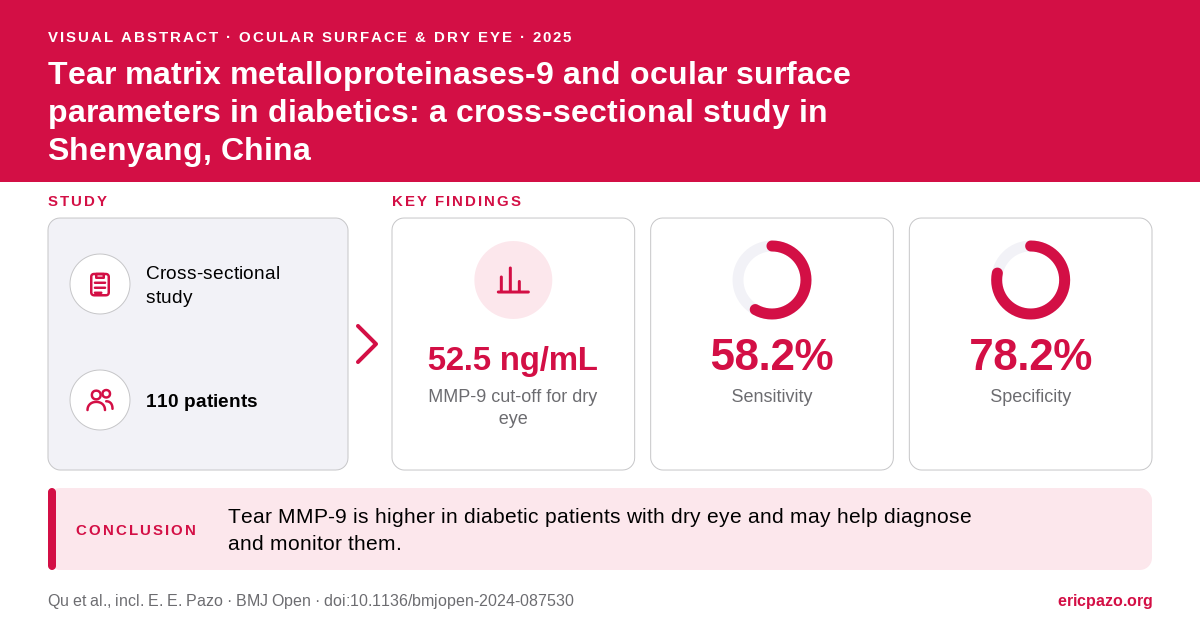
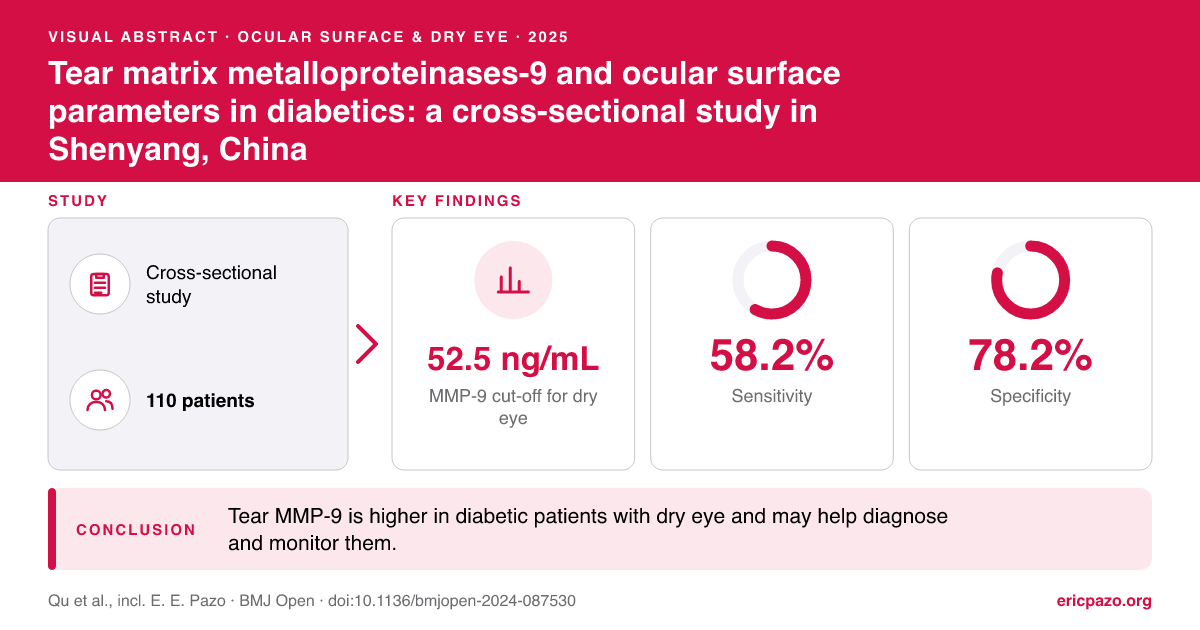
Tear MMP-9 is higher in diabetic patients with dry eye and may help diagnose and monitor them.
- Design
- Cross-sectional study
- Sample
- 110 patients
- MMP-9 cut-off for dry eye
- 52.5 ng/mL
- Sensitivity
- 58.2%
- Specificity
- 78.2%
Abstract
BACKGROUND: Overexpression of tear matrix metalloproteinases-9 (MMP-9) on the ocular surface tissues has been reported to result in ocular surface damage. MMP-9 levels in tears have been listed as one of many tools for confirming dry eye disease (DED). OBJECTIVE: This investigation aimed to compare MMP-9 levels and ocular surface parameters in diabetic patients with and without DED. DESIGN: A cross-sectional study. SETTING: He Eye Specialist Hospital, Shenyang, China. PARTICIPANTS: This study recruited 144 right eyes of 144 diabetic patients between November and December of 2023, and 110 patients with similar propensity scores were included in the analyses. MAIN OUTCOME MEASURES: Non-invasive breakup time (NITBUT), tear film lipid layer (TFLL), conjunctival hyperaemia (redness score (RS)), corneoconjunctival staining (CS), corneal sensitivity and Ocular Surface Disease Index (OSDI) questionnaire were evaluated. MMP-9 was measured using an immunochromatography assay. RESULTS: In total, 55 patients (55 eyes) were grouped as diabetic dry eye (DDE) and 55 patients (55 eyes) as diabetic non-dry eye (DNDE). The mean MMP-9 concentrations were higher in patients with DDE than DNDE (70.63±52.06 ng/mL vs 33.98±33.93 ng/mL; p<0.001). The optimal cut-off value of MMP-9 to predict DED in diabetic patients was>52.5 ng/mL, with 58.2% sensitivity and 78.2% specificity. CONCLUSIONS: MMP-9 concentration was higher in patients with DDE than DNDE. The MMP-9 test is a potential diagnostic tool for DDE. It may help follow-up diabetic patients with DED and guide clinicians in deciding on anti-inflammatory treatments for these patients.
Keywords: MMP-9; ocular surface disease; dry eye diagnosis; tear film lipid layer; conjunctival hyperemia; corneal sensitivity; Ocular Surface Disease Index; diabetic patients
Access
How to cite
Show BibTeX
@article{qu2025tear,
  title = {{Tear matrix metalloproteinases-9 and ocular surface parameters in diabetics: a cross-sectional study in Shenyang, China}},
  author = {Qu, Zhe and Pazo, Emmanuel Eric and Yang, Ling and Chen, Jiayan and Qin, Guanghao and He, Wei},
  journal = {BMJ Open},
  year = {2025},
  doi = {10.1136/bmjopen-2024-087530},
  url = {https://doi.org/10.1136/bmjopen-2024-087530},
}
Related work
- An Analysis of the Influence of Flap Margin Space on Corneal Nerve Regeneration After Femtosecond Laser–Assisted LASIK (2026)
- Comparison between the Effect of Intense Pulsed Light and Lid Hygiene on the Tear Film and Ocular Surface: A Randomized Controlled Study (2026)
- Effects of 3% diquafosol sodium on tear film stability, corneal aberration parameters, and vision-related quality of life in pediatric orthokeratology-associated dry eye disease (2026)
- Association Between Maternal Pre-Pregnancy Body Mass Index and Astigmatism and Corneal Curvature in Offspring: A Cross-Sectional Study (2025)
- Differential Expression of Tear Lymphotoxin-Α, Immunoglobulin E, and Matrix Metalloproteinase-9 in Allergic Conjunctivitis-Associated Dry Eye (2025)