
糖尿病患者泪液基质金属蛋白酶-9 与眼表参数:一项在中国沈阳开展的横断面研究
原文标题: Tear matrix metalloproteinases-9 and ocular surface parameters in diabetics: a cross-sectional study in Shenyang, China
Zhe Qu, Emmanuel Eric Pazo, Ling Yang, Jiayan Chen, Guanghao Qin, Wei He
 BMJ Open, 2025 · 期刊论文 · doi:10.1136/bmjopen-2024-087530 · 被引 8 次 · 开放获取(CC BY-NC)
要点速览
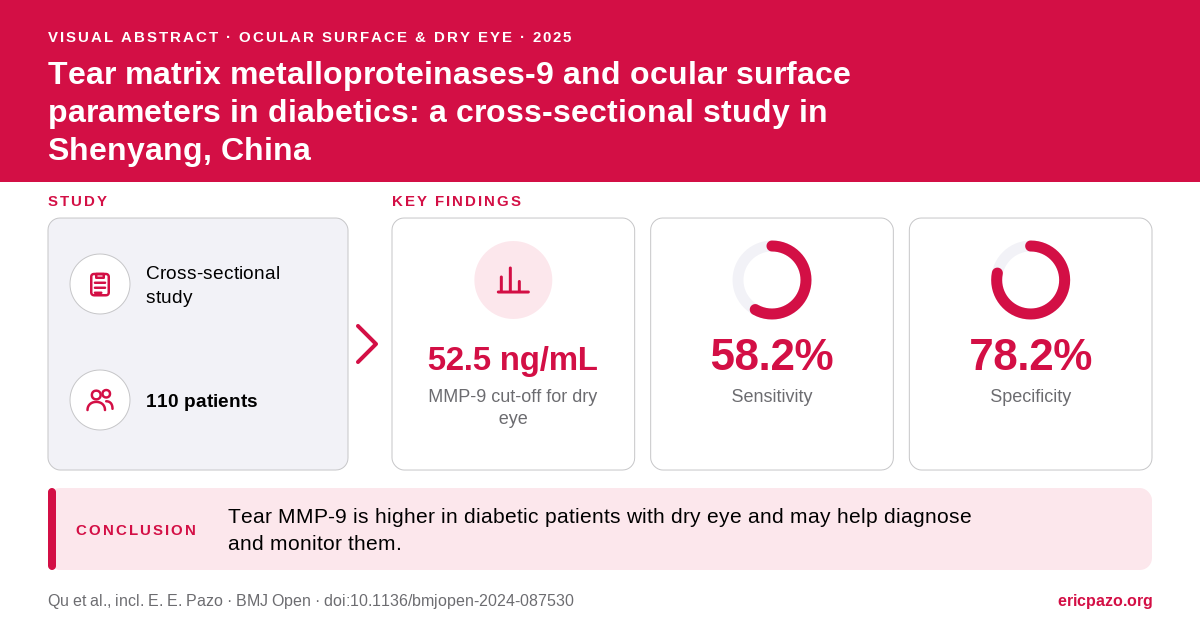
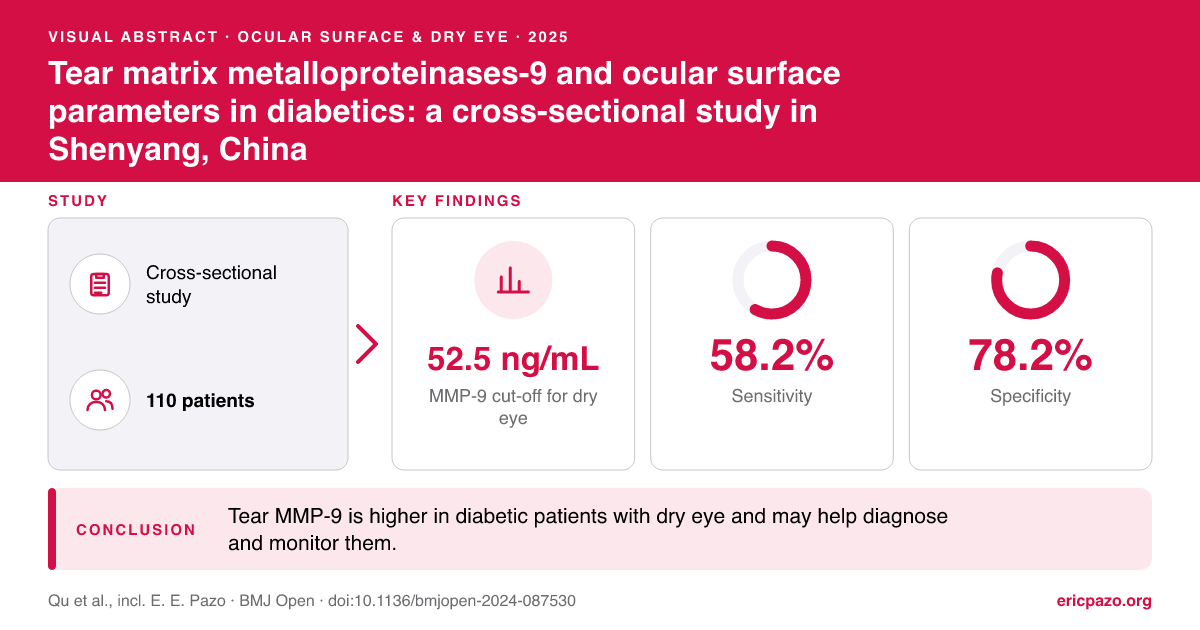
合并干眼的糖尿病患者泪液 MMP-9 水平更高,可能有助于其诊断和监测。
- 研究设计
- 横断面研究
- 样本
- 110 名患者
- 干眼的 MMP-9 临界值
- 52.5 ng/mL
- 灵敏度
- 58.2%
- 特异度
- 78.2%
摘要
背景:已有报道称,泪液基质金属蛋白酶-9(MMP-9)在眼表组织中过度表达会导致眼表损伤。泪液 MMP-9 水平已被列为确诊干眼(DED)的多种工具之一。目的:比较合并与不合并 DED 的糖尿病患者的 MMP-9 水平和眼表参数。设计:横断面研究。地点:中国沈阳何氏眼科医院。参与者:本研究于 2023 年 11 月至 12 月招募了 144 名糖尿病患者的 144 只右眼,其中 110 名倾向性评分相近的患者纳入分析。主要结局指标:评估非侵入性泪膜破裂时间(NITBUT)、泪膜脂质层(TFLL)、结膜充血(红度评分(RS))、角结膜染色(CS)、角膜知觉以及眼表疾病指数(OSDI)问卷。采用免疫层析法测定 MMP-9。结果:共有 55 名患者(55 只眼)归入糖尿病干眼组(DDE),55 名患者(55 只眼)归入糖尿病非干眼组(DNDE)。DDE 患者的平均 MMP-9 浓度高于 DNDE 患者(70.63±52.06 ng/mL 对 33.98±33.93 ng/mL;p<0.001)。预测糖尿病患者 DED 的 MMP-9 最佳临界值为 >52.5 ng/mL,灵敏度为 58.2%,特异度为 78.2%。结论:DDE 患者的 MMP-9 浓度高于 DNDE 患者。MMP-9 检测是 DDE 的一种潜在诊断工具,可能有助于对合并 DED 的糖尿病患者进行随访,并指导临床医生决定是否为这些患者进行抗炎治疗。
译自英文原文摘要(许可协议:CC BY-NC)。
显示英文原文摘要
BACKGROUND: Overexpression of tear matrix metalloproteinases-9 (MMP-9) on the ocular surface tissues has been reported to result in ocular surface damage. MMP-9 levels in tears have been listed as one of many tools for confirming dry eye disease (DED). OBJECTIVE: This investigation aimed to compare MMP-9 levels and ocular surface parameters in diabetic patients with and without DED. DESIGN: A cross-sectional study. SETTING: He Eye Specialist Hospital, Shenyang, China. PARTICIPANTS: This study recruited 144 right eyes of 144 diabetic patients between November and December of 2023, and 110 patients with similar propensity scores were included in the analyses. MAIN OUTCOME MEASURES: Non-invasive breakup time (NITBUT), tear film lipid layer (TFLL), conjunctival hyperaemia (redness score (RS)), corneoconjunctival staining (CS), corneal sensitivity and Ocular Surface Disease Index (OSDI) questionnaire were evaluated. MMP-9 was measured using an immunochromatography assay. RESULTS: In total, 55 patients (55 eyes) were grouped as diabetic dry eye (DDE) and 55 patients (55 eyes) as diabetic non-dry eye (DNDE). The mean MMP-9 concentrations were higher in patients with DDE than DNDE (70.63±52.06 ng/mL vs 33.98±33.93 ng/mL; p<0.001). The optimal cut-off value of MMP-9 to predict DED in diabetic patients was>52.5 ng/mL, with 58.2% sensitivity and 78.2% specificity. CONCLUSIONS: MMP-9 concentration was higher in patients with DDE than DNDE. The MMP-9 test is a potential diagnostic tool for DDE. It may help follow-up diabetic patients with DED and guide clinicians in deciding on anti-inflammatory treatments for these patients.
关键词: MMP-9; ocular surface disease; dry eye diagnosis; tear film lipid layer; conjunctival hyperemia; corneal sensitivity; Ocular Surface Disease Index; diabetic patients
获取全文
引用格式
显示 BibTeX
@article{qu2025tear,
  title = {{Tear matrix metalloproteinases-9 and ocular surface parameters in diabetics: a cross-sectional study in Shenyang, China}},
  author = {Qu, Zhe and Pazo, Emmanuel Eric and Yang, Ling and Chen, Jiayan and Qin, Guanghao and He, Wei},
  journal = {BMJ Open},
  year = {2025},
  doi = {10.1136/bmjopen-2024-087530},
  url = {https://doi.org/10.1136/bmjopen-2024-087530},
}
相关研究
- 飞秒激光辅助 LASIK 术后角膜瓣边缘间隙对角膜神经再生影响的分析 (2026)
- 强脉冲光与睑缘清洁对泪膜和眼表影响的比较:一项随机对照研究 (2026)
- Effects of 3% diquafosol sodium on tear film stability, corneal aberration parameters, and vision-related quality of life in pediatric orthokeratology-associated dry eye disease (2026)
- 母亲孕前体重指数与子代散光及角膜曲率的关联:一项横断面研究 (2025)
- 过敏性结膜炎相关干眼中泪液淋巴毒素-α、免疫球蛋白 E 及基质金属蛋白酶-9 的差异表达 (2025)