
Impacto combinado de la luz pulsada intensa y la solución oftálmica de diquafosol al 3% en el ojo seco evaporativo: un estudio controlado aleatorizado
Título original: The Combined Impact of Intense Pulsed Light Combined and 3% Diquafosol Ophthalmic Solution on Evaporative Dry Eye: A Randomized Control Study
Jiayan Chen, Guanghao Qin, Liangzhe Li, Yifan Qi, Xia Yang, Qing Zhang, Yi Wu, Yue You, Lanting Yang, Naici Guo, Salissou Moutari, Jonathan Edward Moore, Shaochong Bu, Ling Xu, Wei He, Sile Yu, Emmanuel Eric Pazo, Xingru He
 Ophthalmology and Therapy, 2023 · artículo · doi:10.1007/s40123-023-00784-z · citado 14 veces · Acceso abierto (CC BY-NC)
De un vistazo
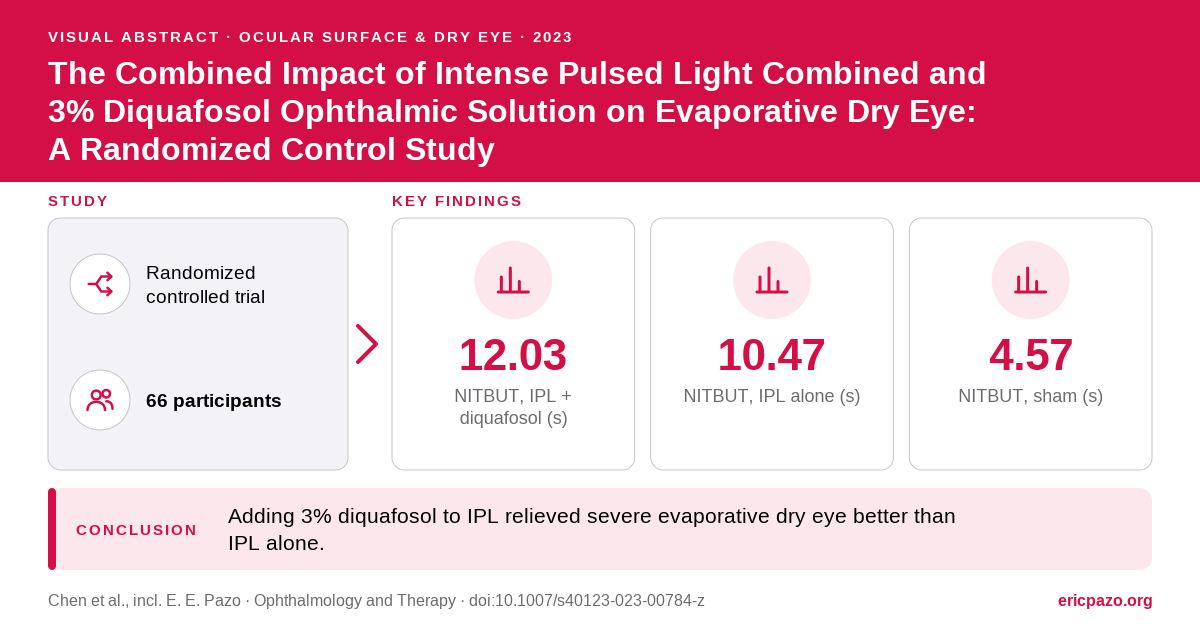
Añadir diquafosol al 3% a la IPL alivió el ojo seco evaporativo grave mejor que la IPL sola.
- Diseño
- Ensayo controlado aleatorizado
- Muestra
- 66 participantes
- NITBUT, IPL + diquafosol (s)
- 12.03
- NITBUT, IPL sola (s)
- 10.47
- NITBUT, simulación (s)
- 4.57
Resumen
INTRODUCCIÓN: El objetivo principal de este estudio es evaluar si la combinación de luz pulsada intensa (IPL) con solución oftálmica de diquafosol (DQS) al 3% es más eficaz que la luz pulsada intensa para aliviar los signos y síntomas de la enfermedad de ojo seco (EOS). MÉTODOS: Este estudio aleatorizado incluyó a 66 participantes con ojo seco evaporativo (OSE) que recibieron terapia IPL + DQS (n = 44 ojos), terapia IPL (n = 44 ojos) o terapia simulada (n = 44 ojos). Todos los participantes se examinaron al inicio (D0), el día 14 (D14) y el día 28 (D28) para valorar el tiempo de ruptura lagrimal no invasivo (NITBUT), la capa lipídica de la película lagrimal (TFLL), la tinción corneoconjuntival (CS), la calidad de las glándulas de Meibomio (MGQ), la expresión de las glándulas de Meibomio (MGEx) y el índice de enfermedad de la superficie ocular (OSDI). RESULTADOS: El día 28, la comparación entre la terapia IPL + DQS, la terapia IPL y la terapia simulada mostró diferencias significativas en el NITBUT medio (12.03 ± 1.27 frente a 10.47 ± 3.48 frente a 4.57 ± 0.46; p < 0.001), la TFLL (2.09 ± 0.29 frente a 2.27 ± 0.45 frente a 2.89 ± 0.65; p < 0.001), la CS (1.43 ± 0.82 frente a 1.93 ± 1.32 frente a 3.52 ± 1.00; p < 0.001), la MGQ (1.55 ± 0.66 frente a 1.91 ± 0.77 frente a 2.66 ± 0.53; p < 0.001), la MGEx (1.27 ± 0.45 frente a 1.75 ± 0.44 frente a 2.41 ± 0.50; p < 0.001) y la puntuación OSDI (19.36 ± 7.01 frente a 24.77 ± 4.68 frente a 42.61 ± 7.49; p < 0.001); se observaron mejoras significativas del NITBUT, la TFLL, la CS, la MGQ, la MGEx y el OSDI con la terapia IPL + DQS y con la terapia IPL, mientras que la terapia simulada no produjo mejoras significativas. CONCLUSIÓN: Combinar la solución oftálmica de diquafosol al 3% con la luz pulsada intensa fue superior a la terapia IPL sola para aliviar los signos y síntomas de los pacientes con EOS evaporativa grave. REGISTRO DEL ENSAYO: identificador de Clinical Trials: NCT05694026.
Traducido del resumen original en inglés (licencia: CC BY-NC).
Mostrar el resumen original
INTRODUCTION: The primary objective of this study is to assess whether the combination of intense pulsed light (IPL) with 3% diquafosol (DQS) ophthalmic solution is more effective than intense pulsed light in alleviating signs and symptoms of dry eye disease (DED). METHODS: This randomized study included 66 participants with evaporative dry eye (EDE) who received IPL + DQS therapy (n = 44 eyes), IPL therapy (n = 44 eyes), or sham therapy (n = 44 eyes). All participants were examined at baseline (D0), day 14 (D14), and day 28 (D28) for non-invasive break-up time (NITBUT), tear-film lipid layer (TFLL), corneal conjunctival staining (CS), meibomian gland quality (MGQ), meibomian gland expression (MGEx), and ocular surface disease index (OSDI). RESULTS: At day 28, comparison among the IPL + DQS therapy, IPL therapy, and sham therapy found significant differences in the mean NITBUT (12.03 ± 1.27 versus 10.47 ± 3.48 versus 4.57 ± 0.46; p < 0.001), TFLL (2.09 ± 0.29 versus 2.27 ± 0.45 versus 2.89 ± 0.65; p < 0.001), CS (1.43 ± 0.82 versus 1.93 ± 1.32 versus 3.52 ± 1.00; p < 0.001), MGQ (1.55 ± 0.66 versus 1.91 ± 0.77 versus 2.66 ± 0.53; p < 0.001), MGEx (1.27 ± 0.45 versus 1.75 ± 0.44 versus 2.41 ± 0.50; p < 0.001), and OSDI score (19.36 ± 7.01 versus 24.77 ± 4.68 versus 42.61 ± 7.49; p < 0.001); significant improvements in NITBUT, TFLL, CS, MGQ, MGEx, and OSDI were found in the IPL + DQS therapy and IPL therapy, while the sham therapy had no significant improvements. CONCLUSION: Combining 3% diquafosol ophthalmic solution with intense pulsed light was superior to IPL therapy alone in relieving the signs and symptoms of patients with severe evaporative DED. TRIAL REGISTRATION: Clinical Trials Identifier: NCT05694026.
Palabras clave: evaporative dry eye; intense pulsed light; meibography; meibomian gland dysfunction; tear film break-up time; tear film lipid layer; corneal and conjunctival staining; Ocular Surface Disease Index
Acceso
Cómo citar
Mostrar BibTeX
@article{chen2023the,
  title = {{The Combined Impact of Intense Pulsed Light Combined and 3% Diquafosol Ophthalmic Solution on Evaporative Dry Eye: A Randomized Control Study}},
  author = {Chen, Jiayan and Qin, Guanghao and Li, Liangzhe and Qi, Yifan and Yang, Xia and Zhang, Qing and Wu, Yi and You, Yue and Yang, Lanting and Guo, Naici and Moutari, Salissou and Moore, Jonathan Edward and Bu, Shaochong and Xu, Ling and He, Wei and Yu, Sile and Pazo, Emmanuel Eric and He, Xingru},
  journal = {Ophthalmology and Therapy},
  year = {2023},
  doi = {10.1007/s40123-023-00784-z},
  url = {https://doi.org/10.1007/s40123-023-00784-z},
}
Trabajos relacionados
- Análisis de la influencia del espacio del margen del colgajo en la regeneración de los nervios corneales tras LASIK asistido por láser de femtosegundo (2026)
- Comparación entre el efecto de la luz pulsada intensa y la higiene palpebral sobre la película lagrimal y la superficie ocular: un estudio controlado aleatorizado (2026)
- Effects of 3% diquafosol sodium on tear film stability, corneal aberration parameters, and vision-related quality of life in pediatric orthokeratology-associated dry eye disease (2026)
- Asociación entre el índice de masa corporal materno previo al embarazo y el astigmatismo y la curvatura corneal de la descendencia: un estudio transversal (2025)
- Expresión diferencial de linfotoxina α, inmunoglobulina E y metaloproteinasa de matriz 9 en lágrimas en el ojo seco asociado a conjuntivitis alérgica (2025)