
Impact combiné de la lumière pulsée intense et du collyre de diquafosol à 3 % sur la sécheresse oculaire évaporative : une étude contrôlée randomisée
Titre original : The Combined Impact of Intense Pulsed Light Combined and 3% Diquafosol Ophthalmic Solution on Evaporative Dry Eye: A Randomized Control Study
Jiayan Chen, Guanghao Qin, Liangzhe Li, Yifan Qi, Xia Yang, Qing Zhang, Yi Wu, Yue You, Lanting Yang, Naici Guo, Salissou Moutari, Jonathan Edward Moore, Shaochong Bu, Ling Xu, Wei He, Sile Yu, Emmanuel Eric Pazo, Xingru He
 Ophthalmology and Therapy, 2023 · article · doi:10.1007/s40123-023-00784-z · cité 14 fois · Accès libre (CC BY-NC)
Surface oculaire et sécheresse oculaire
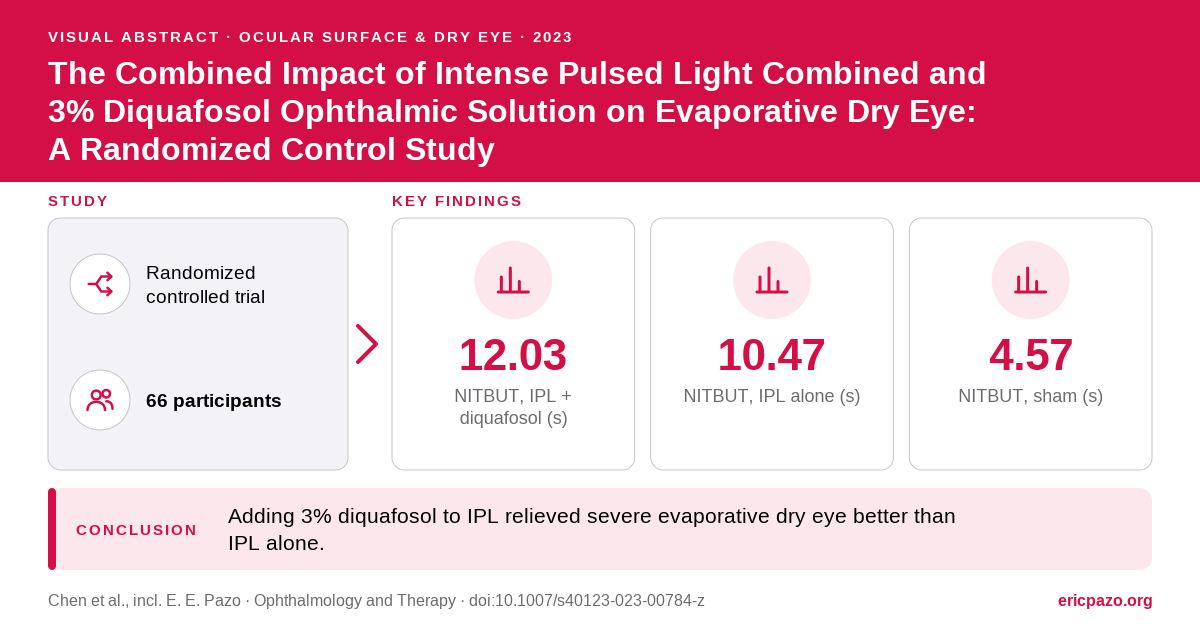
En bref
L'ajout de diquafosol à 3 % à la LPI a mieux soulagé la sécheresse oculaire évaporative sévère que la LPI seule.
- Type d'étude
- Essai contrôlé randomisé
- Échantillon
- 66 participants
- NITBUT, LPI + diquafosol (s)
- 12.03
- NITBUT, LPI seule (s)
- 10.47
- NITBUT, simulation (s)
- 4.57
Résumé
INTRODUCTION : L'objectif principal de cette étude est de déterminer si l'association de la lumière pulsée intense (LPI) au collyre de diquafosol (DQS) à 3 % est plus efficace que la lumière pulsée intense seule pour soulager les signes et symptômes de la sécheresse oculaire (SO). MÉTHODES : Cette étude randomisée a inclus 66 participants atteints de sécheresse oculaire évaporative (SOE) ayant reçu un traitement LPI + DQS (n = 44 yeux), un traitement LPI (n = 44 yeux) ou un traitement simulé (n = 44 yeux). Tous les participants ont été examinés à l'inclusion (J0), au jour 14 (J14) et au jour 28 (J28) pour le temps de rupture non invasif (NITBUT), la couche lipidique du film lacrymal (TFLL), la coloration cornéo-conjonctivale (CS), la qualité des glandes de Meibomius (MGQ), l'expression des glandes de Meibomius (MGEx) et l'indice de la maladie de la surface oculaire (OSDI). RÉSULTATS : Au jour 28, la comparaison entre les traitements LPI + DQS, LPI et simulé a montré des différences significatives du NITBUT moyen (12.03 ± 1.27 contre 10.47 ± 3.48 contre 4.57 ± 0.46 ; p < 0.001), de la TFLL (2.09 ± 0.29 contre 2.27 ± 0.45 contre 2.89 ± 0.65 ; p < 0.001), de la CS (1.43 ± 0.82 contre 1.93 ± 1.32 contre 3.52 ± 1.00 ; p < 0.001), de la MGQ (1.55 ± 0.66 contre 1.91 ± 0.77 contre 2.66 ± 0.53 ; p < 0.001), de la MGEx (1.27 ± 0.45 contre 1.75 ± 0.44 contre 2.41 ± 0.50 ; p < 0.001) et du score OSDI (19.36 ± 7.01 contre 24.77 ± 4.68 contre 42.61 ± 7.49 ; p < 0.001) ; des améliorations significatives du NITBUT, de la TFLL, de la CS, de la MGQ, de la MGEx et de l'OSDI ont été observées avec les traitements LPI + DQS et LPI, tandis que le traitement simulé n'a apporté aucune amélioration significative. CONCLUSION : L'association du collyre de diquafosol à 3 % à la lumière pulsée intense s'est révélée supérieure à la LPI seule pour soulager les signes et symptômes des patients atteints de SO évaporative sévère. ENREGISTREMENT DE L'ESSAI : identifiant Clinical Trials : NCT05694026.
Traduit du résumé original en anglais (licence : CC BY-NC).
Afficher le résumé original
INTRODUCTION: The primary objective of this study is to assess whether the combination of intense pulsed light (IPL) with 3% diquafosol (DQS) ophthalmic solution is more effective than intense pulsed light in alleviating signs and symptoms of dry eye disease (DED). METHODS: This randomized study included 66 participants with evaporative dry eye (EDE) who received IPL + DQS therapy (n = 44 eyes), IPL therapy (n = 44 eyes), or sham therapy (n = 44 eyes). All participants were examined at baseline (D0), day 14 (D14), and day 28 (D28) for non-invasive break-up time (NITBUT), tear-film lipid layer (TFLL), corneal conjunctival staining (CS), meibomian gland quality (MGQ), meibomian gland expression (MGEx), and ocular surface disease index (OSDI). RESULTS: At day 28, comparison among the IPL + DQS therapy, IPL therapy, and sham therapy found significant differences in the mean NITBUT (12.03 ± 1.27 versus 10.47 ± 3.48 versus 4.57 ± 0.46; p < 0.001), TFLL (2.09 ± 0.29 versus 2.27 ± 0.45 versus 2.89 ± 0.65; p < 0.001), CS (1.43 ± 0.82 versus 1.93 ± 1.32 versus 3.52 ± 1.00; p < 0.001), MGQ (1.55 ± 0.66 versus 1.91 ± 0.77 versus 2.66 ± 0.53; p < 0.001), MGEx (1.27 ± 0.45 versus 1.75 ± 0.44 versus 2.41 ± 0.50; p < 0.001), and OSDI score (19.36 ± 7.01 versus 24.77 ± 4.68 versus 42.61 ± 7.49; p < 0.001); significant improvements in NITBUT, TFLL, CS, MGQ, MGEx, and OSDI were found in the IPL + DQS therapy and IPL therapy, while the sham therapy had no significant improvements. CONCLUSION: Combining 3% diquafosol ophthalmic solution with intense pulsed light was superior to IPL therapy alone in relieving the signs and symptoms of patients with severe evaporative DED. TRIAL REGISTRATION: Clinical Trials Identifier: NCT05694026.
Mots-clés : evaporative dry eye; intense pulsed light; meibography; meibomian gland dysfunction; tear film break-up time; tear film lipid layer; corneal and conjunctival staining; Ocular Surface Disease Index
Accès
Comment citer
Afficher le BibTeX
@article{chen2023the,
  title = {{The Combined Impact of Intense Pulsed Light Combined and 3% Diquafosol Ophthalmic Solution on Evaporative Dry Eye: A Randomized Control Study}},
  author = {Chen, Jiayan and Qin, Guanghao and Li, Liangzhe and Qi, Yifan and Yang, Xia and Zhang, Qing and Wu, Yi and You, Yue and Yang, Lanting and Guo, Naici and Moutari, Salissou and Moore, Jonathan Edward and Bu, Shaochong and Xu, Ling and He, Wei and Yu, Sile and Pazo, Emmanuel Eric and He, Xingru},
  journal = {Ophthalmology and Therapy},
  year = {2023},
  doi = {10.1007/s40123-023-00784-z},
  url = {https://doi.org/10.1007/s40123-023-00784-z},
}
Travaux liés
- Analyse de l'influence de l'espace au bord du volet sur la régénération des nerfs cornéens après LASIK assisté par laser femtoseconde (2026)
- Comparaison des effets de la lumière pulsée intense et de l'hygiène palpébrale sur le film lacrymal et la surface oculaire : une étude contrôlée randomisée (2026)
- Effects of 3% diquafosol sodium on tear film stability, corneal aberration parameters, and vision-related quality of life in pediatric orthokeratology-associated dry eye disease (2026)
- Association entre l'indice de masse corporelle maternel avant la grossesse et l'astigmatisme et la courbure cornéenne de l'enfant : une étude transversale (2025)
- Expression différentielle de la lymphotoxine α, de l'immunoglobuline E et de la métalloprotéinase matricielle 9 lacrymales dans la sécheresse oculaire associée à la conjonctivite allergique (2025)